Facts
The State appealed under Section 2(1) of the Madhya Pradesh Uchcha Nyayalaya (Khand Nyaypeeth Ko Appeal) Adhiniyam, 2005 against an order dated 24 March 2026 allowing review and holding that the respondent was entitled to an increment with effect from 1 July 2017
Source reference: para. 1, 4The respondent’s qualification had previously been adjudicated in a writ petition by order dated 4 July 2023, which the State had not challenged
Source reference: para. 4–5The appeal was filed 72 days late. The State sought condonation on the basis of bona fide administrative, procedural and institutional reasons
Source reference: para. 2, 7–8Issues
Whether the appeal against the review order was maintainable where the review had modified the order in the writ petition
Source reference: para. 2–6Whether the State had shown sufficient cause to condone the 72-day delay in filing the appeal
Source reference: para. 7–14Law Applied
Section 2(1) of the Madhya Pradesh Uchcha Nyayalaya (Khand Nyaypeeth Ko Appeal) Adhiniyam, 2005 provides for writ appeals.
Source reference: para. 1Under the principles governing condonation of delay under Section 5 of the Limitation Act, 1963, the State is not entitled to preferential treatment and must satisfy the same standard as other litigants.
Source reference: para. 10, 13In State of M.P. v. Ramkumar Choudhary, the Supreme Court emphasised the need for States to streamline legal processes and fix responsibility for delay.
Source reference: para. 9In Shivamma (Dead) by LRs. v. Karnataka Housing Board, the Supreme Court reaffirmed that general assertions of bureaucratic delay do not justify condonation; the State must demonstrate sufficient cause, and negligence by officials cannot be used to dilute limitation requirements.
Source reference: para. 10Reasoning
The Court overruled the maintainability objection because the review order had modified the writ order, so an appeal against the review order could not, in the circumstances, be treated as inherently unmaintainable.
Source reference: para. 4, 6However, the State did not explain why it had failed to challenge the original writ order, which had adjudicated the respondent’s qualification.
Source reference: para. 4–5On limitation, the State relied on general administrative, procedural and institutional reasons, but did not clarify whether it intended to take action against those responsible for the delay.
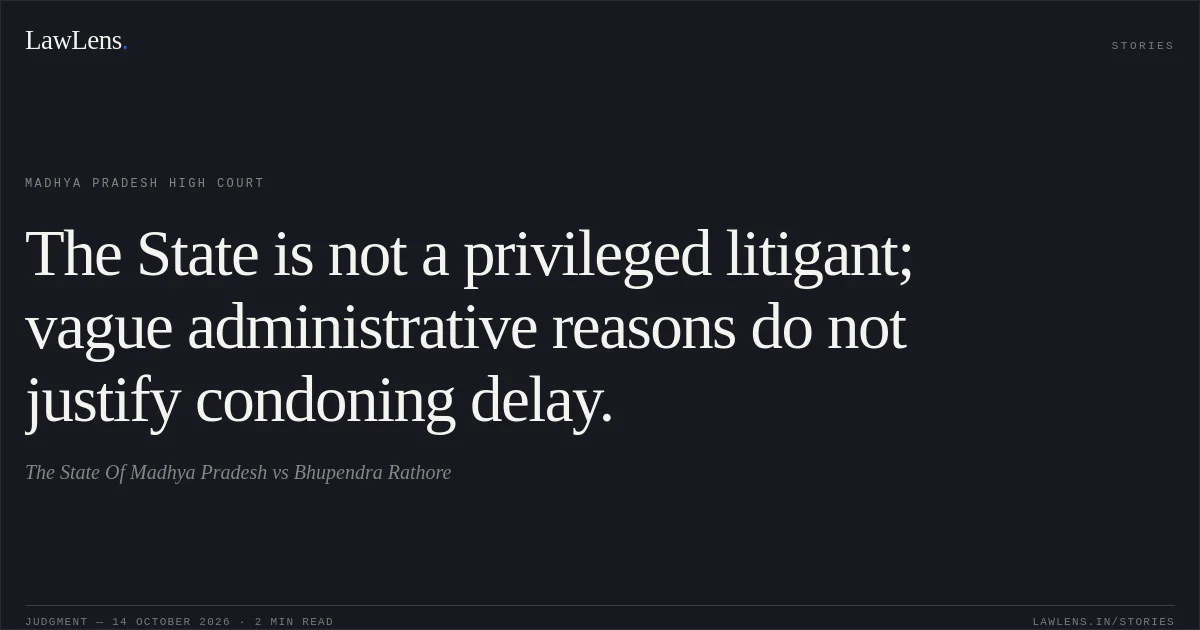
Source reference: para. 8, 11The Court held that the State could not disclaim responsibility for the delay or claim the status of a privileged litigant; it had failed to establish sufficient cause for the 72-day delay.
Source reference: para. 12–14Holding
The Court overruled the office objection as to maintainability but rejected I.A. No. 14295/2026 seeking condonation of delay.
Consequently, the appeal was dismissed as time-barred, without determination of the substantive entitlement to the increment.
Source reference: para. 15Acts & Sections Cited
1 provisions across 1 statute referred to in this judgment. Each provision opens on LawLens.
Limitation Act, 19631
Original Court PDF
The State Of Madhya PradeshvsBhupendra Rathore
Click to open original judgment
Original judgment, available to read, download and summarize on LawLens.in


