Facts
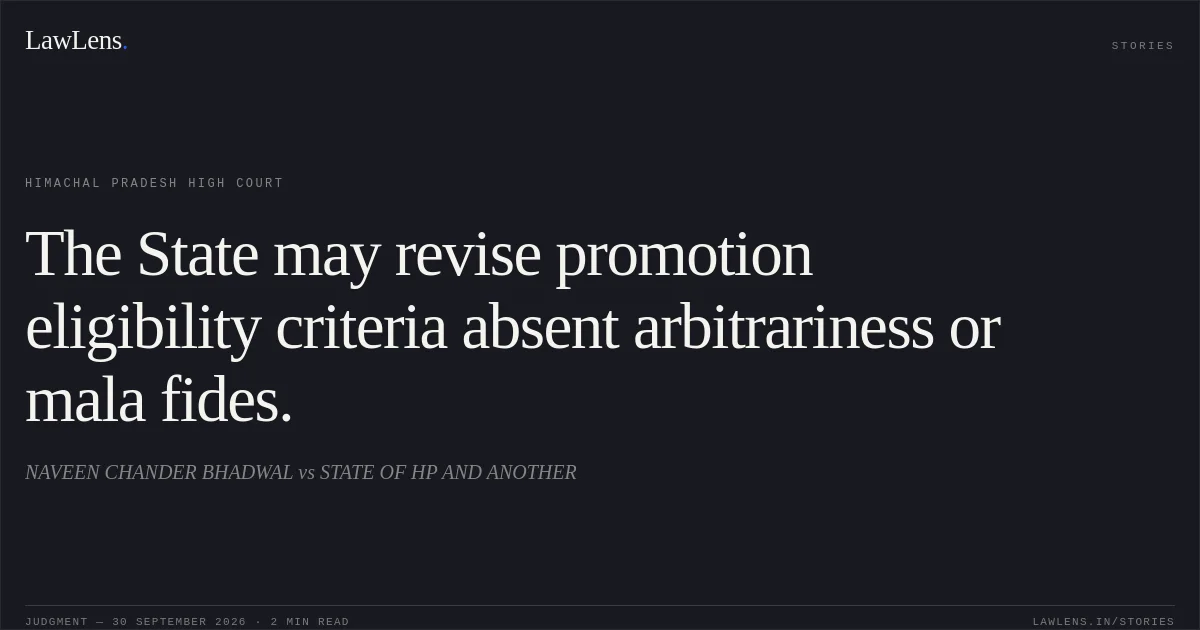
The petitioner, a Camera Operator, challenged the 2024 Recruitment and Promotion Rules for Overseer Offset.
Source reference: paras. 2–4Under the 2010 Rules, the educational qualifications prescribed for direct recruitment also applied to promotion.
Source reference: paras. 2–4The 2024 Rules repealed the 2010 Rules, removed that qualification requirement for promotion, and added feeder categories.
Source reference: paras. 2–4The petitioner alleged that the change was tailor-made to benefit otherwise ineligible employees and sought to have the Rules and a related order quashed, with a direction to promote him.
Source reference: paras. 2–4The State said the change recognised feeder-cadre employees’ experience and expertise and widened promotional opportunities; it also contended that affected employees had not been joined as parties.
Source reference: para. 5The Court noted that the post was occupied until July 2025.
Source reference: para. 8Issues
Whether the 2024 Rules’ removal of the educational qualification requirement for promotion was arbitrary, discriminatory, or tailor-made to benefit particular employees.
Source reference: paras. 3–5, 10Whether the petitioner was entitled to promotion or other relief despite the affected employees not being impleaded.
Source reference: paras. 5, 9, 12–13Law Applied
The Court relied on P.U. Joshi v. Accountant General, Ahmedabad, (2003) 2 SCC 632, for the principle that cadre structure, qualifications, service conditions, and promotion avenues fall within the State’s policy-making discretion, subject to constitutional limitations; courts should not substitute their preferred recruitment or promotion criteria for the State’s choices.
Source reference: para. 11An employee has no fundamental right to promotion, but has a right to fair consideration for promotion.
Source reference: para. 13The Court also treated the failure to implead persons likely to be affected by the relief sought as a non-joinder of necessary parties.
Source reference: para. 9Reasoning
The State gave a cogent explanation for changing the Rules: feeder-cadre employees had acquired experience and expertise, and the amendment also included categories that previously lacked promotional avenues.
Source reference: paras. 8, 10The petitioner produced no material showing that the amendment was arbitrary, mala fide, or a colourable exercise of power.
Source reference: para. 10The Court therefore deferred to the State’s policy choice, found that the petitioner’s right to be considered had not been shown to have been breached, and noted that his promotion remained subject to seniority, applicable conditions, vacancy, and constitution of a Departmental Promotion Committee.
Source reference: paras. 11–13The absence of employees who could be affected by the relief was an additional defect.
Source reference: para. 9Holding
The High Court dismissed the writ petition and any pending miscellaneous applications.
It upheld the 2024 Rules against the challenges raised, finding no substantiated arbitrariness or mala fides and no demonstrated violation of the petitioner’s right to consideration for promotion.
Source reference: paras. 10–13Original Court PDF
NAVEEN CHANDER BHADWALvsSTATE OF HP AND ANOTHER
Click to open original judgment
Original judgment, available to read, download and summarize on LawLens.in