Facts
The petitioners, appointed as Samvida Shala Shikshak Grade III (also referred to as Gurujis), received remuneration of ₹5,000 per month under the Madhya Pradesh Panchayat Samvida Shala Shikshak (Niyojan Evam Samvida Ki Shartein) Rules, 2005.
Source reference: p. 6They contended that the State had enhanced remuneration for other contractual personnel by order dated 23 June 2025 but had omitted their post, leaving them on the original amount.
Source reference: pp. 6–9They sought enhanced remuneration with arrears and compensation of ₹10 lakh each, relying in part on Smita Shrivastava v. State of Madhya Pradesh.
Source reference: pp. 3–5The State opposed the claims, arguing that remuneration was governed by the Rules and that enhancement and compensation were not legally due.
Source reference: p. 5The five petitions, raising the same controversy, were heard and disposed of together.
Source reference: p. 2Issues
Whether the petitioners were entitled to equal pay, minimum wages, or the enhanced remuneration granted to other contractual personnel.
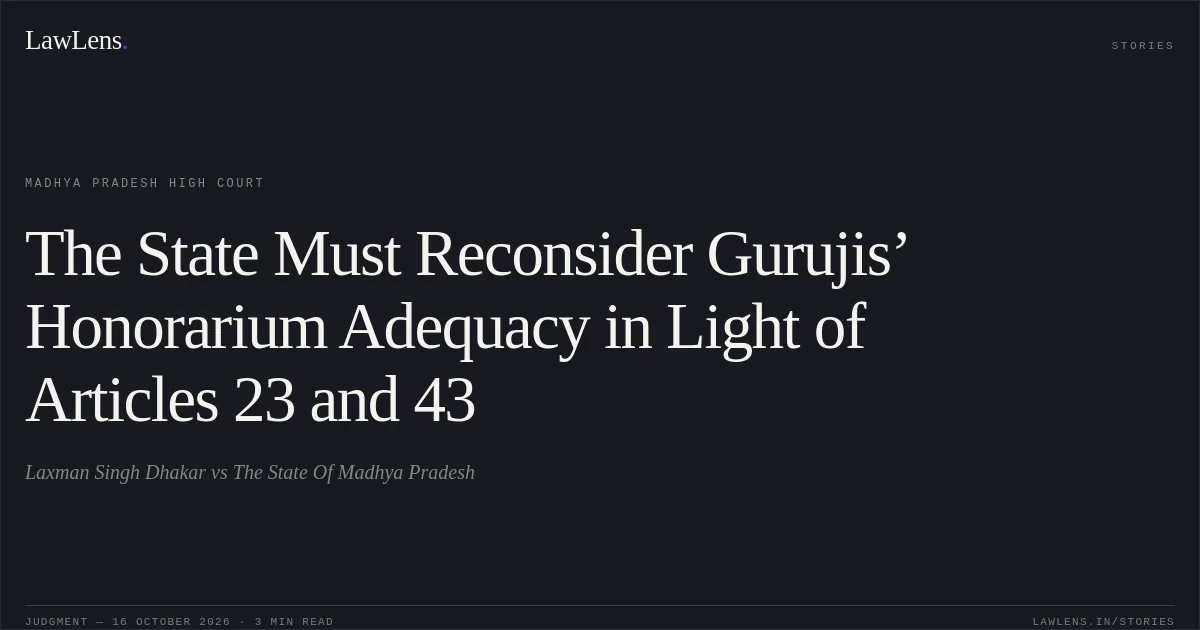
Source reference: pp. 8–10, 21Whether, notwithstanding the absence of established pay parity or entitlement to minimum wages, the State was required to reconsider the adequacy of the petitioners’ honorarium.
Source reference: pp. 14–22Whether the petitioners were entitled to exemplary compensation of ₹10 lakh each in light of Smita Shrivastava.
Source reference: pp. 3–6Law Applied
The Court considered the principle of equal pay for equal work, derived from Articles 14 and 16 read with Article 39(d) of the Constitution; parity requires proof of substantial identity between posts, including their recruitment, qualifications, duties, responsibilities and other relevant conditions, and the burden rests on the claimants (Steel Authority of India Ltd. v. Dibyendu Bhattacharya, (2011) 11 SCC 122; Monirujjaman Mullick; Randhir Singh v. Union of India, (1982) 1 SCC 618).
Source reference: pp. 9–11It also relied on Article 23’s prohibition of forced labour and People’s Union for Democratic Rights v. Union of India, (1982) 3 SCC 235, concerning the possibility that nominal remuneration may, in circumstances of economic compulsion, amount to exploitation.
Source reference: pp. 11–13Article 43 directs the State to endeavour to secure a living wage and decent conditions of work.
Source reference: p. 13The minimum-wage notification was treated as an indicator of the inadequacy of the petitioners’ remuneration, not as a source of an entitlement under the Minimum Wages Act.
Source reference: pp. 15–16Reasoning
The Court found no basis to order equal pay or minimum wages: the petitioners had not established the wholesale parity required with other posts, and the Minimum Wages Act did not apply to them.
Source reference: pp. 9–10, 15–16, 21However, their honorarium had remained at ₹5,000 while the State’s 2025 order provided higher remuneration to other contractual personnel, and the notified minimum-wage rates demonstrated the substantial gap between that amount and wages considered necessary for workers’ subsistence.
Source reference: pp. 6–9, 15–16Treating the payment as the petitioners’ livelihood, the Court held that its description as “honorarium” did not remove the need to assess its adequacy consistently with the constitutional principles discussed under Articles 23 and 43.
Source reference: pp. 14–20The Court did not grant the claimed ₹10 lakh compensation; it confined its operative relief to reconsideration of the honorarium.
Source reference: pp. 21–23Holding
The Court held that the petitioners had not established entitlement to equal pay, a minimum wage, or the minimum of a pay scale, but directed the respondents to reconsider the adequacy of their honorarium, keeping in view the principles flowing from Articles 23 and 43.
The State may appoint an expert body for this purpose and must complete the exercise and pass appropriate orders within three months.
Source reference: pp. 21–23The petitions were disposed of; pending interlocutory applications were also disposed of.
Source reference: p. 23Acts & Sections Cited
8 provisions across 8 statutes referred to in this judgment. Linked provisions open on LawLens.
Hungarian Labour Code1
Czechoslovak Code1
Bulgarian Code1
Code of the German Democratic Republic1
Rumanian Code1
the Act (alias, unresolved)1
Grundgesetz of the German Federal Republic1
Constitution of India1
Original Court PDF
Laxman Singh DhakarvsThe State Of Madhya Pradesh
Click to open original judgment
Original judgment, available to read, download and summarize on LawLens.in