Facts
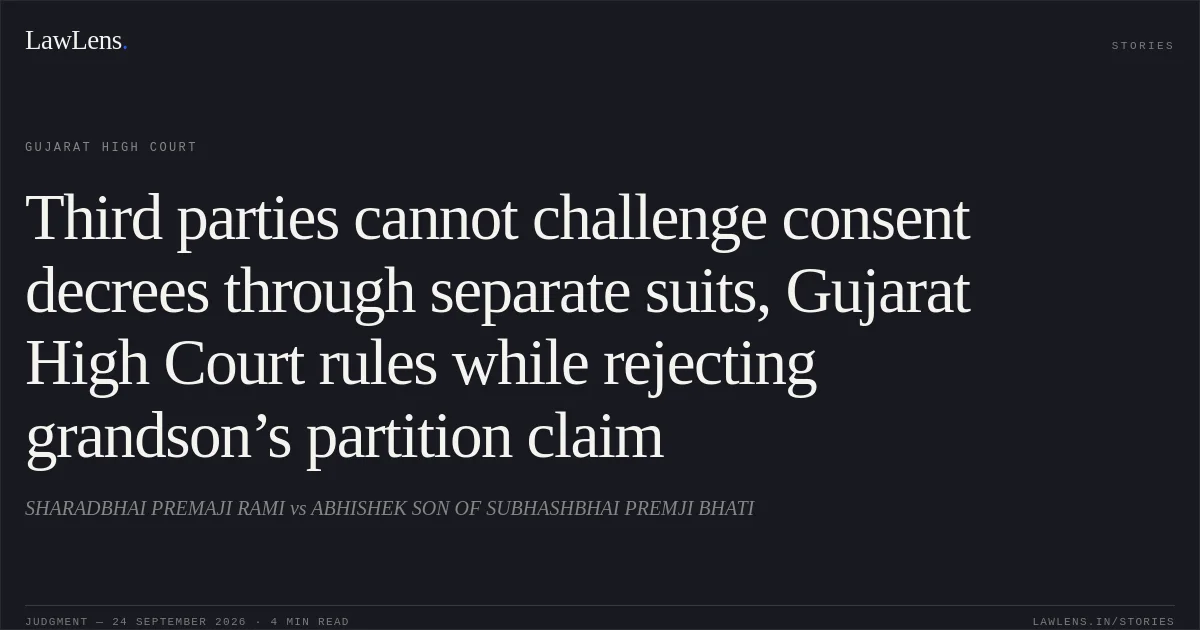
The plaintiff, Abhishek, born on 3 April 1995, instituted Regular Civil Suit No. 215 of 2012 through his mother and natural guardian, seeking a declaration that the consent decree dated 25 September 1996 in Regular Civil Suit No. 505 of 1996 was void and prejudicial to his interests, cancellation of consequential alienations, and partition of the suit properties by metes and bounds.
Source reference: paras. 2–2.4; pp. 2–4, 13–14Before the plaintiff’s birth, a registered partition deed had been executed on 26 March 1979 between the grandfather, grandmother, father and uncles. A further oral partition, recorded in a family settlement dated 5 July 1993, was also alleged to have taken place.
Source reference: para. 2.3; p. 3In 1996, the plaintiff’s grandmother and one uncle instituted a suit concerning the properties, which culminated in the consent decree dated 25 September 1996.
Source reference: paras. 2.4, 9–9.1; pp. 4, 13–14The original defendant No. 1 applied under Order VII Rule 11 of the Code of Civil Procedure, 1908, contending that the suit was barred by Order XXIII Rule 3A CPC and that the plaintiff had no enforceable right to seek partition.
Source reference: paras. 2.5–2.6; pp. 4–5The Trial Court rejected the application on the ground that the issues involved triable questions requiring evidence.
Source reference: paras. 2.5–2.6; pp. 4–5The defendant challenged that order in the present revision application under Section 115 CPC.
Source reference: para. 1; p. 1Issues
Whether a person who was not a party to a consent decree can maintain a separate suit to declare the consent decree void or set it aside?
Source reference: paras. 10(i), 12–17; pp. 15–24Whether the plaintiff had a legally enforceable right to claim partition on the basis of an alleged birthright in properties inherited by his father and uncles from their father after the commencement of the Hindu Succession Act, 1956?
Source reference: paras. 10(ii), 18–26; pp. 15, 25–33Whether the plaint disclosed a cause of action and was liable to be rejected under Order VII Rule 11 CPC?
Source reference: paras. 21, 24, 26–28; pp. 27–35Law Applied
Order XXIII Rule 3A CPC creates an express bar against a separate suit to set aside a decree on the ground that the compromise underlying it was unlawful.
Source reference: paras. 13.1, 16.1–16.2, 17, 27.1; pp. 18–24, 34The Supreme Court decisions in Triloki Nath Singh v. Anirudh Singh, Manjunath Tirakappa Malagi v. Gurusiddappa Tirakappa Malagi, and Shri Mukund Bhavan Trust v. Srimanth Chhatrapati Udyan Raje Pratasinh Maharaj Bhonsle were relied upon for the principle that the bar applies even to strangers or third parties to the compromise decree, whose remedy lies before the court that recorded the compromise, and, where permissible, by an appeal with leave.
Source reference: paras. 13.1, 16.1–16.2, 17, 27.1; pp. 18–24, 34Under Sections 6 and 8 of the Hindu Succession Act, 1956, succession to a Hindu male’s property is generally governed by Section 8, while Section 6 applies to existing coparcenary property.
Source reference: paras. 18–19, 23.1; pp. 25–31Following Commissioner of Wealth Tax, Kanpur v. Chander Sen, Yudhishter v. Ashok Kumar, and Nachiketa Kantibhai Patel v. Kantibhai Ishwarbhai Patel, property inherited by a son after 1956 does not, merely by inheritance, become coparcenary property in which his son acquires an interest by birth.
Source reference: paras. 18–19, 23.1; pp. 25–31Order VI Rule 4 CPC requires material and foundational particulars to be pleaded, and Order VII Rule 11 permits rejection where the plaint is barred by law or does not disclose a cause of action.
Source reference: paras. 22–24, 27.4–28; pp. 28–35Reasoning
The Court held that although the plaintiff was not a party to the 1996 consent decree, that circumstance did not permit him to institute an independent suit challenging its legality.
Source reference: paras. 12–17, 27.1–27.2; pp. 15–24, 34Applying Order XXIII Rule 3A CPC and the Supreme Court authorities, the Court concluded that a separate suit was barred; the plaintiff’s remedy, if otherwise available, was to approach the court that recorded the compromise or pursue an appellate remedy with leave.
Source reference: paras. 12–17, 27.1–27.2; pp. 15–24, 34Independently, the plaint alleged only that the properties had belonged to the grandfather and were inherited by his sons after his death in 1981.
Source reference: paras. 18, 20–23, 25; pp. 25–33It did not plead the necessary foundational facts establishing that the properties were coparcenary or HUF properties, nor did it explain how a coparcenary survived the earlier partitions of 1979 and 1993.
Source reference: paras. 18, 20–23, 25; pp. 25–33On the pleaded case, succession opened after 1956 and was therefore governed by Section 8 of the Hindu Succession Act, making the inherited shares the individual properties of the defendants; the plaintiff, whose father was alive, acquired no right by birth.
Source reference: paras. 19–21, 24–26; pp. 25–33Consequently, the plaint disclosed neither a valid challenge to the consent decree nor a cause of action for partition.
Source reference: paras. 19–21, 24–26; pp. 25–33Holding
The Court answered both principal issues against the plaintiff.
It held that a third party cannot challenge a consent decree through a separate suit because such a suit is barred by Order XXIII Rule 3A CPC, and that the plaintiff had no birthright or enforceable partition claim in properties inherited by his father and uncles under Section 8 of the Hindu Succession Act, 1956.
Source reference: paras. 27.1–27.4; p. 34The Trial Court’s order dated 12 December 2012 was quashed and set aside; the defendant’s application under Order VII Rule 11 CPC was allowed; and the plaint in Regular Civil Suit No. 215 of 2012 was rejected.
Source reference: paras. 28–29; p. 35The connected civil applications were disposed of, the Rule was made absolute, and no order as to costs was passed.
Source reference: paras. 28–29; p. 35Acts & Sections Cited
7 provisions across 2 statutes referred to in this judgment. Each provision opens on LawLens.
Code of Civil Procedure, 19085
Original Court PDF
SHARADBHAI PREMAJI RAMIvsABHISHEK SON OF SUBHASHBHAI PREMJI BHATI
Click to open original judgment
Original judgment, available to read, download and summarize on LawLens.in