Facts
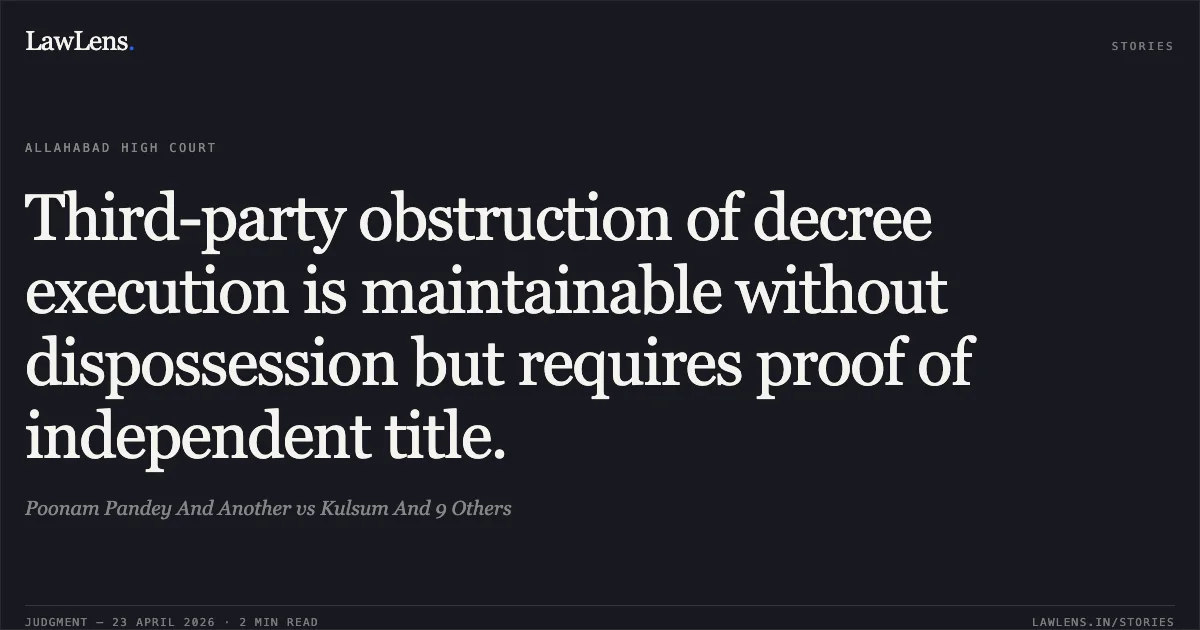
The appellants challenged an order dated 06.01.2026 passed by the Civil Judge (Senior Division), Ghazipur, which rejected their application under Order 21 Rule 97 and 99 of the CPC as non-maintainable
Source reference: para. 2The underlying dispute began with Original Suit (O.S.) No. 348 of 1988, where the respondent (Nizamuddin) successfully sued Shivanand Bharti and others for possession based on a sale deed
Source reference: para. 7-9That decree was affirmed in appeal in 2019
Source reference: para. 10During execution (Case No. 03 of 2020), the appellants—heirs of Paramhans Pandey and relatives of the judgment debtors—filed objections claiming independent ownership via a family partition
Source reference: para. 12, 18The executing court dismissed the objections solely because the appellants were not yet dispossessed, holding the application premature under Rule 99 and not maintainable under Rule 97
Source reference: para. 13Issues
1. Whether an application under Order 21 Rule 97 and 99 CPC by a third party is maintainable only after actual dispossession.
Source reference: para. 13, 162. Whether the appellants demonstrated a prima facie independent right, title, or interest in the disputed property to resist the execution of the decree.
Source reference: para. 16, 23Law Applied
The court applied the provisions of Order 21 Rules 35, 97, 99, 101, and 103 of the CPC, which constitute a "complete code" for resolving execution disputes
Source reference: para. 14Relying on Periyammal v. V. Rajamani (2025) and Brahmdeo Chaudhary v. Rishikesh Prasad Jaiswal (1997), the court noted that a stranger to a decree can offer resistance before being dispossessed under Rule 97
Source reference: para. 14, 44It further cited Alka Shrirang Chavan v. Hemchandra Rajaram Bhonsale (2026) to establish that "any person" includes those not bound by the decree
Source reference: para. 15Finally, it applied the guidelines from Rahul S. Shah v. Jinendra Kumar Gandhi (2021), which mandate that executing courts must refrain from entertaining frivolous or mala fide third-party claims intended to delay the fruits of a decree
Source reference: para. 14, 17Reasoning
The High Court observed that the executing court’s reasoning—that the application was non-maintainable because the appellants weren't yet dispossessed—was legally erroneous
Source reference: para. 16Under the established precedent, Rule 97 allows a stranger to adjudicate their rights prior to actual eviction
Source reference: para. 14The High Court proceeded to examine the merits of the appellants' claim to prevent a "retrial" in execution. It found that the appellants failed to provide documentary evidence of the alleged family partition or their father’s title
Source reference: para. 17, 19-20The court noted that since the appellants resided in the same house as the judgment debtors, it was "improbable" they were unaware of the 38-year-old litigation
Source reference: para. 21The court concluded that the application was a collusive attempt with the judgment debtors to frustrate the decree, lacking any bona fide independent interest
Source reference: para. 23Holding
The Court answered the first issue by holding that the executing court's grounds for rejection were incorrect; dispossession is not a prerequisite for a Rule 97 application
On the second issue, the Court held that the appellants failed to prove any independent right, rendering their objection meritless
Source reference: para. 23The High Court dismissed the appeal and affirmed the rejection of the appellants' application, modifying the reasoning to focus on the lack of a prima facie case rather than maintainability
Source reference: para. 25-26Acts & Sections Cited
7 provisions across 2 statutes referred to in this judgment. Each provision opens on LawLens.
Code of Civil Procedure, 19086
Transfer of Property Act, 18821
Original Court PDF
Poonam Pandey And AnothervsKulsum And 9 Others
Click to open original judgment
Original judgment, available to read, download and summarize on LawLens.in