Facts
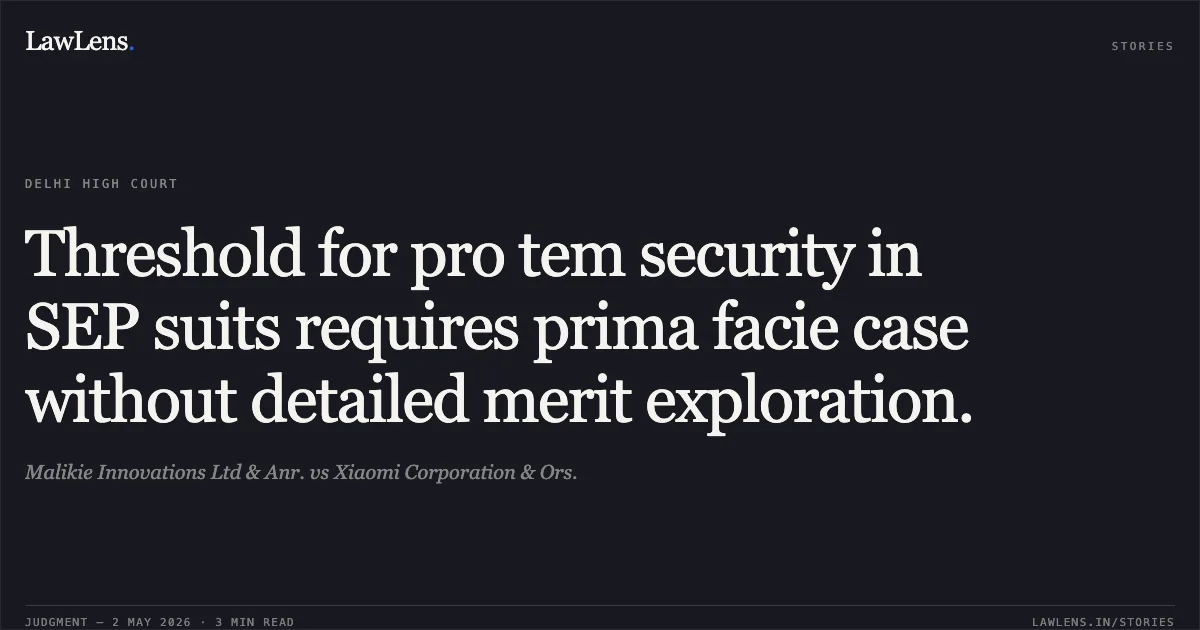
The Plaintiffs, Malikie Innovations Ltd. (acquirers of BlackBerry’s patent portfolio), filed a suit for infringement of three Standard Essential Patents (SEPs) related to 3G, 4G, and 5G technologies
Source reference: para 2-3Negotiations for a Fair, Reasonable, and Non-Discriminatory (FRAND) license had persisted since October 2023 without reaching an agreement
Source reference: para 5.1In March 2026, Defendant No. 3 filed a rate-setting suit before the Shenzhen Court in China for Chinese patents
Source reference: para 59The Plaintiffs filed the present application (I.A. 17510/2025) under Section 151 of the CPC seeking pro tem security deposit based on their licensing offer, citing the Defendants’ "hold-out" tactics and the precarious financial situation of Xiaomi’s Indian subsidiary
Source reference: para 1, 5.4, 86Issues
1. Whether the Court is empowered to grant pro tem security in SEP disputes under Section 151 of the CPC as a temporary arrangement before the determination of the interim injunction
Source reference: para 14, 212. Whether the Plaintiffs established a prima facie case of validity, essentiality, and infringement for the purpose of pro tem relief
Source reference: para 47-483. Whether the Defendants are liable to deposit security despite not having access to the Plaintiffs' third-party Patent License Agreements (PLAs)
Source reference: para 38-39Law Applied
The Court relied on Section 151 of the CPC to exercise inherent powers to balance equities via temporary arrangements
Source reference: para 12, 14It applied the Standard Essential Patent (SEP) regime principles from Intex Technologies v. Ericsson, establishing that both licensors and implementers have reciprocal FRAND obligations, and implementers cannot derive an "unfair competitive edge" by using technology without payment
Source reference: para 13It followed the precedent in Nokia v. Oppo, holding that pro tem security does not require a full prima-facie adjudication on merits and that non-furnishing of third-party PLAs is irrelevant at this stage
Source reference: para 15, 38, 89It further observed Rule 3(B)(vi) of the Delhi High Court Patent Rules, which places the burden on defendants to disclose alternate technology used to avoid infringement
Source reference: para 71Reasoning
The Court determined that a pro tem order is a temporary measure distinct from an injunction and requires a lower threshold of scrutiny
Source reference: para 89On validity and essentiality, the Court found the patents prima facie valid as fundamental wireless technologies [para 55] and noted that Xiaomi's act of filing a FRAND rate-setting suit in China constituted a prima facie admission that the Plaintiffs own SEPs requiring licensing
Source reference: para 61-63On infringement, the Court observed Xiaomi’s own self-declarations of 4G/5G compliance on its website [para 70] and its failure to provide any evidence of alternate technology used
Source reference: para 71-74The Court found the Defendants' financial standing "precarious" due to ongoing ED investigations and the lack of physical assets in India for the parent/Chinese entities, necessitating security to ensure a future decree is not illusory
Source reference: para 84-87Regarding PLAs, the Court ruled that implementers can use their own existing licenses with other SEP holders to determine a fair counter-offer, and the patentee is not mandated to disclose confidential third-party agreements at the pro tam stage
Source reference: para 41-42Holding
The Court allowed the application, holding that the Plaintiffs established a prima facie case for pro tem security
The Court quantified the deposit at $28.7 million (approx. ₹272 crores), calculated as 19.12% (Xiaomi's Indian market share) of the mean value between the Plaintiffs’ last offer and the Defendants’ last counter-offer
Source reference: para 96-97The Defendants were directed to deposit ₹272 crores with the Registrar General or provide an unconditional Bank Guarantee within six weeks. Failure to comply allows the Plaintiffs to seek an immediate interim injunction
Source reference: para 98, para 98(c)Acts & Sections Cited
1 provisions across 1 statute referred to in this judgment. Each provision opens on LawLens.
Code of Civil Procedure, 19081
Original Court PDF
Malikie Innovations Ltd & Anr.vsXiaomi Corporation & Ors.
Click to open original judgment
Original judgment, available to read, download and summarize on LawLens.in