01Facts
The Appellant (Intas) manufactures an anti-cancer drug containing the molecule ‘Bevacizumab’ under the mark ‘BEVATAS’, launched in 2016.
¶ 2.2The Respondent (Sun Pharma) holds a 1983 registration for ‘BEVETEX’, used since 2015 for an anti-cancer drug containing ‘Paclitaxel’.
¶ 2.4Sun Pharma sued for infringement and passing off, alleging deceptive similarity.
¶ 1At the interim stage, the Trial Court and High Court refused an injunction, finding the marks dissimilar.
¶ 2.7However, after a full trial, the learned Single Judge (LSJ) permanently enjoined Intas from using ‘BEVATAS’, holding it deceptively similar to ‘BEVETEX’.
¶ 2.9Intas appealed, noting the drugs have different compositions, indications (treatment lines), and are administered intravenously by specialists in hospitals.
¶ 2.2-2.402Issues
i.1. Whether the Respondent established a valid cause of action for passing off and unfair competition despite admitting "no commercial interest" in the suit.
¶ 13-16ii.2. Whether the rival marks ‘BEVATAS’ and ‘BEVETEX’ are deceptively similar under Section 29(2)(b) of the Trade Marks Act, 1999.
¶ 39, 63iii.3. Whether there exists a ‘likelihood of confusion’ among the relevant class of purchasers (Oncologists, pharmacists, and trained nurses).
¶ 40, 4403Law Applied
The court primarily applied Section 29(2)(b) of the Trade Marks Act, 1999, which requires proving similarity of marks and similarity/identity of goods leading to a likelihood of confusion.
¶ 38-39It relied on the "Factors Test" from Cadila Health Care Ltd. v. Cadila Pharmaceuticals Ltd., necessitating a holistic assessment of phonetic, visual, and structural similarity, the nature of goods, and the class of purchasers.
¶ 81The court applied the "Anti-Dissection Rule" as cstrystallized in Gufic Ltd. v. Clinique Laboratories, LLC, requiring marks to be compared as a whole rather than split into components.
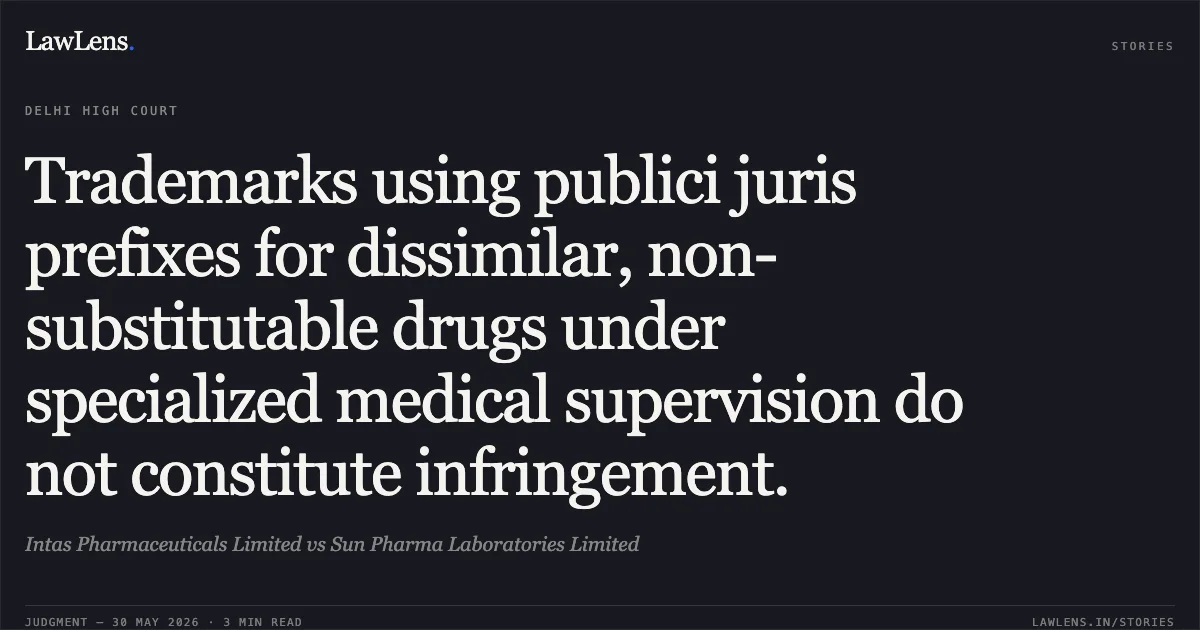
¶ 83It further noted the principle from Astrazeneca UK Limited v. Orchid Chemicals that where a prefix is derived from a generic molecule name (INN), it is publici juris (common to the trade), and the focus must shift to the uncommon parts of the marks.
¶ 101, 108Provisions in the judgment · 5 · Linked ones open on LawLens
Trade Marks Act, 1999 Section 2Section 29Section 135
Code of Civil Procedure, 1908 Section 21Section 96
04Reasoning
The Court found the Respondent’s suit vexatious as it pleaded passing off while admitting the drugs were non-substitutable and caused no commercial loss.
¶ 16, 26On the merits of infringement, the Court held the LSJ erred by applying a "presumption of confusion" akin to Section 29(3), which only applies to identical marks/goods—not the case here.
¶ 71-72The Court determined that the syllable ‘BEV’/‘BEVA’ is publici juris as it is derived from the molecule ‘Bevacizumab’ and used by numerous other manufacturers.
¶ 101-104Phonetically, ‘BEVATAS’ (beh-vuh-tas) and ‘BEVETEX’ (beh-veh-tex) were found distinct due to different vowel modulations and suffixes (‘TAS’ vs ‘TEX’).
¶ 105-106Critically, the Court found the goods dissimilar: one is a biologic (rDNA) and the other a synthetic chemical.
¶ 92Since both are Schedule H drugs administered only by trained oncology nurses under specialist supervision in controlled environments, the "imaginary negligent chemist" theory was rejected.
¶ 113, 131The Respondent failed to lead any expert evidence (Oncologists or pharmacists) to prove actual or likely confusion.
¶ 45, 6005Holding
The Court answered the issues in the negative, setting aside the impugned judgment and dismissing the suit.
¶ 155-156It held that the marks ‘BEVATAS’ and ‘BEVETEX’ are not deceptively similar and do not cause a likelihood of confusion.
¶ 143-144The final decree restrained the Respondent from interfering with the Appellant’s mark and awarded costs to the Appellant, including drafting fees and counsel fees for one senior and one junior advocate.
¶ 158-161Original Court PDF
Intas Pharmaceuticals LimitedvsSun Pharma Laboratories Limited
Click to open original judgment
Original judgment, available to read, download and summarize on LawLens.in