Facts
On 28 October 2021, police alleged that Arjun Sarkar drove a Maruti Alto at high speed, failed to stop when signalled, struck the SDPO’s official vehicle, and continued driving before his vehicle capsized.
Source reference: pp. 3–4, para. 5Police recovered foreign-liquor bottles from the vehicle and alleged that Sarkar had no driving licence.
Source reference: pp. 3–4, para. 5The trial court convicted him and imposed imprisonment and fines under Section 279 IPC and provisions of the Motor Vehicles Act; the Sessions Judge dismissed his appeal and affirmed the conviction and sentence.
Source reference: pp. 1–2, para. 1; p. 4, para. 6Sarkar challenged both decisions in revision, arguing that the evidence was unreliable and that the sentence should be reduced to a fine.
Source reference: pp. 2–3, para. 3; p. 7, para. 19Issues
Whether the trial court’s findings of guilt, affirmed by the Sessions Judge, were unsupported by the evidence or otherwise warranted interference in revision.
Source reference: pp. 7–8, paras. 19–20Whether the imprisonment component of the sentence should be altered, having regard to the petitioner’s status as a first-time offender.
Source reference: p. 8, paras. 20–21Law Applied
The Court considered the offences and convictions under Section 279 of the Indian Penal Code and Sections 179 and 184 of the Motor Vehicles Act, along with a further Motor Vehicles Act provision whose identification is inconsistent in the judgment.
Source reference: pp. 1–2, para. 1; p. 4, para. 5; p. 8, para. 21It applied no identified precedent or separately stated legal test.
Source reference: no citationIts reasoning proceeded on the evidentiary conclusion that the prosecution witnesses’ accounts remained materially intact under cross-examination, and on the sentencing consideration that leniency could be shown because the petitioner appeared to be a first-time offender.
Source reference: pp. 5–8, paras. 8–18, 20–21Reasoning
The Court found that the SDPO and other prosecution witnesses consistently described the petitioner’s driving, the collision with the official vehicle, and the subsequent recovery of liquor; it held that cross-examination had not raised a circumstance sufficient to discredit their evidence.
Source reference: pp. 5–7, paras. 8–18It therefore found no basis to disturb the concurrent findings of guilt.
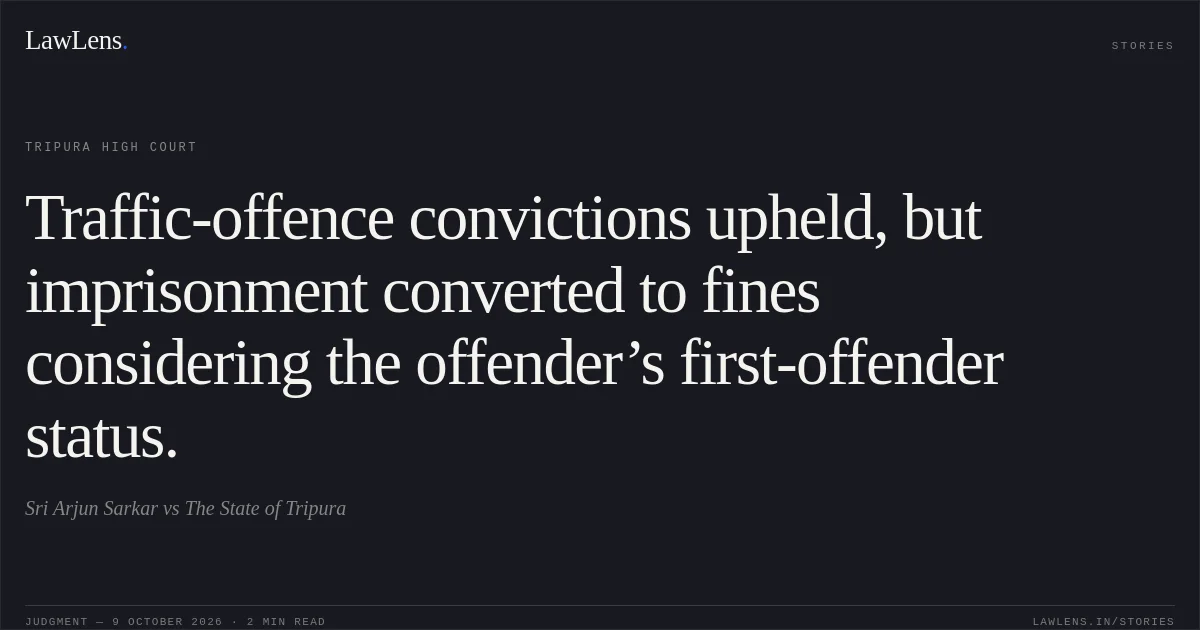
Source reference: p. 8, para. 20On sentence, it considered the petitioner’s apparent lack of prior offending and substituted fines for the imprisonment imposed below.
Source reference: pp. 8–9, para. 21The judgment is internally inconsistent as to the fourth Motor Vehicles Act provision: the original sentence is described as being under Section 180, while the final order imposes the ₹5,000 fine under Section 181.
Source reference: pp. 2, para. 1; p. 8, para. 21Holding
The revision petition was dismissed on the merits, and the convictions were maintained.
The imprisonment component was converted to fines of ₹1,000 under Section 279 IPC, ₹1,000 under Section 184 of the Motor Vehicles Act, ₹1,000 under Section 179, and ₹5,000 under Section 181, totalling ₹8,000.
Source reference: pp. 8–9, para. 21The amount was directed to be deposited before the Chief Judicial Magistrate within 15 days; in default, the petitioner was to undergo four months’ imprisonment.
Source reference: pp. 8–9, para. 21This final reference to Section 181 conflicts with the earlier description of the ₹5,000 fine as imposed under Section 180.
Source reference: p. 2, para. 1Acts & Sections Cited
7 provisions across 3 statutes referred to in this judgment. Each provision opens on LawLens.
Indian Penal Code, 18602
Motor Vehicles Act, 19884
Code of Criminal Procedure, 19731
Original Court PDF
Sri Arjun SarkarvsThe State of Tripura
Click to open original judgment
Original judgment, available to read, download and summarize on LawLens.in