Facts
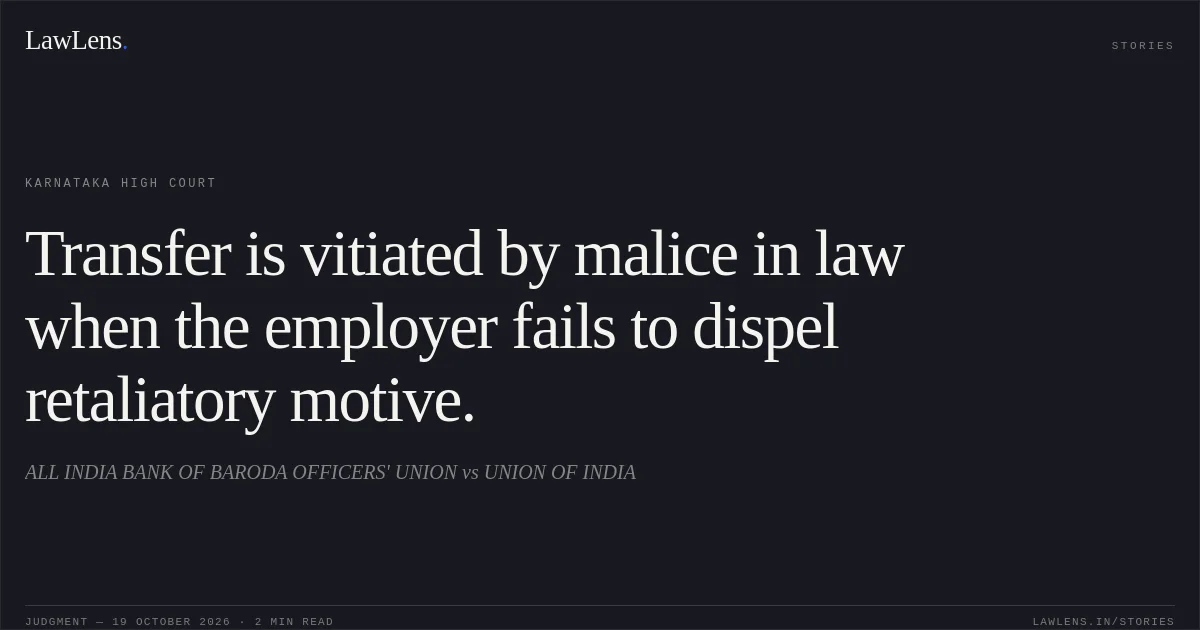
Petitioner No. 2, a Bank of Baroda officer and Joint Secretary of the petitioner Union, challenged the Bank’s order dated 17 March 2026 transferring and relieving him from his Bengaluru assignment and directing him to report to the Mangaluru Zone for further placement.
Source reference: para. 1–2He alleged that the transfer was retaliatory, following his reports of irregularities and the Bank’s show-cause communication dated 16 March 2026 alleging unauthorised disclosure of confidential information.
Source reference: para. 6, 13, 17–18The petitioners also relied on Government guidelines and the Bank’s transfer policy, and disputed the authority and process underlying the order.
Source reference: para. 3–5The Bank maintained that the transfer was made for administrative exigencies, had the Chief General Manager’s approval, and was authorised by Regulation 47 of the Bank of Baroda (Officers’ Service) Regulations, 1979.
Source reference: para. 7–8Issues
1. Whether the transfer order dated 17 March 2026 was liable to be set aside as mala fide, given its proximity to the show-cause communication of 16 March 2026 and the petitioner’s reports of alleged irregularities.
Source reference: para. 13–232. Whether the transfer could be invalidated for alleged non-compliance with Government guidelines and the Bank’s transfer policy, notwithstanding the Bank’s reliance on Regulation 47.
Source reference: para. 3–5, 7, 10–12Law Applied
Regulation 47 of the Bank of Baroda (Officers’ Service) Regulations, 1979 authorises the transfer of an officer to any office or branch of the Bank in India; the Court held that the Regulations take precedence over inconsistent policy provisions or Government directions.
Source reference: para. 7, 10–11Transfer is ordinarily an incident of service, and courts generally do not interfere for breach of guidelines or policy absent violation of a statutory right or proof of mala fides.
Source reference: para. 12Relying on Ms. X v. Registrar General, High Court of Madhya Pradesh and Another, (2022) 14 SCC 187, the Court recognised that an order based on an irrelevant ground, rather than a factor germane to transfer, may be vitiated by malice in law.
Source reference: para. 20Reasoning
Although Regulation 47 gave the Bank broad transfer authority and ordinarily limited judicial intervention, the Court considered the timing and circumstances of the decision.
Source reference: no citationThe show-cause communication alleging misuse of official email and disclosure of confidential information was issued on 16 March 2026, and the transfer followed the next day; the petitioner also alleged that the action was retaliation for raising concerns about irregularities.
Source reference: para. 13–18The Court found that the Bank had not dispelled the allegation that the transfer was connected to the show-cause communication or established that the order was untainted by an oblique motive.
Source reference: para. 21–22It therefore treated the transfer as vitiated by mala fides, notwithstanding the Bank’s general power to transfer under Regulation 47.
Source reference: para. 23Holding
The Court held that the transfer order dated 17 March 2026 was vitiated by mala fides and set aside Annexure-E.
The petition was allowed in part.
Source reference: para. 23–24Acts & Sections Cited
1 provisions across 1 statute referred to in this judgment. Linked provisions open on LawLens.
Trade Unions Act, 19261
Original Court PDF
ALL INDIA BANK OF BARODA OFFICERS' UNIONvsUNION OF INDIA
Click to open original judgment
Original judgment, available to read, download and summarize on LawLens.in