Facts
The petitioner, a teacher at Primary School, Nayapara, Bodri, was transferred to Primary School, Rehtator, Block Masturi, vide an order dated 04.06.2025
Source reference: p.2She challenged this transfer order and subsequent orders dated 27.06.2025 and 06.08.2025, alleging that the decisions were arbitrary, illegal, and violated the Teacher Rationalization Policy
Source reference: p.2, para 2The petitioner essentially contended that the transfer caused her undue hardship and disregarded the norms prescribed under the state’s rationalization policy
Source reference: p.2, para 2Issues
1. Whether the impugned transfer order was liable to be quashed for violating the guidelines of the Teacher Rationalization Policy
Source reference: p.2, para 1-22. Whether the court should interfere with a transfer order passed in the context of administrative exigency and rationalization
Source reference: p.3, para 3Law Applied
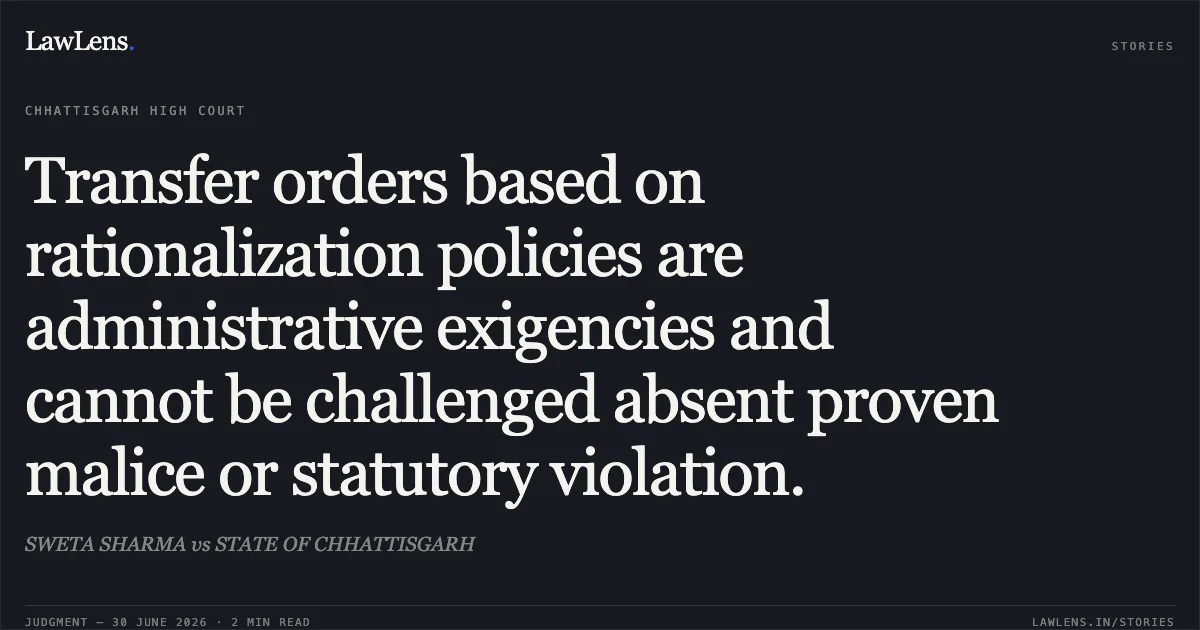
The court relied on the established legal principle that transfer is an incidence of service and that courts should not interfere unless there is proven malice, lack of competence, or violation of statutory rules
Source reference: p.3, para 3It specifically applied the holding from Shashi Shrivastava v. State of Chhattisgarh Others (WA No. 674 of 2025), which clarified that Teacher Rationalization Instructions are mere guidelines and do not supplant the employer’s general powers under statutory service rules to post employees in the public interest or administrative exigency
Source reference: p.3, para 3Reasoning
The court found that the facts and legal issues in the present petition were identical to those decided by the Division Bench in the Shashi Shrivastava case
Source reference: p.4, para 5In that precedent, the court reasoned that rationalization policies are administrative guidelines rather than rigid statutory mandates that override an employer's power to manage staff
Source reference: p.3, para 3Since the petitioner could not demonstrate any mala fide (malice) or a specific infraction of a statutory Rule (as opposed to a guideline), the court determined that the transfer was a routine exercise of administrative power
Source reference: p.3-4, para 3-5Consequently, following the principle of judicial consistency, the court declined to take a different view from the Division Bench
Source reference: p.4, para 5Holding
The court answered the issues in the negative, holding that the transfer order did not warrant judicial interference.
The writ petition was dismissed in terms of the judgment dated 18.09.2025 passed in WA No. 674 of 2025. The court upheld that administrative exigency and public interest in rationalizing teacher placements outweigh the personal hardships or guideline-based grievances of individual employees
Source reference: p.3, para 3; p.4, para 6Original Court PDF
SWETA SHARMAvsSTATE OF CHHATTISGARH
Click to open original judgment
Original judgment, available to read, download and summarize on LawLens.in


![Subsequent exoneration does not retrospectively invalidate a finalized promotion select list.. UNNIKRISHNAN M vs M/o Environment And Forests. CAT - ['Ernakulam']. LawLens](/stories/thumbnails/subsequent-exoneration-does-not-retrospectively-invalidate-a-finalized-promotion-select-li-ce80a0e84f2f4887857271e8b4341c42.webp)