Facts
The applicant, a Upper Division Clerk (UDC) in the Directorate of Enforcement, was transferred from Delhi to Chennai on August 21, 2023
Source reference: p. 6Citing the medical conditions of his wife (Schizophrenia) and mother (paralysis), he requested a transfer back to Delhi
Source reference: p. 5-6On May 14, 2025, the respondents issued a transfer order moving him to Delhi
Source reference: p. 2However, the respondents subsequently kept this order in abeyance on May 27, 2025, and cancelled it on July 25, 2025
Source reference: p. 2The respondents contended that during his 22-month tenure in Chennai, the applicant was unauthorizedly absent for approximately 21 months and had been served a disciplinary memorandum on April 29, 2025, for such absence
Source reference: p. 6-7The applicant challenged the cancellation, seeking implementation of the original transfer to Delhi
Source reference: p. 2Issues
1. Whether the applicant has a vested right to seek implementation of the transfer order dated 14.05.2025
Source reference: para. 132. Whether the impugned orders dated 27.05.2025 and 25.07.2025 suffer from illegality, arbitrariness, or mala fides
Source reference: para. 133. Whether the applicant is entitled to relief in light of his conduct, specifically his prolonged unauthorized absence
Source reference: para. 13Law Applied
The Tribunal applied the settled principle that transfer is an incident of service and remains the exclusive domain of the employer, barring instances of mala fides, incompetence, or statutory violations
Source reference: para. 14It relied on Somesh Tiwari v. Union of India, distinguishing between administrative exigencies and punitive transfers
Source reference: para. 2The Tribunal further applied the ratio from Jai Bhagwan Sangwan v. UOI, which establishes that employees in disciplined services cannot stay away from duty without justification
Source reference: para. 8Regarding compassionate transfers, the Tribunal referred to Clause 4.18 of the relevant Transfer Guidelines, which requires a certificate from a competent authority for "Specified Disability" to exempt an employee from routine transfer
Source reference: para. 6Reasoning
The Tribunal found that the applicant lacked an indefeasible right to the implementation of the transfer order, as administrative authorities may reconsider such orders based on subsequent developments
Source reference: para. 15-16The record indicated the applicant was absent for nearly 95% of his Chennai tenure without sanctioned leave or verifiable medical documentation
Source reference: para. 15The Tribunal reasoned that the respondents’ decision to cancel the transfer was a "precautionary administrative measure" prompted by the applicant’s serious misconduct of unauthorized absence and the issuance of a disciplinary memorandum
Source reference: para. 15Furthermore, the Tribunal rejected the applicant's plea for compassionate grounds, noting he failed to produce the requisite disability certifications mandated by the Transfer Policy
Source reference: para. 16It distinguished this case from Pradeep Kumar Shrivastava v. CBI, noting that unlike the applicant there, the present applicant provided no evidence of "certified disabilities" and demonstrated a significant breach of service discipline
Source reference: para. 18Holding
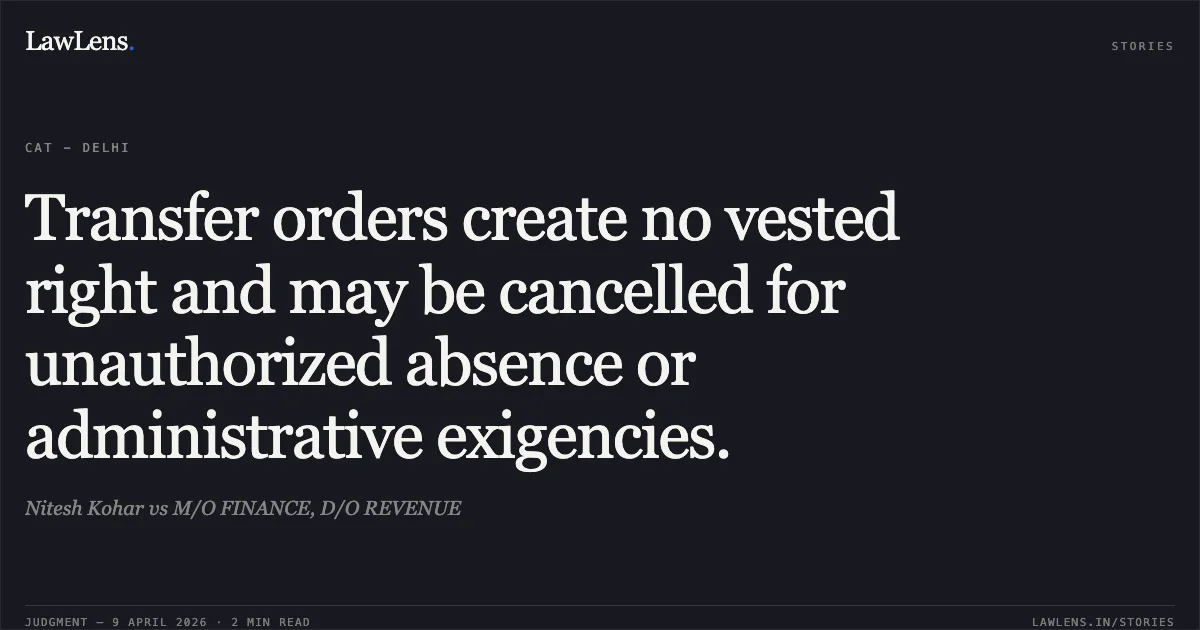
The Tribunal dismissed the Original Application, holding that the applicant had no enforceable right to the implementation of the May 14, 2025 transfer order
The Tribunal concluded that the impugned orders of abeyance and cancellation were based on valid administrative considerations regarding the applicant's conduct and absence from duty, and were not vitiated by mala fides or illegality
Source reference: para. 19All pending Miscellaneous Applications were also disposed of
Source reference: para. 21Original Court PDF
Nitesh KoharvsM/O FINANCE, D/O REVENUE
Click to open original judgment
Original judgment, available to read, download and summarize on LawLens.in


![Subsequent exoneration does not retrospectively invalidate a finalized promotion select list.. UNNIKRISHNAN M vs M/o Environment And Forests. CAT - ['Ernakulam']. LawLens](/stories/thumbnails/subsequent-exoneration-does-not-retrospectively-invalidate-a-finalized-promotion-select-li-ce80a0e84f2f4887857271e8b4341c42.webp)