Facts
The Respondent, a Squadron Leader in the Indian Air Force (IAF) serving at Jodhpur, was transferred to Tezpur, Assam, vide Signal dated 27.02.2026.
Source reference: para 2He challenged this transfer before a Single Judge, contending it was "premature" under the IAF Human Resource Policy as he had served only one year at Jodhpur.
Source reference: para 8He further cited compassionate grounds, stating his father had a renal tumor (one kidney removed) and his mother was a 50% burn survivor requiring care.
Source reference: paras 2, 10The Single Judge allowed the writ petition and quashed the transfer on 30.03.2026.
Source reference: para 3The Union of India appealed this judgment, asserting that transfer is an incidence of service and judicial interference is restricted in Armed Forces matters.
Source reference: para 4Issues
1. Whether the "Policy for Posting of Officers" possesses statutory force or is merely a set of executive guidelines.
Source reference: para 13, 242. Whether compassionate grounds and personal hardships of an officer can override administrative exigencies and operational requirements in the Armed Forces.
Source reference: para 15, 213. Whether the High Court, under Article 226, can interfere with a transfer order of an Armed Forces member in the absence of mala fides or statutory violation.
Source reference: para 4, 23Law Applied
The Court applied the principle that transfer is an incidence of service as established in Public Services Tribunal Bar v. State of U.P.
Source reference: para 25It relied on Union of India v. S.L. Abbas, which held that executive instructions regarding transfers are mere guidelines without statutory force.
Source reference: para 24The Court followed the "limited interference" doctrine from J.K. Bansal v. Union of India, stating that Courts should be extremely slow to interfere with military postings unless an exceptionally strong case is made out.
Source reference: para 17It also reinforced the precedent from Union of India v. Surendra Kumar, which held that the Air Force's administrative discretion overrules welfare policies.
Source reference: para 18Reasoning
The Court reasoned that while the IAF Posting Policy (Para 7) suggests a tenure of three years for stability, Paras 1 and 3 of the same policy explicitly subject these guidelines to "overriding service exigencies" and "operational effectiveness".
Source reference: para 14, 19The Bench observed that the policy is a management tool for human resources rather than a source of enforceable legal rights.
Source reference: para 20Regarding the respondent's personal hardships, the Court noted that his parents resided in Ambala/Chandigarh and were not physically dependent on him at his station.
Source reference: para 15It held that while the respondent’s clean service record and family health issues evoke sympathy, they do not constitute "exceptionally strong" legal grounds to quash a transfer.
Source reference: para 22, 26The Court emphasized that allowing such challenges would "open floodgates" and compromise the operational flexibility and discipline essential for the Armed Forces.
Source reference: para 5, 21Holding
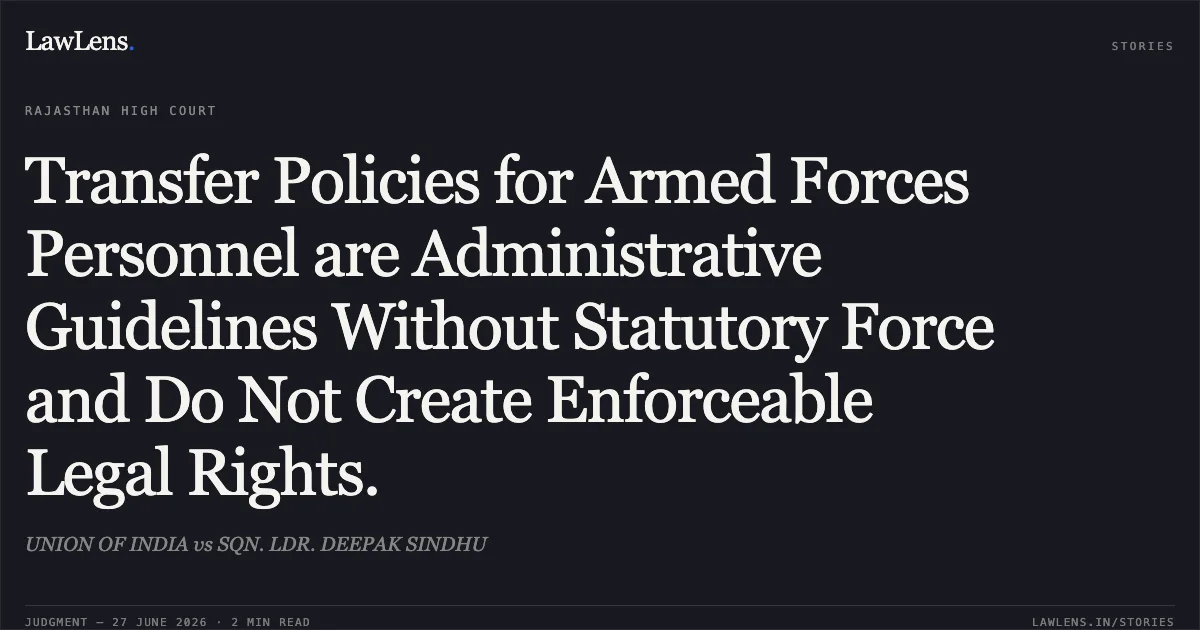
The Court answered the issues by holding that the posting policy lacks statutory force and administrative discretion remains paramount.
The Division Bench allowed the appeal, set aside the judgment dated 30.03.2026, dismissed the original writ petition (SBCWP No. 5942/2026), and found no infirmity in the appellants' decision to transfer the respondent in the interest of service.
Source reference: para 27Acts & Sections Cited
2 provisions across 1 statute referred to in this judgment. Linked provisions open on LawLens.
Air Force Human Resource Policy2
Original Court PDF
UNION OF INDIAvsSQN. LDR. DEEPAK SINDHU
Click to open original judgment
Original judgment, available to read, download and summarize on LawLens.in


