Facts
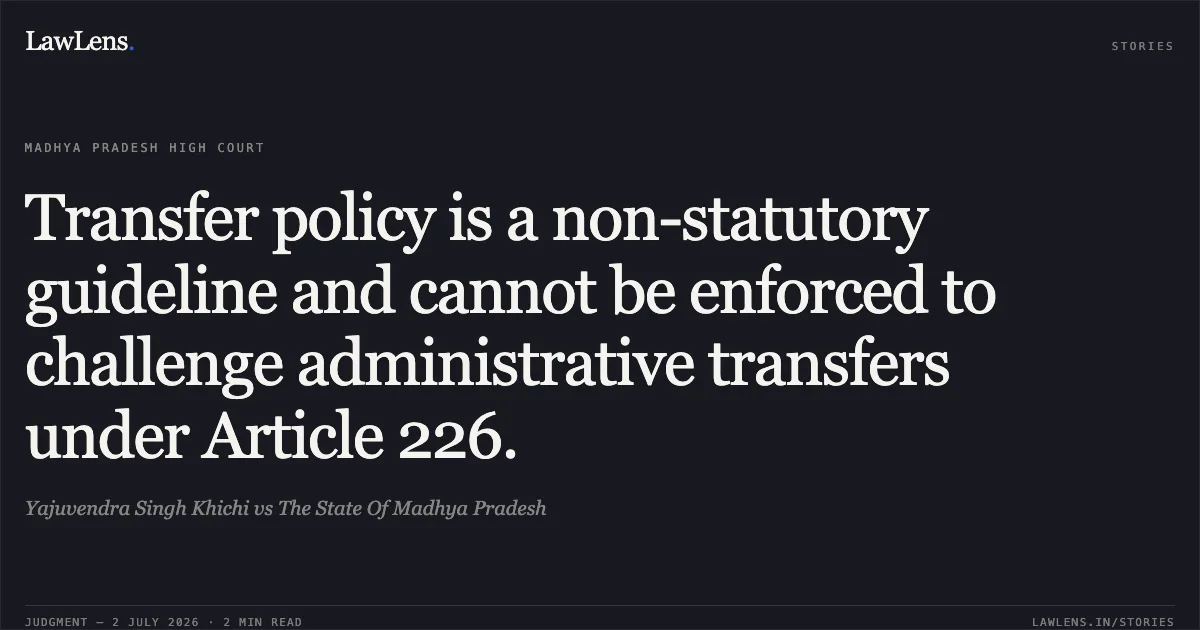
The petitioner, an Additional District Public Prosecutor, challenged a transfer order dated June 15, 2026, which moved him from Shujalpur to Mandsaur.
Source reference: para. 3The petitioner argued that the transfer was frequent, occurring within one year of a previous posting, and violated the state's transfer policy which suggests a three-year tenure at one station.
Source reference: para. 3He further claimed the order lacked specific reasoning and contradicted established judicial precedents regarding employee efficiency.
Source reference: para. 3The respondents maintained that the transfer was necessitated by administrative exigencies and that transfer is an inherent condition of service.
Source reference: para. 4Issues
1. Whether a transfer order can be quashed solely on the ground that it violates executive transfer policy guidelines regarding tenure and frequency.
Source reference: para. 3 / para. 82. Whether the court can exercise judicial review over a transfer order issued on the grounds of administrative exigency in the absence of proven malafides.
Source reference: para. 7 / para. 8Law Applied
Article 226 of the Constitution of India regarding the limited scope of judicial review in administrative matters.
Source reference: para. 1The principle that transfer is an incident of service, as established in Nepal Singh Dodia v. State of Madhya Pradesh.
Source reference: para. 6Transfer policies are executive instructions without statutory force as clarified in Tarachand Nayak v. State of Madhya Pradesh.
Source reference: para. 7Courts should not act as appellate authorities over administrative transfers unless the order is vitiated by malafides or violates mandatory statutory rules, as affirmed in Union of India v. S.L. Abbas and State of M.P. v. S.S. Kourav.
Source reference: para. 7Reasoning
The court reasoned that while the petitioner cited a violation of the three-year tenure policy, such guidelines are meant for administrative guidance and do not confer a justiciable right upon the employee.
Source reference: para. 7The court observed that the impugned order explicitly cited "administrative exigency," a factor that outweighs personal inconvenience or policy preferences.
Source reference: para. 8The court emphasized that the proper remedy for policy violations is a representation to the executive authorities rather than litigation, drawing from R.S. Chaudhary v. State of M.P.
Source reference: para. 7The court concluded that interfering with such transfers based merely on policy clauses would hamper effective governance and create administrative hardship.
Source reference: para. 8Holding
The court answered both issues in the negative, holding that transfer is an integral part of service and that policy guidelines do not prohibit the employer's inherent right to transfer for administrative reasons.
The court found no grounds for interference under Article 226 as there was no evidence of malice or statutory breach, and consequently, the Writ Petition was dismissed.
Source reference: para. 8 / para. 9Acts & Sections Cited
1 provisions across 1 statute referred to in this judgment. Linked provisions open on LawLens.
the policy (alias, unresolved)1
Original Court PDF
Yajuvendra Singh KhichivsThe State Of Madhya Pradesh
Click to open original judgment
Original judgment, available to read, download and summarize on LawLens.in