Facts
The respondents were retired employees of Tamil Nadu State Transport Corporations, which are companies registered under the Companies Act.
Source reference: pp. 9–11, 25They were covered by the Tamil Nadu State Transport Corporation Employees’ Pension Fund Rules, a scheme distinct from the Tamil Nadu Pension Rules governing State Government employees
Source reference: pp. 9–11, 25By G.O.Ms.No.142 dated 26 September 2019, the Government extended pension revision linked to the Seventh Pay Commission to Transport Corporation pensioners who retired between 1 January 2016 and 31 March 2018, with notional effect from 1 January 2016 and prospective monetary benefits.
Source reference: pp. 13, 18Pensioners who retired before 1 January 2016 sought the same revision and related benefits.
Source reference: pp. 8, 14–16, 26The Single Judge allowed their writ petitions, holding, in substance, that pensioners formed a homogeneous class and the cut-off date was impermissible.
Source reference: pp. 8, 14–16, 26The State and Transport Corporations appealed; a connected writ petition was also before the Division Bench
Source reference: pp. 8, 14–16, 26Issues
1. Whether pensioners of State Transport Corporations, governed by a separate pension scheme, could claim parity with State Government pensioners governed by different rules
Source reference: pp. 25–262. Whether the cut-off date of 1 January 2016 for extending the pension revision to Transport Corporation pensioners was arbitrary or discriminatory under Article 14
Source reference: pp. 22–263. Whether the Single Judge was justified in directing extension of the benefits to Transport Corporation pensioners who retired before the cut-off date
Source reference: pp. 18–19, 26Law Applied
The Court applied the Tamil Nadu State Transport Corporation Employees’ Pension Fund Rules, including Rule 2(w), which defines pensionary benefits under that scheme and distinguishes them from Government employees’ retirement benefits.
Source reference: pp. 9, 18It held that a Government-owned company remains distinct from the Government and that its employees do not, merely by reason of Government ownership, become Government servants or acquire a right to Government service benefits.
Source reference: pp. 11, 25Under Article 14, a cut-off date for extending financial benefits may be valid where it has a rational basis, including the Government’s financial considerations; courts ordinarily do not interfere with such policy decisions absent arbitrariness or a similar defect.
Source reference: pp. 20–24D.S. Nakara v. Union of India does not establish that all pensioners across distinct schemes or employer categories must be treated as one homogeneous class; its application is limited by later decisions, including Himachal Road Transport Corporation v. HRTC Retired Employees Union and State of Punjab v. Amar Nath Goyal.
Source reference: pp. 23–24The Court also relied on Chairman and MD, Kerala SRTC v. K.O. Varghese concerning the relevance of a corporation’s financial position when deciding whether to implement enhanced pension benefits.
Source reference: p. 22Reasoning
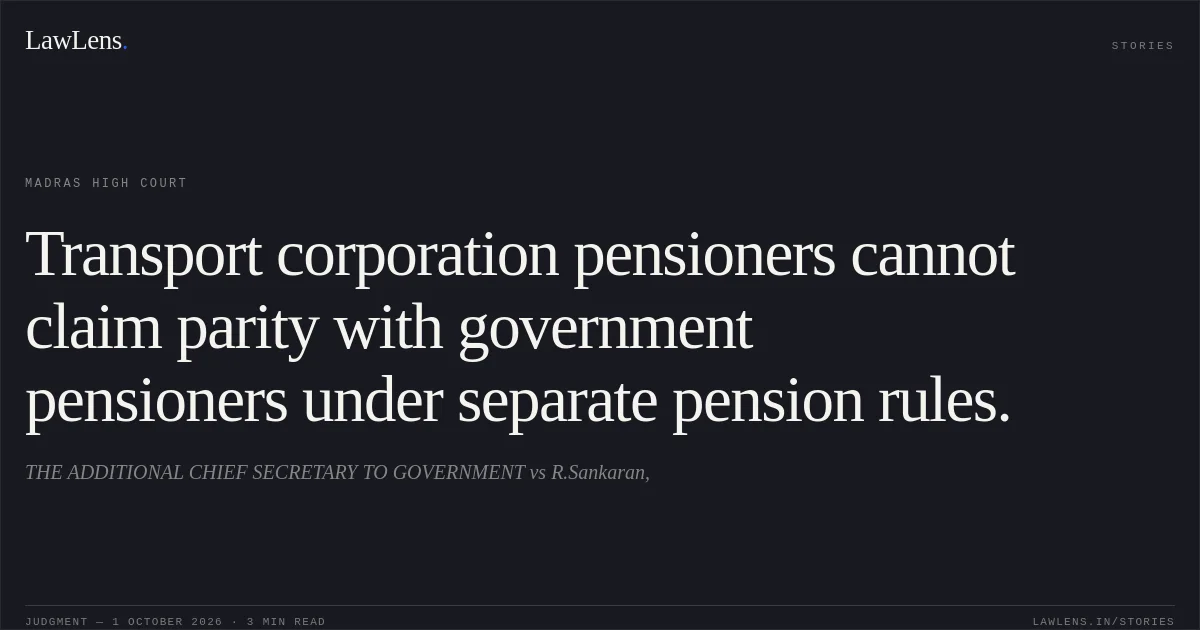
The Court found that the respondents were governed by the Transport Corporation Pension Fund Rules, not the Tamil Nadu Pension Rules, and therefore could not claim automatic parity with State Government pensioners.
Source reference: pp. 18, 25–26G.O.Ms.No.142 was a separate administrative and policy decision, limited to Transport Corporation employees retiring within the specified period; that order had not been challenged.
Source reference: p. 18Extending it to all earlier retirees would impose a substantial financial burden—stated to be approximately ₹1,300 crores—on the Pension Fund Trust.
Source reference: p. 19The Court held that financial implications could legitimately inform the cut-off date and that the Single Judge’s reliance on Nakara to treat pensioners as one homogeneous class overlooked the distinct governing schemes and the limits recognised in subsequent Supreme Court decisions.
Source reference: pp. 20–25Holding
The Division Bench allowed the State’s and Transport Corporations’ writ appeals, set aside the common order dated 22 April 2022, and dismissed W.P. No. 12751 of 2021.
It upheld the distinction between Government pensioners and Transport Corporation pensioners and declined to extend the benefits of G.O.Ms.No.142 to Transport Corporation pensioners who retired before 1 January 2016.
Source reference: p. 26No costs were ordered.
Source reference: p. 26Acts & Sections Cited
2 provisions across 1 statute referred to in this judgment. Linked provisions open on LawLens.
Companies Act, 19562
Original Court PDF
THE ADDITIONAL CHIEF SECRETARY TO GOVERNMENTvsR.Sankaran,
Click to open original judgment
Original judgment, available to read, download and summarize on LawLens.in