Facts
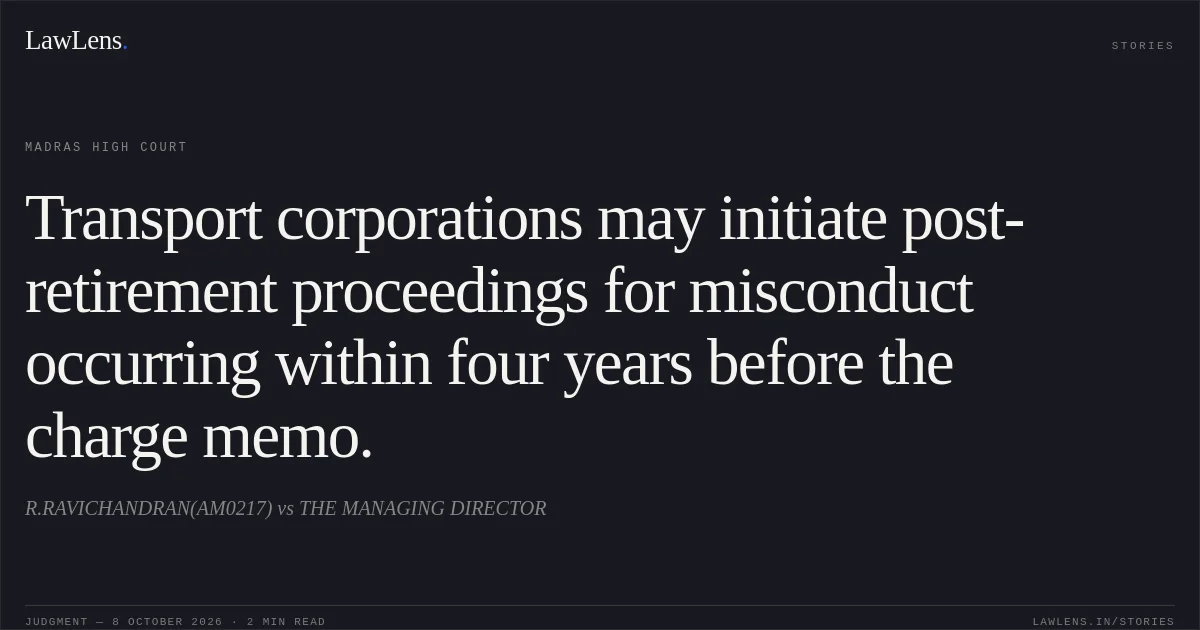
The petitioner retired as Deputy Manager on 31 May 2025. On 22 September 2025, the respondent Corporation issued him a charge memo alleging that he had secured promotion to that post by misrepresentation on 23 October 2024.
Source reference: p. 1–3He challenged the memo, arguing that the Corporation lacked authority to initiate disciplinary proceedings after his retirement. The Court had earlier granted an interim stay; the Corporation relied on Rule 19(c) of the Tamil Nadu State Transport Corporation Employee Pension Fund Trust Rules, inserted by G.O. (Ms) No. 257 dated 29 August 2017, to assert authority to proceed after retirement.
Source reference: p. 1–3The enquiry had concluded ex parte, but no final order had been passed while the interim stay was in force.
Source reference: p. 7Issues
Whether the respondent Corporation had authority to initiate disciplinary proceedings against the petitioner after his retirement under Rule 19(c) of the Pension Fund Rules read with Rule 9 of the Tamil Nadu Pension Rules, 1978.
Source reference: p. 3–4, 6Whether the charge memo was outside the temporal limit the Court applied under Rule 9.
Source reference: p. 4–6Law Applied
Rule 9 of the Tamil Nadu Pension Rules, 1978 reserves the Government’s right to withhold or withdraw pension, or recover pecuniary loss, where a pensioner is found guilty of grave misconduct or negligence in departmental or judicial proceedings.
Source reference: p. 5Rule 19(c) of the Tamil Nadu State Transport Corporation Employee Pension Fund Trust Rules applies Rule 9 to retired Corporation employees and identifies the competent authority for pension-related action; withholding or withdrawal of pension requires prior Government approval.
Source reference: p. 5–6The Court construed these provisions as permitting disciplinary proceedings after retirement where the alleged misconduct falls within four years of the charge memo.
Source reference: p. 4, 6It distinguished State Bank of India v. Naveen Kumar, Civil Appeal No. 1279 of 2024, because the rules considered there permitted continuation, but not initiation, of proceedings after retirement.
Source reference: p. 5Reasoning
The Court held that Rule 19(c), read with Rule 9, displaced the petitioner’s contention that retirement and the end of the employer–employee relationship barred initiation of proceedings.
Source reference: p. 4–6The alleged misrepresentation occurred on 23 October 2024, and the charge memo was issued on 22 September 2025—within the four-year period applied by the Court—so the memo was within the Corporation’s authority.
Source reference: p. 4–6The Court declined to assess whether the promotion allegation was well-founded, leaving that issue to the Disciplinary Authority.
Source reference: p. 3–4, 6Given that the earlier enquiry had concluded ex parte, the Court directed a de novo enquiry with an opportunity for the petitioner to participate.
Source reference: p. 7Holding
The Court found no jurisdictional error in issuing the charge memo and dismissed the writ petition, without deciding the merits of the charges.
It directed the Corporation to conduct a de novo enquiry, afford the petitioner an opportunity to participate, and conclude the proceedings within three months of receiving the order; the petitioner was directed to cooperate.
Source reference: p. 6–7The interim stay was dissolved, and there was no order as to costs.
Source reference: p. 6–7Original Court PDF
R.RAVICHANDRAN(AM0217)vsTHE MANAGING DIRECTOR
Click to open original judgment
Original judgment, available to read, download and summarize on LawLens.in