Facts
The appellant (deceased employee), a driver with the Delhi Transport Corporation (DTC) since 1982, was issued a charge sheet on August 20, 1987, for remaining absent from duty for 161 days without authorized leave
Source reference: p. 2Following a departmental inquiry, he was removed from service. The deceased raised an industrial dispute; the Labour Court, vide award dated April 8, 2010, set aside the termination and ordered reinstatement, holding that the inquiry was conducted in haste and the absence was due to illness
Source reference: p. 3The DTC challenged this award via a writ petition. The learned Single Judge set aside the Labour Court's award on May 3, 2013, holding the inquiry valid and the absence unauthorized
Source reference: p. 3-4The legal heirs of Dilbagh Singh filed this intra-court appeal challenging the Single Judge's order.
Source reference: no citationIssues
1. Whether the departmental inquiry was vitiated by a breach of natural justice or conducted in undue haste
Source reference: p. 5 / para. 92. Whether "leave without pay" for 161 days constitutes "authorized leave" or "habitual negligence/unauthorized absence" under the Standing Orders
Source reference: p. 8-9 / para. 19-203. Whether the Labour Court was justified in exercising its jurisdiction to order reinstatement based on medical grounds despite lack of proven evidence
Source reference: p. 10 / para. 26Law Applied
Paragraphs 4(ii) and 19(h) of the DTC Standing Orders, which define "habitual absence without permission" and "habitual negligence of duties" as misconduct
Source reference: p. 8-9Supreme Court precedent in DTC v. Sardar Singh (AIR 2004 SC 4161), which established that the burden of proving authorized leave lies on the employee and that mere submission of an application does not constitute sanctioned leave
Source reference: p. 10Industrial tribunals should not exercise "misplaced sympathy" to protect habitually indifferent employees, as such actions breed inefficiency
Source reference: p. 10-11, para. 26Reasoning
The Court observed that the deceased employee was offered a defence assistant and an opportunity to cross-examine management witnesses but declined both, thereby nullifying the claim of a hurried or biased inquiry
Source reference: p. 5-6, para. 10; p. 13, para. 20Regarding the merits of the absence, the Court noted that under Standing Order 4, an employee must obtain prior permission or provide immediate intimation with a medical certificate for sudden illness; the appellant failed to produce any evidence of such applications in the inquiry
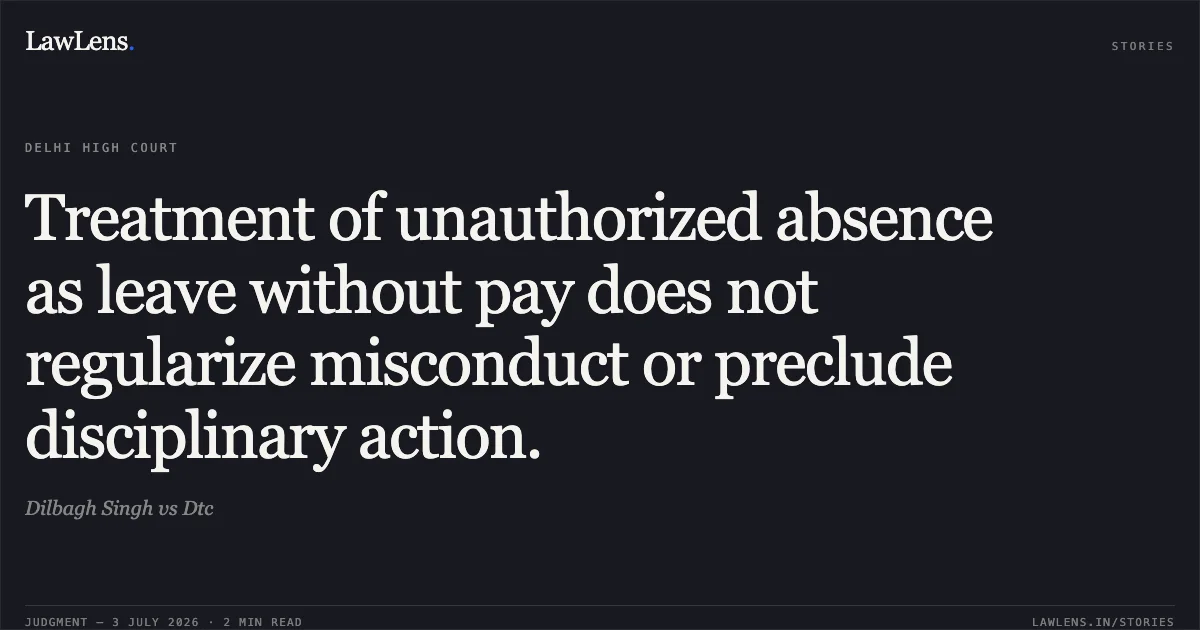
Source reference: p. 7, para. 16-17The Court rejected the argument that "leave without pay" (LWP) equates to "sanctioned leave," clarifying that LWP is a method of recording unauthorized absence for payroll purposes and does not regularize misconduct
Source reference: p. 9, para. 20Furthermore, the appellant’s past record showed two prior penalties for excessive leave, establishing him as a "habitual absentee"
Source reference: p. 8, para. 18; p. 15, para. 27Holding
The Court answered the issues in the negative, finding no merit in the appeal.
It held that the Labour Court's findings were perverse as the employee failed to satisfy the burden of proof regarding sanctioned leave
Source reference: p. 15, para. 25The Court upheld the Single Judge’s decision, ruling that the inquiry followed the principles of natural justice and the termination was justified given the habitual nature of the absence. The appeal was dismissed.
Source reference: p. 15-16, para. 27; p. 16, para. 28Acts & Sections Cited
2 provisions across 2 statutes referred to in this judgment. Linked provisions open on LawLens.
Industrial Disputes Act, 19471
Delhi Road Transport Laws (Administration) Act, 19501
Original Court PDF
Dilbagh SinghvsDtc
Click to open original judgment
Original judgment, available to read, download and summarize on LawLens.in


![Subsequent exoneration does not retrospectively invalidate a finalized promotion select list.. UNNIKRISHNAN M vs M/o Environment And Forests. CAT - ['Ernakulam']. LawLens](/stories/thumbnails/subsequent-exoneration-does-not-retrospectively-invalidate-a-finalized-promotion-select-li-ce80a0e84f2f4887857271e8b4341c42.webp)