Facts
The petitioner challenged an order dated 04.06.2026 passed by the Additional Sessions Judge, Bhanpura in S.T. No. 11/2024.
Source reference: para. 2The trial court had allowed a prosecution application under Section 348 of the Bharatiya Nagarik Suraksha Sanhita (BNSS), 2023 [formerly Section 311 CrPC], to recall the father of the prosecutrix and introduce additional electronic evidence (video clips, chats, and mobile data).
Source reference: para. 2The petitioner contended that the application was filed at a belated stage after the conclusion of prosecution evidence and recording of the accused's statement.
Source reference: para. 3He further alleged that the electronic evidence was available prior to the FIR and that the application was a "malafide counterblast" to a pending recovery dispute under Section 138 of the NI Act.
Source reference: para. 3-4Issues
1. Whether the trial court’s discretionary power to recall witnesses and admit additional evidence under Section 348 BNSS is limited by the advanced stage of the trial.
Source reference: para. 4, 82. Whether the impugned order allowing the recall of a witness and admission of electronic evidence constituted a patent illegality or an improper attempt to fill lacunae in the prosecution's case.
Source reference: para. 3, 9Law Applied
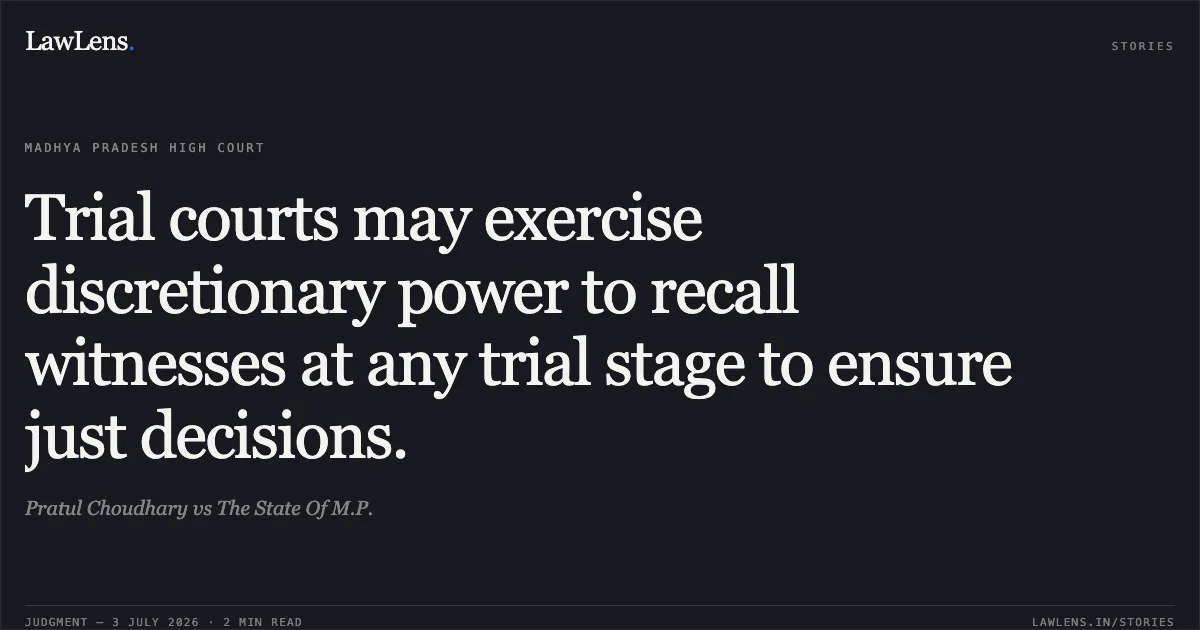
Section 348 of the Bharatiya Nagarik Suraksha Sanhita (BNSS), 2023, which is pari materia with Section 311 of the CrPC, grants courts broad discretionary power to summon or recall witnesses "at any stage" if their evidence is essential to a "just decision of the case".
Source reference: para. 2, 4, 5, 8The court relied on V.N. Patil v. K. Niranjan Kumar (2021) to establish that the determinative factor is the necessity of evidence for justice.
Source reference: para. 5The court cited Vijay Kumar v. State of U.P. (2011) and Swapan Kumar Chatterjee v. CBI (2019), which mandate that while the power is wide, it must be exercised judicially, with caution, and not to permit the abuse of process.
Source reference: para. 5-6Reasoning
The court reasoned that the statutory phrase "at any stage" explicitly allows the trial court to exercise its jurisdiction even when a matter is fixed for final arguments.
Source reference: para. 8It found that procedural lapses, delays, or prosecution oversight do not serve as an absolute embargo if the evidence is "essential" to unearthing the truth.
Source reference: para. 8The High Court observed that the trial judge had recorded subjective satisfaction that the evidence was imperative to prevent a miscarriage of justice.
Source reference: para. 9The court dismissed the petitioner's claim of prejudice, noting that the admission of evidence does not equate to a finding of guilt, provided the accused is given a fair opportunity to rebut it.
Source reference: para. 9-10Holding
The court held that there was no perversity or material irregularity in allowing the recall of the witness.
The High Court dismissed the Criminal Revision and the application for stay (I.A. No. 8412/2026), affirming the trial court's order, and directed that the petitioner must be granted a "proper, adequate, and unfettered opportunity" to cross-examine the recalled witness and rebut the newly admitted electronic evidence.
Source reference: para. 10Acts & Sections Cited
9 provisions across 5 statutes referred to in this judgment. Each provision opens on LawLens.
Indian Penal Code, 18601
Protection of Children from Sexual Offences Act, 20124
Bharatiya Nagarik Suraksha Sanhita, 20231
Code of Criminal Procedure, 19732
Negotiable Instruments Act, 18811
Original Court PDF
Pratul ChoudharyvsThe State Of M.P.
Click to open original judgment
Original judgment, available to read, download and summarize on LawLens.in


![Subsequent exoneration does not retrospectively invalidate a finalized promotion select list.. UNNIKRISHNAN M vs M/o Environment And Forests. CAT - ['Ernakulam']. LawLens](/stories/thumbnails/subsequent-exoneration-does-not-retrospectively-invalidate-a-finalized-promotion-select-li-ce80a0e84f2f4887857271e8b4341c42.webp)