Facts
The Appellant/Plaintiff, a construction firm, filed a civil suit for the recovery of Rs. 11,00,000/- with interest for work completed under a 2008 work order
Source reference: para 2.1The Respondent/Defendant filed a written statement followed by an application under Order 7 Rule 11 of the CPC read with Section 8 of the Arbitration and Conciliation Act, 1996 ("the Act"), citing Clause 15 of the agreement which mandated dispute resolution through arbitration
Source reference: para 2.2The Trial Court (4th Additional District Judge, Raipur) allowed the application and rejected the plaint on 09.08.2017, holding that the dispute must be settled through arbitration
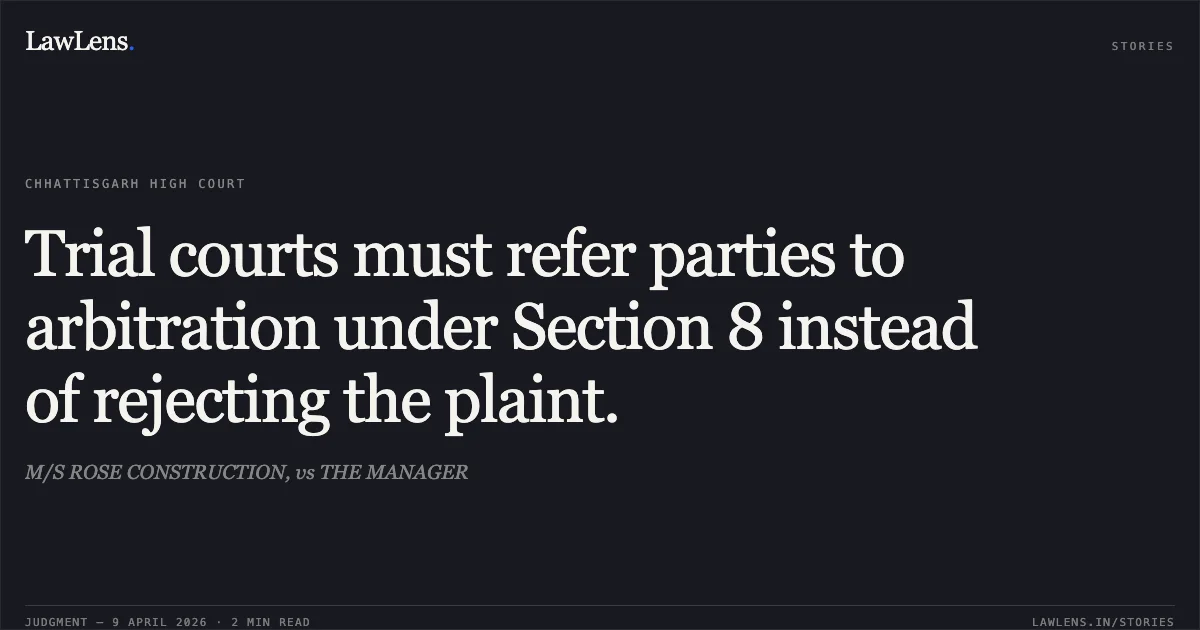
Source reference: para 2.4The Appellant challenged this, arguing that the Trial Court should have referred the parties to arbitration rather than dismissing/rejecting the suit entirely
Source reference: para 3Issues
1. Whether the Trial Court committed a legal error by rejecting the plaint under Order 7 Rule 11 CPC instead of referring the parties to arbitration under Section 8(1) of the Act?
Source reference: para 102. Whether the judicial authority’s power under Section 8(1) of the Act to refer parties to arbitration includes the jurisdiction to appoint an arbitrator?
Source reference: para 10Law Applied
Section 8(1) of the Arbitration and Conciliation Act, 1996, which mandates that a judicial authority refer parties to arbitration if the dispute is subject to an arbitration agreement
Source reference: para 6Atul Singh v. Sunil Kumar Singh, emphasizing the necessity of a valid agreement for Section 8 to apply
Source reference: para 7Rashtriya Ispat Nigam Ltd. v. Verma Transport Company, which clarified that a party must not have waived their right to arbitrate
Source reference: para 7P. Anand Gajapathi Raju v. P.V.G. Raju (Dead) to establish that the language of Section 8 is peremptory, making it obligatory for the Court to refer parties to arbitration once the requirements are met
Source reference: para 8Reasoning
The Court observed that Clause 15 of the work order constituted a valid arbitration agreement
Source reference: para 9-10While the Respondent had properly invoked the arbitration clause, the Court found the Trial Court’s procedure flawed. Under Section 8(1) of the Act, once a valid arbitration agreement is identified, the Court’s mandate is to "refer the parties to arbitration," not to reject the plaint under Order 7 Rule 11 CPC
Source reference: para 10The High Court characterized the straightway rejection of the plaint as a "grave legal error," reasoning that the power to refer parties to arbitration inherently includes the jurisdiction to facilitate the process by appointing an arbitrator
Source reference: para 10Holding
The High Court partly set aside the impugned judgment and decree, holding that the suit should have been referred to arbitration rather than being rejected
Exercising powers under Section 8(1) of the Act and with the consent of the parties, the Court appointed Hon’ble Shri Justice Deepak Tiwari (Retired) as the sole arbitrator to resolve the dispute. The appeal was allowed to this extent, and the Registry was directed to communicate the order to the appointed arbitrator
Source reference: para 11-12Acts & Sections Cited
4 provisions across 2 statutes referred to in this judgment. Each provision opens on LawLens.
Code of Civil Procedure, 19082
Arbitration and Conciliation Act, 19962
Original Court PDF
M/S ROSE CONSTRUCTION,vsTHE MANAGER
Click to open original judgment
Original judgment, available to read, download and summarize on LawLens.in