Facts
On the prosecution’s case, a quarrel occurred on 19 November 2011 between deceased Umraj/Umrao Gond and Shivnath and his son, the appellant Pratap Singh. During the altercation, the appellant and Shivnath allegedly assaulted the deceased with bamboo sticks, resulting in his death. The appellant was initially charged under Sections 302/34 IPC. The trial court acquitted Shivnath but convicted the appellant under Section 304 Part I IPC and sentenced him to five years’ rigorous imprisonment with a fine of ₹1,00,000, with three months’ additional imprisonment in default of payment
Source reference: paras. 1–5The prosecution examined eight witnesses. The principal witness, Surajwati Gond (PW-1), gave inconsistent evidence regarding whether she had witnessed the assault; several other witnesses turned hostile, the seizure witnesses did not support the alleged recovery, and the medical evidence did not establish injuries caused by the seized lathi. The appellant challenged the conviction, particularly contending that the trial court had improperly relied on answers elicited through its questioning under Section 165 of the Indian Evidence Act, 1872
Source reference: paras. 6–10, 15–21Issues
Whether the appellant’s conviction under Section 304 Part I IPC was sustainable on the prosecution evidence, including the testimony of PW-1, the alleged recovery of the lathis, and the medical evidence
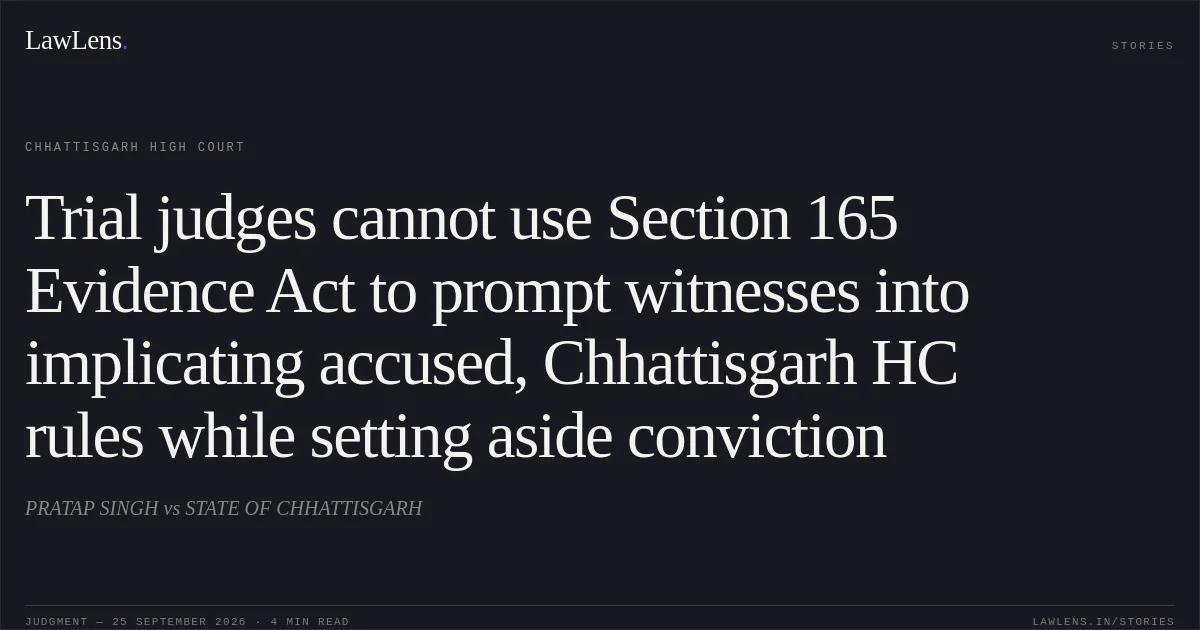
Source reference: para. 13; paras. 15–22Whether the trial court exceeded the permissible scope of Section 165 of the Indian Evidence Act, 1872 by putting questions that elicited the appellant’s alleged role in the assault and thereby filled gaps in the prosecution case
Source reference: paras. 22–28Whether the appellant could be convicted when the co-accused, allegedly implicated on substantially the same evidence and assigned a similar role, had been acquitted
Source reference: paras. 29–30Law Applied
Section 304 Part I IPC applies where the prosecution proves culpable homicide not amounting to murder, committed with the intention of causing death or such bodily injury as is likely to cause death. Under Section 165 of the Indian Evidence Act, 1872, a judge has wide power to ask questions and seek clarification to discover relevant facts and ensure a just decision; however, that power cannot be exercised so as to assume the role of the prosecutor, intimidate or confuse a witness, suggest material answers, introduce essential facts absent from the testimony, or repair deficiencies in the prosecution case
Source reference: paras. 22–28The Court relied on Ram Chander v. State of Haryana, 1981 (3) SCC 191, which requires judicial questioning to remain impartial and not descend into the arena; State of Rajasthan v. Ani, (1997) 6 SCC 162, which cautions that judicial intervention must not fill lacunae in the prosecution case; and Jamatraj Kewalji Govani v. State of Maharashtra, 1967 SCC OnLine SC 19, which recognises the court’s power to obtain evidence necessary for a just decision
Source reference: paras. 24–27It also applied the parity principle stated in Javed Shaukat Ali Qureshi v. State of Gujarat, (2023) 9 SCC 164: where identical or substantially similar evidence attributes the same or similar role to co-accused, the court should not convict one while acquitting the other without a legally sustainable distinction
Source reference: para. 29Reasoning
The High Court held that the prosecution had not produced reliable, independent evidence proving the appellant’s participation in the assault beyond reasonable doubt. PW-1’s evidence was internally inconsistent: although she stated in examination-in-chief that she heard the lathi blows and later saw the deceased lying on the ground, the record also showed that she was inside the house when the assault began and did not clearly establish which accused inflicted the fatal injuries
Source reference: paras. 15–16, 22, 24The other material witnesses either turned hostile or failed to support the alleged recovery, while the investigating officer’s assertion that the appellant had assaulted the deceased three or four times was not sufficient by itself to establish guilt
Source reference: paras. 17–20The medical evidence did not match any injury with a lathi, and no human blood was found on the seized articles
Source reference: para. 21The trial court’s questioning under Section 165 elicited an affirmative assertion that Pratap had struck the deceased on the neck, but that assertion was not supported by the witness’s consistent prior testimony or by other evidence. The High Court found that the questioning effectively supplied a material link missing from the prosecution case and therefore could not lawfully sustain the conviction. Further, Shivnath had been acquitted on the same evidentiary foundation, and the prosecution failed to demonstrate a principled distinction justifying the appellant’s conviction alone
Source reference: paras. 22–30Holding
The High Court answered the principal issue in favour of the appellant and held that the conviction under Section 304 Part I IPC was legally unsustainable
The appeal was allowed; the judgment of conviction and sentence dated 28 September 2011 was set aside; and the appellant was acquitted by extending the benefit of reasonable doubt. As the appellant was already on bail, his bail bonds were directed to continue under Section 481 of the Bharatiya Nagarik Suraksha Sanhita
Source reference: Order, clauses (i)–(iv)Acts & Sections Cited
6 provisions across 3 statutes referred to in this judgment. Each provision opens on LawLens.
Code of Criminal Procedure, 19732
Indian Penal Code, 18603
Bharatiya Nagarik Suraksha Sanhita, 20231
Original Court PDF
PRATAP SINGHvsSTATE OF CHHATTISGARH
Click to open original judgment
Original judgment, available to read, download and summarize on LawLens.in