01Facts
On 17.05.2004, the claimant, a salesman, was injured in an accident caused by the rash and negligent driving of a vehicle insured with the second respondent, the National Insurance Co. Ltd. He sustained multiple injuries, including serious leg injuries, and could no longer perform his work as before.
¶ 3He claimed Rs.3,00,000 in M.C.O.P. No. 54 of 2005. The Insurance Company disputed the manner of accident, the involvement of the vehicle, the driver's negligence, and the quantum claimed.
¶ 4The claimant examined himself (P.W.1), a doctor (P.W.2) and another witness (P.W.3), and Exs. P1–P18 were marked.
¶ 5By award dated 05.01.2009, the Tribunal (Sub Court, Sivagangai) awarded Rs.75,000 with 7.5% interest from the date of petition.
¶ 5The Tribunal awarded Rs.30,000 for permanent disability (assessed at 15%), Rs.25,000 for medical expenses, and Rs.10,000 for pain and suffering.
¶ 6 · ¶ 7 · ¶ 11 · ¶ 13 · ¶ 14The claimant filed this appeal for enhancement. He died during pendency, and his legal representatives (appellants 2–7) were brought on record by order dated 01.07.2014.
The Insurance Company contended that the Tribunal rightly assessed disability at 15% because the claimant continued in employment, and that the medical bills, which totalled Rs.34,000, were rightly reduced.
¶ 802Issues
i.1. Whether the claimant is entitled to enhancement of compensation for the permanent disability suffered by him in the accident.
¶ 1003Law Applied
The statutory basis for the appeal is Section 173 of the Motor Vehicles Act, 1988.
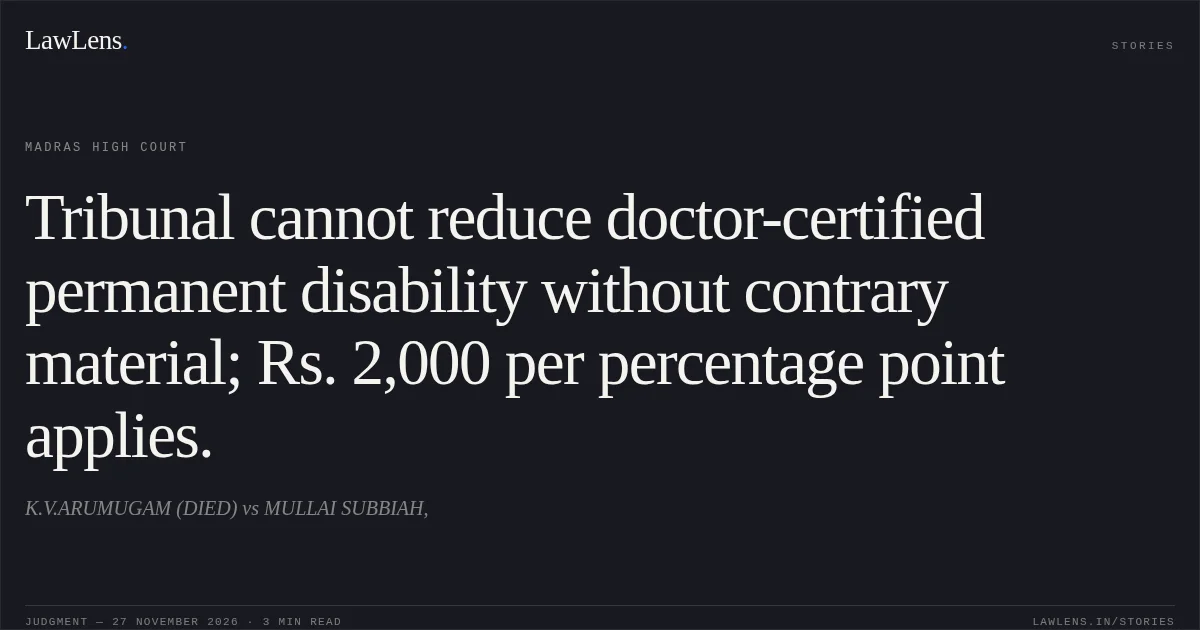
p. 1Compensation for permanent disability is computed at Rs.2,000 per percentage of disability, which the court stated it "has consistently adopted... in appropriate cases".
¶ 12A Tribunal's finding of disability may be disturbed only where there is "no convincing material on record to disbelieve" a medical assessment, and a reduction in assessed disability requires material support.
¶ 11An award below proven, unrebutted medical expenditure requires proper reasons, and the absence of a specific objection to bills at the time of marking weighs against their reduction.
¶ 13Pain and suffering awards must reflect the nature of injuries, operations and treatment period.
¶ 14Provisions in the judgment · 1 · Linked ones open on LawLens
Motor Vehicles Act, 1988 Section 173
04Reasoning
The court found that the evidence of P.W.1, P.W.2 and the medical records (Exs. P3, P11, P12, P17) established serious injuries and a 45% permanent disability certified by Ex. P17 and the doctor.
¶ 11The Tribunal's reduction to 15% was made "without any material," and the Insurance Company's reliance on continued employment was not accepted as a basis for disbelieving the medical assessment.
¶ 8 · ¶ 11Applying Rs.2,000 per percentage, 45% yielded Rs.90,000; after deducting the Rs.30,000 already awarded, the court granted Rs.60,000 more.
¶ 12The Tribunal gave no reason for disallowing Rs.9,000 of the Rs.34,000 proven bills, and the insurer had raised no specific objection at marking, so the award was raised to Rs.34,000.
¶ 13Given the surgeries and the treatment period, the Rs.10,000 award for pain and suffering was held inadequate and raised to Rs.20,000.
¶ 14The enhancement therefore totals Rs.79,000, taking the award from Rs.75,000 to Rs.1,54,000.
¶ 1505Holding
The court answered the sole issue in the affirmative: the claimant was entitled to permanent disability assessed at 45%, not 15%.
¶ 11The appeal is partly allowed. The award in M.C.O.P. No. 54 of 2005 is modified to Rs.1,54,000. The enhanced amount carries 7.5% interest from the date of the claim petition until deposit. The Insurance Company must deposit the enhanced amount with accrued interest within six weeks of receiving the order, and the appellant may then withdraw it under the usual procedure. No costs.
¶ 16.1 · ¶ 16.2 · ¶ 16.3 · ¶ 16.4Original Court PDF
K.V.ARUMUGAM (DIED)vsMULLAI SUBBIAH,
Click to open original judgment
Original judgment, available to read, download and summarize on LawLens.in