Facts
On February 28, 2005, the original claimant (Respondent No. 1) was traveling in a chhakda rickshaw with goods when the driver (Respondent No. 2) lost control due to excessive speed, causing the vehicle to overturn.
Source reference: p. 1-2The claimant sustained grievous injuries, including a spinal fracture.
Source reference: p. 2The Motor Accident Claims Tribunal, Panchmahals, awarded the claimant ₹7,95,000/- with 9% interest.
Source reference: p. 1The Appellant Insurance Company challenged the award on two primary grounds: first, that the compensation exceeded the amount specifically prayed for in the claim petition (₹4,00,000/-), and second, that the vehicle exceeded its seating capacity, thereby violating policy terms and absolving the insurer of liability.
Source reference: p. 3Issues
1. Whether the Tribunal is legally permitted to award compensation in excess of the amount claimed by the applicant in the claim petition.
Source reference: p. 4 / para. 72. Whether the Insurance Company can be held liable to satisfy the award in the absence of documentary evidence proving a breach of the vehicle’s seating capacity.
Source reference: p. 3, 5 / para. 8Law Applied
The court applied the cardinal principle of "just compensation" under the Motor Vehicles Act, which mandates that awards must be fair, reasonable, and equitable regardless of the specific prayer in the petition.
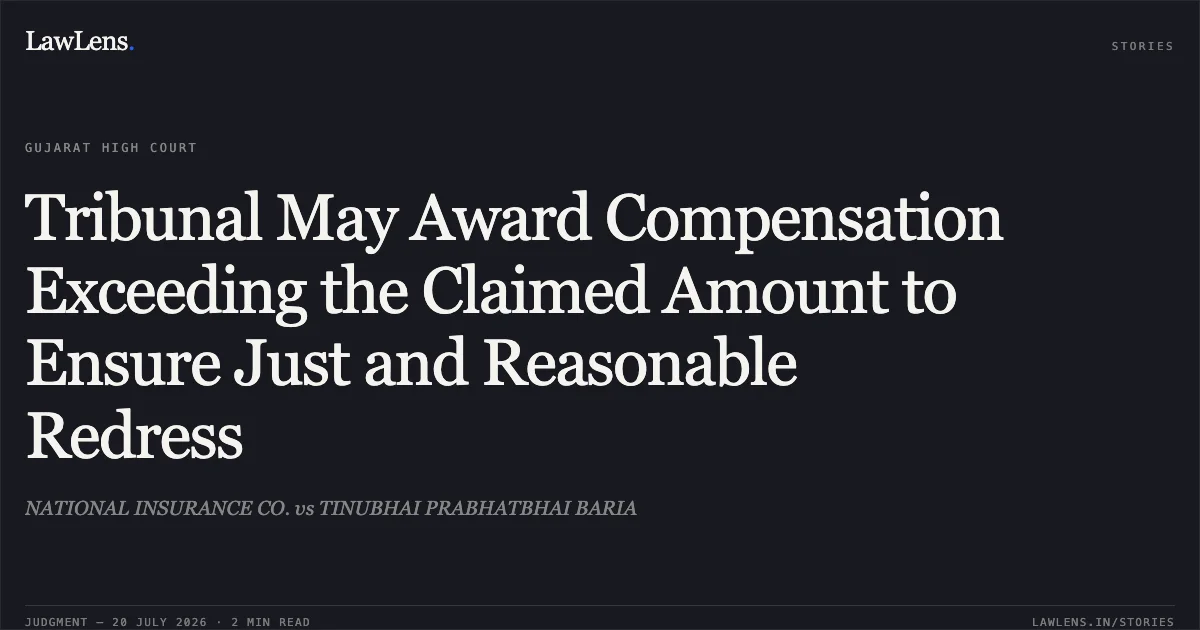
Source reference: p. 4The court specifically relied on the precedent established by the Hon’ble Supreme Court in Nagappa v. Gurudayal Singh and Ors. (2003) 2 SCC 274, which held that there is no restriction on a Tribunal/Court awarding an amount exceeding the claimed sum if such amount constitutes just compensation.
Source reference: p. 5the court applied the evidentiary principle that the burden of proof lies on the insurer to substantiate a defense regarding policy breach (e.g., seating capacity) through material evidence like the R.C. book.
Source reference: p. 5Reasoning
The court dismissed the Appellant's first contention by reasoning that the objective of the law is to provide "just" relief; hence, the Tribunal’s power is not fettered by the statutory claim figure if the evidence warrants a higher amount.
Source reference: p. 4-5Regarding the second contention of seating capacity, the court noted that while the Insurance Company argued the chhakdo rickshaw was only meant for one person (the driver), the Appellant failed to lead any oral or documentary evidence, such as the Registration Certificate (R.C. book), to prove this assertion before the Tribunal.
Source reference: p. 5Because the insurer failed to meet the burden of proof to substantiate its defense of policy violation, the liability remained fastened upon them.
Source reference: p. 5Holding
The High Court found no merit in the appeal and upheld the Tribunal’s judgment, holding that the award of ₹7,95,000/- was just and that the insurer failed to prove a breach of policy terms.
The appeal was dismissed, and the Tribunal was directed to disburse the entire awarded amount to the claimants forthwith after due verification and deduction of any deficit court fees.
Source reference: p. 5-6No order as to costs was made.
Source reference: p. 6Original Court PDF
NATIONAL INSURANCE CO.vsTINUBHAI PRABHATBHAI BARIA
Click to open original judgment
Original judgment, available to read, download and summarize on LawLens.in