Facts
The Appellant company was ordered by the Respondent on 12.01.2024 to pay ₹6,27,44,486/- as provident fund dues for 2018–2021 under Section 7A of the EPF Act.
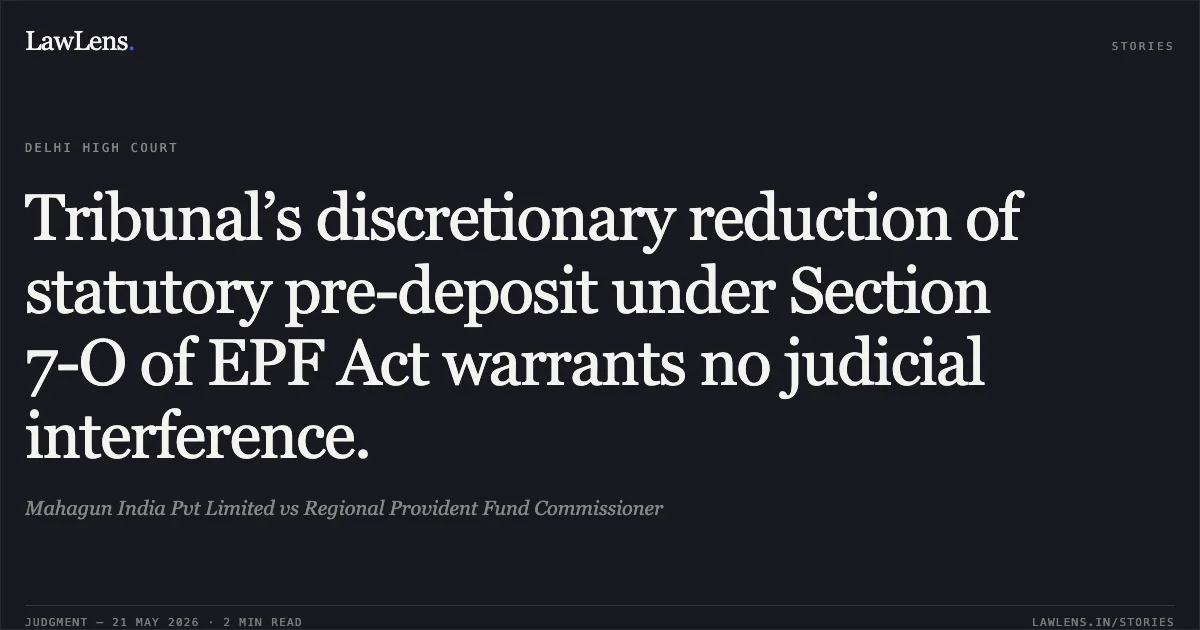
Source reference: p. 2The Appellant appealed the assessment before the Central Government Industrial Tribunal (CGIT) under Section 7-I and filed an application under Section 7-O for a total waiver of the mandatory 75% pre-deposit.
Source reference: p. 2On 01.12.2025, the Tribunal reduced the pre-deposit to 40% to be deposited via FDR.
Source reference: p. 3The Appellant challenged this order via a Writ Petition, alleging a 138-day delay in pronouncement and failure to consider that two Enforcement Officer reports were contradictory.
Source reference: p. 3The learned Single Judge dismissed the Writ Petition on 04.05.2026, holding that the Tribunal had already granted substantial relief.
Source reference: p. 4The Appellant subsequently moved this intra-court appeal (LPA).
Source reference: no citationIssues
1. Whether the delay in pronouncement of the order by the Tribunal and the failure to examine Enforcement Officers vitiated the order under Section 7-O.
Source reference: p. 5/6, para. 14-162. Whether the High Court should interfere with the discretionary exercise of power by a Tribunal in reducing pre-deposit amounts under Article 226/227.
Source reference: p. 7, para. 24Law Applied
Section 7-O of the Employees’ Provident Funds and Miscellaneous Provisions Act, 1952, which mandates a 75% pre-deposit for entertaining an appeal but grants the Tribunal discretion to reduce or waive it for reasons recorded in writing.
Source reference: p. 6, para. 19-20Order XX Rule 1 of the CCP regarding judgment pronouncement and the Supreme Court precedent Anil Rai v. State of Bihar (2001), which provides guidelines on timely judicial decisions.
Source reference: p. 5, para. 14-16Principle of limited judicial review over discretionary interlocutory orders under Articles 226 and 227 of the Constitution of India.
Source reference: p. 7, para. 24Reasoning
The Court reasoned that Section 7-O grants the Tribunal broad discretion to determine the quantum of pre-deposit based on the facts of each case.
Source reference: p. 7, para. 24The Tribunal had specifically recorded reasons for the reduction—namely the non-identifiability of beneficiaries—and granted substantial relief by lowering the deposit from 75% to 40%.
Source reference: p. 6, para. 21Regarding the 138-day delay and procedural infirmities (non-examination of officers), the Court held these are merits-based arguments meant for the final hearing of the appeal, not for the adjudication of a pre-deposit waiver.
Source reference: p. 7, para. 22The Court found no perversity or manifest illegality in the Single Judge’s refusal to interfere with a discretionary order that already benefited the Appellant.
Source reference: p. 7, para. 23-24Holding
The Court answered that there was no infirmity in the Tribunal's exercise of discretion and that the observations in Anil Rai were inapplicable.
The Court held that since the main appeal before the Tribunal had already been dismissed on 29.04.2026 due to non-compliance with the 40% pre-deposit condition, the present LPA had become infructuous.
Source reference: p. 8, para. 25The appeal was dismissed, and the Impugned Order was affirmed.
Source reference: p. 8, para. 26Acts & Sections Cited
3 provisions across 1 statute referred to in this judgment. Linked provisions open on LawLens.
Employees’ Provident Funds And Miscellaneous Provisions Act, 19523
Original Court PDF
Mahagun India Pvt LimitedvsRegional Provident Fund Commissioner
Click to open original judgment
Original judgment, available to read, download and summarize on LawLens.in


![Subsequent exoneration does not retrospectively invalidate a finalized promotion select list.. UNNIKRISHNAN M vs M/o Environment And Forests. CAT - ['Ernakulam']. LawLens](/stories/thumbnails/subsequent-exoneration-does-not-retrospectively-invalidate-a-finalized-promotion-select-li-ce80a0e84f2f4887857271e8b4341c42.webp)