Facts
On 24 February 2018, a motorcycle carrying three persons collided head-on with a GSRTC bus near Babalpura bus stand.
Source reference: paras. 4, 9; pp. 3, 5The two pillion riders, Bhalabhai and Lalabhai, died; the motorcycle rider sustained injuries.
Source reference: paras. 4, 9; pp. 3, 5Their heirs filed claims under Section 166 of the Motor Vehicles Act, 1988.
Source reference: paras. 1, 4; pp. 1, 3The Tribunal attributed negligence to the bus driver and awarded ₹17,12,200 in MACP No. 793 of 2018 and ₹17,92,200 in MACP No. 792 of 2018, with interest at 9% per annum.
Source reference: paras. 1, 4; pp. 1, 3GSRTC appealed, arguing that the motorcycle rider’s negligence and the fact of triple riding warranted a reduction in compensation.
Source reference: para. 6; p. 4Issues
Whether negligence of the motorcycle driver could be imputed to the deceased pillion riders, or otherwise reduce their compensation, where the accident involved the bus and motorcycle.
Source reference: paras. 6–10; pp. 4–6Whether triple riding, without evidence of a causal connection to the accident or its impact, established contributory negligence warranting a deduction from compensation.
Source reference: paras. 6, 14; pp. 4, 12–13Law Applied
Under Section 166 of the Motor Vehicles Act, 1988, claimants are entitled to just compensation; Section 173 provides for an appeal against the Tribunal’s award.
Source reference: paras. 1–2; pp. 1–2In composite negligence, a claimant may recover the entire compensation from any joint tortfeasor, and apportionment between tortfeasors does not reduce the claimant’s recovery; the inter se allocation is relevant to recovery between tortfeasors (Khenyei v. New India Assurance Co. Ltd., (2015) 9 SCC 273, quoted at para. 11).
Source reference: para. 11; pp. 6–8A vehicle driver’s negligence is not imputed to a passenger (Union of India v. United India Insurance Co. Ltd., (1997) 8 SCC 683, discussed at paras. 11–13).
Source reference: paras. 11–13; pp. 8–11Triple riding, by itself, does not establish contributory negligence: there must be evidence of a causal connection between the violation and the accident or the injury’s impact (Mohammed Siddique v. National Insurance Co. Ltd., (2020) 3 SCC 57, quoted at para. 14).
Source reference: para. 14; pp. 12–13Reasoning
The deceased were pillion riders and were not themselves shown to have caused the collision. The Court treated the accident as one involving composite negligence and held that GSRTC could not reduce their compensation by attributing the motorcycle driver’s negligence to them; a passenger is not legally identified with the driver.
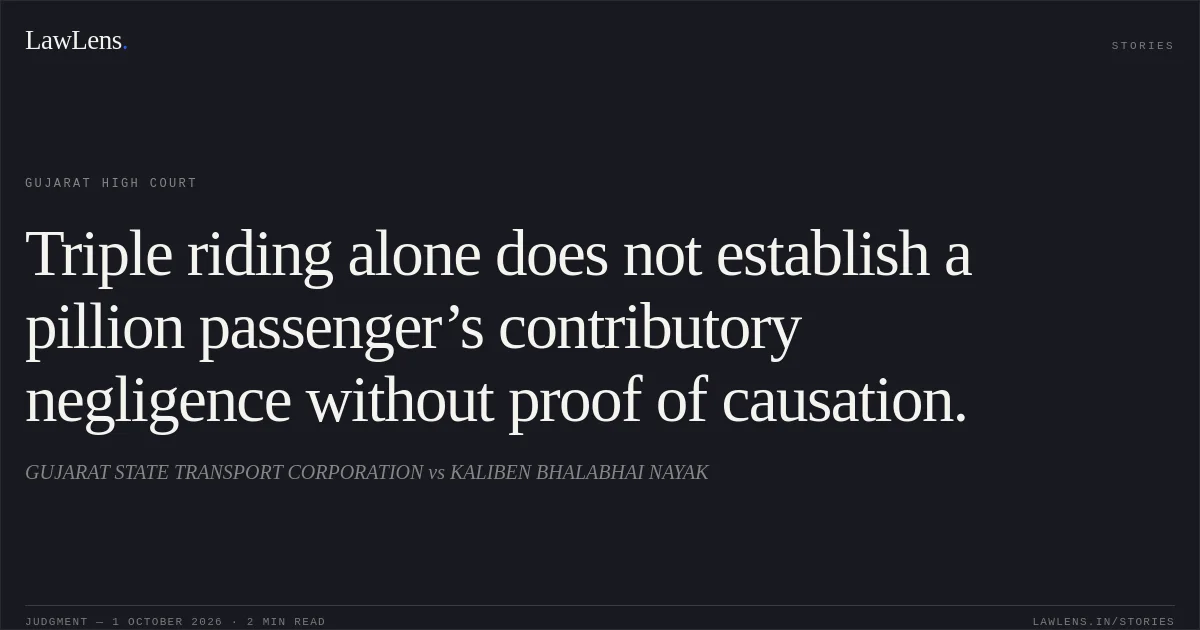
Source reference: paras. 9–13; pp. 5–11Nor did the fact of triple riding, without evidence that it contributed to the collision or increased the impact on the deceased, establish contributory negligence. The proposed deduction was therefore unsupported by the applicable legal principles.
Source reference: para. 14; pp. 12–13Holding
The Court dismissed both appeals as devoid of merit and confirmed the Tribunal’s awards in MACP Nos. 792 and 793 of 2018.
It directed the Tribunal to disburse the full compensation to the claimants if it had not already been disbursed.
Source reference: para. 15; p. 14Acts & Sections Cited
4 provisions across 1 statute referred to in this judgment. Each provision opens on LawLens.
Motor Vehicles Act, 19884
Original Court PDF
GUJARAT STATE TRANSPORT CORPORATIONvsKALIBEN BHALABHAI NAYAK
Click to open original judgment
Original judgment, available to read, download and summarize on LawLens.in