Facts
The appellant, a retired Judge of the High Court, was appointed on 10 June 2010 as Chairman of the Committee constituted by the Government of Tripura for determining the fee structure of private technical institutions in the State, pursuant to the directions of the Supreme Court in Islamic Academy of Education v. State of Karnataka, (2003) 6 SCC 697.
Source reference: p.2He contended that he was not provided staff, infrastructure, or remuneration.
Source reference: p.2He sought remuneration from 1 December 2018, stating that prior to that date he had been holding another office and was not claiming payment for the earlier period.
Source reference: p.2The State rejected his claim on 6 May 2023.
Source reference: p.2His writ petition was dismissed by the learned Single Judge on 16 May 2025 in WP(C) No. 253 of 2025, principally on the grounds that the Committee had not become operational, that Justice Jayanta Kumar Biswas had subsequently expressed willingness to replace him, and that the assignment was honorary.
Source reference: pp.2–3The appellant challenged that decision in the present writ appeal.
Source reference: p.3Issues
Whether the appellant was entitled to remuneration for serving as Chairman of the Technical Institutions Fee Structure Regulatory Committee from 1 December 2018, despite not demonstrating that the Committee had undertaken any fee-determination work?
Source reference: pp.3–4, paras. 12–16Whether Justice Jayanta Kumar Biswas’s willingness to assume the chairmanship automatically reconstituted the Committee or displaced the appellant in the absence of a formal Government notification?
Source reference: p.4, para. 14Whether the State Government had failed to implement the Supreme Court’s directions in Islamic Academy of Education by merely constituting the Committee on paper without providing remuneration, staff, infrastructure, and operational arrangements?
Source reference: pp.4–8, paras. 17–20Law Applied
The Court applied the directions issued by the Supreme Court in Islamic Academy of Education v. State of Karnataka, (2003) 6 SCC 697, particularly paragraphs 19 and 20, requiring every State to establish a permanent committee headed by a retired High Court Judge to oversee admission-related matters and fee regulation in professional institutions.
Source reference: pp.5–8The Supreme Court further directed that the State bear the Committee’s expenses and provide the necessary infrastructure, allowances, and remuneration to its Chairman and members.
Source reference: p.8These directions were issued under Article 142 of the Constitution and were to remain operative until appropriate legislation was enacted.
Source reference: p.8The Court also applied the principle that mere constitution of a committee does not justify payment of remuneration where the claimant has not shown that the Committee performed the functions for which it was constituted.
Source reference: p.4, paras. 12 and 15It further held that a person’s willingness to assume office does not, by itself, reconstitute a statutory or governmental committee in the absence of a formal notification.
Source reference: p.4, para. 14Reasoning
The Division Bench held that the appellant had not pleaded or established that, between 10 June 2010 and 1 December 2018, he had invited applications, determined fee structures, or undertaken any substantive work for an academic year.
Source reference: p.4, para. 12Consequently, the mere fact of his appointment did not entitle him to remuneration for a Committee that had not performed its assigned functions.
Source reference: p.4, paras. 12 and 15The Court nevertheless rejected the reasoning that Justice Jayanta Kumar Biswas’s willingness automatically displaced the appellant, since no formal notification reconstituting the Committee had been issued.
Source reference: p.4, para. 14While denying the appellant’s individual monetary claim, the Court found the State’s failure to operationalise the Committee for nearly twenty-three years to be contrary to the spirit of the Supreme Court’s directions.
Source reference: pp.4–8, paras. 17–20The State had constituted the Committee only on paper and had failed to provide rules regarding remuneration, staff, infrastructure, and conditions of service, thereby leaving private technical institutions without effective fee regulation.
Source reference: pp.4–8, paras. 17–20Holding
The Court declined to grant the appellant remuneration because he had not shown that the Committee had carried out any fee-determination work during the relevant period.
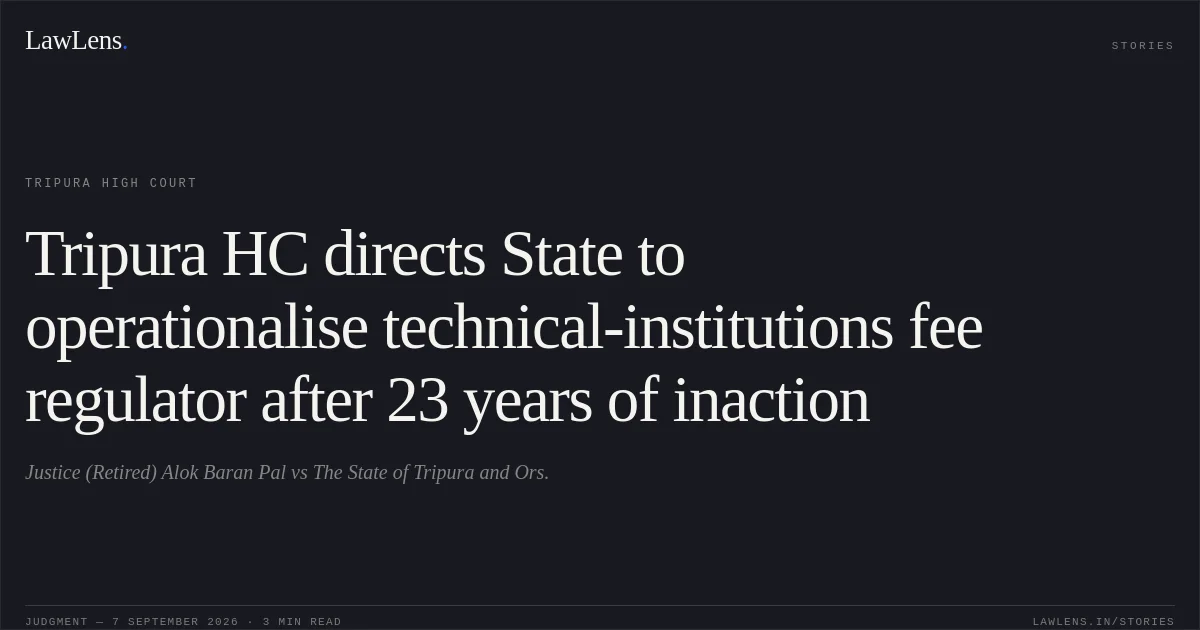
However, it directed the State Government to forthwith constitute and operationalise the Technical Institutions Fee Regulatory Committee in accordance with Islamic Academy of Education, prescribe the remuneration and other conditions of service of its Chairman and members, and provide the Committee with staff and infrastructure.
Source reference: p.8, para. 20The exercise was ordered to be completed within one month from receipt of the judgment.
Source reference: p.9, para. 21The writ appeal was accordingly disposed of, and any pending application was also disposed of.
Source reference: p.9, para. 21Original Court PDF
Justice (Retired) Alok Baran PalvsThe State of Tripura and Ors.
Click to open original judgment
Original judgment, available to read, download and summarize on LawLens.in