01Facts
News reports published in June–July 2026 described NH-108B and NH-208 in Tripura as being in an unsafe and severely deteriorated condition, with potholes, broken surfaces, waterlogging and alleged use of substandard construction materials.
¶ 1–4The High Court registered the matter suo motu as a PIL concerning road safety and connectivity, particularly because the highways were important lifelines in areas lacking alternative railway connectivity.
¶ 4–10NHIDCL was impleaded as a respondent and accepted responsibility for the development and maintenance of the highways pursuant to the Ministry of Road Transport and Highways’ notification dated 18 July 2025.
¶ 11–20The State Government stated that NHIDCL had exclusive administrative control over the highways and that the relevant works were within the five-year defect liability period. It also acknowledged recurring pavement failures, cracking, settlement and inadequate rectification despite repeated communications to NHIDCL.
¶ 26–34A District Legal Services Authority inspection conducted in July 2026 recorded widespread potholes, pavement distress, blocked and inadequate drainage, waterlogging, rutting, damaged culverts, absent safety barriers and poor maintenance across several stretches of NH-208 and NH-108B. All inspected locations were classified as presenting a “High” risk.
¶ 41–45 · Annexure · pp. 29–47NHIDCL attributed the deterioration primarily to failures by EPC contractors to mobilise adequate resources and carry out contractual maintenance. It relied on cure notices, risk-and-cost work, extensions of time, technical assessments by CSIR-CRRI and NIT Agartala, and proposed restoration measures.
¶ 46–84The Court found that the record nevertheless disclosed prolonged delays, repeated failures after successive monsoons, poor supervision, extensive reliance on extensions and possible impropriety in contractor selection and monitoring.
¶ 85–10202Issues
i.1. Whether NHIDCL, having been delegated responsibility for the development and maintenance of national highways in Tripura, owed a legally enforceable duty of care to highway users, notwithstanding the engagement of EPC contractors?
¶ 18–23ii.2. Whether NHIDCL and its EPC contractors failed to discharge their statutory and contractual obligations by allowing NH-108B and NH-208 to remain unsafe and non-motorable?
¶ 41–45, 85–102iii.3. Whether the material on record warranted directions for continuing judicial monitoring, an independent road-condition audit and an inquiry into possible corruption, collusion and use of substandard materials?
¶ 106–111iv.4. Whether the State Government was required to explore civil or criminal proceedings against NHIDCL and the EPC contractors for exposing residents to serious risk?
¶ 36–40, 111(b)03Law Applied
The Court applied Sections 4 and 5 of the National Highways Act, 1956, under which national highways vest in the Union and the Central Government remains responsible for their proper development and maintenance, subject to lawful delegation of functions.
¶ 18The Court held that the Ministry’s notification dated 18 July 2025 delegated these functions to NHIDCL, thereby imposing upon NHIDCL a duty of care towards highway users; that duty continued even where construction or maintenance was outsourced to EPC contractors.
¶ 19–23Relying on MCD v. Sushila Devi, (1999) 4 SCC 317, and Vadodara Municipal Corporation v. Purushottam V. Murjani, (2014) 16 SCC 14, the Court recognised potential tortious liability for failure to supervise contracted activities.
¶ 22It also relied on NHAI v. Aam Aadmi Lokmanch, (2021) 11 SCC 566, for the proposition that highway authorities are responsible for safety and remedial action where deficiencies and foreseeable risks are known.
¶ 22The Court further invoked the principles of institutional accountability in Vijay Rajmohan v. CBI, (2023) 1 SCC 329, and the executive’s duty of continuous monitoring and performance assessment discussed in Yash Developers v. Harihar Krupa Cooperative Society, (2024) 9 SCC 606.
¶ 107–108Provisions in the judgment · 3 · Linked ones open on LawLens
National Highways Act, 1956 Section 4Section 5
National Highways Authority of India Act, 1988 Section 16
04Reasoning
The Court treated the DLSA’s contemporaneous inspection report as objective evidence of dangerous and recurring defects, including potholes, pavement failure, blocked drainage, waterlogging, damaged culverts and absence of safety measures.
¶ 41–45NHIDCL’s own pleadings showed that several projects had suffered repeated failures after completion, that contractors had achieved inadequate progress, and that NHIDCL had granted extensions and relied on delayed or incomplete risk-and-cost works.
¶ 46–84The Court held that contractual notices and correspondence did not, by themselves, establish discharge of NHIDCL’s statutory duty of care.
¶ 85–102The delay in obtaining the CRRI report, the failure to undertake timely repairs before the next monsoon, repeated deterioration soon after completion and inadequate supervision raised serious concerns regarding contractor selection, construction quality and possible collusion between NHIDCL officials and EPC contractors.
¶ 85–102The State Government was also criticised for limiting itself to correspondence with Union authorities instead of taking stronger administrative or legal measures to protect residents.
¶ 35–40Since the Court could not finally determine corruption or tortious liability on the existing record, it ordered continuing reports, an independent technical audit and a Union Government inquiry.
¶ 106–11105Holding
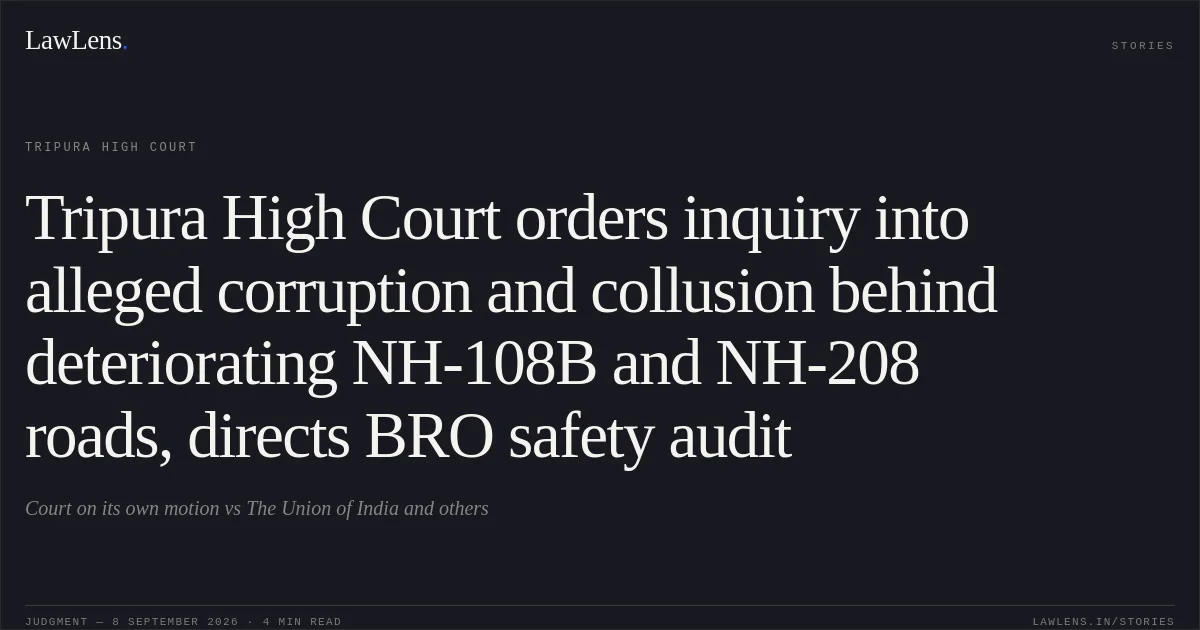
The Court held that NHIDCL owed a duty of care to users of NH-108B and NH-208 and that the existing condition of the highways demonstrated a prima facie failure to maintain them in a safe and motorable condition.
¶ 20–23, 106–111NHIDCL was directed to file bi-weekly progress reports concerning repair and maintenance of four identified stretches of NH-108B and NH-208.
¶ 111(a)The State Government was directed to explore civil and criminal proceedings against NHIDCL and its EPC contractors.
¶ 111(b)After completion of repairs, the Border Roads Organisation was directed to conduct an independent audit and submit a sealed-cover report by 30 January 2027, with NHIDCL and its contractors required to cooperate.
¶ 111(c)–(d)The Union of India was directed to inquire into possible corruption in contractor selection, collusion between NHIDCL officials and EPC contractors, and the alleged use of substandard materials, and to submit its report by 1 December 2026; appropriate civil or criminal action was to follow if impropriety or corruption was established.
¶ 111(e)The matter was directed to be listed on 22 September 2026.
p. 28Original Court PDF
Court on its own motionvsThe Union of India and others
Click to open original judgment
Original judgment, available to read, download and summarize on LawLens.in