Facts
On 23 December 2001, Sangitaben and her husband, Mukeshbhai, were travelling on a motorcycle from Vadod to Ahmedabad when a truck bearing registration No. GJ-7-X-5003 allegedly hit the motorcycle from behind near Dabhan bus stand. The motorcycle climbed onto the road divider, causing both occupants to be thrown onto the road; Mukeshbhai subsequently died and Sangitaben sustained injuries
Source reference: paras. 1–2; p.2The Motor Accident Claims Tribunal partly allowed MACP Nos. 534 and 535 of 2002. In the fatal-accident claim, it assessed compensation at ₹18,37,352 but attributed 60% negligence to the motorcycle driver and awarded ₹7,35,000. In the injury claim, it assessed compensation at ₹81,650, deducted 60% for contributory negligence, and awarded ₹32,700
Source reference: paras. 1, 12; pp.1, 9–10The claimants filed First Appeals Nos. 35 and 36 of 2011 seeking enhancement and reversal of the finding of contributory negligence. The Insurance Company filed First Appeals Nos. 29 and 30 of 2011 challenging the Tribunal’s award and the involvement of the truck
Source reference: para. 1.1; p.2Issues
1. Whether the truck was involved in the accident and whether its driver was negligent in causing the collision?
Source reference: paras. 3–10; pp.3–92. Whether the Tribunal erred in attributing 60% contributory negligence to the deceased motorcycle driver?
Source reference: paras. 9–11; pp.8–93. Whether the claimants were entitled to reassessment and enhancement of compensation under the applicable principles governing loss of dependency, future prospects and conventional heads?
Source reference: paras. 12–16; pp.9–134. Whether the Insurance Company’s appeals challenging the Tribunal’s award were maintainable on the facts and evidence?
Source reference: paras. 4–10, 17; pp.4–9, 13–14Law Applied
The Court applied the principles governing adjudication of claims under the Motor Vehicles Act, including proof of involvement of the offending vehicle, rash and negligent driving, contributory negligence, and the liability of the driver, owner and insurer.
Source reference: paras. 6–10; pp.6–9Physical damage to the vehicle, scene-of-accident evidence, eyewitness testimony and admissions of the driver may be relied upon cumulatively to establish negligence
Source reference: paras. 6–10; pp.6–9The Court further relied on National Insurance Co. Ltd. v. Pranay Sethi, 2017 (16) SCC 680, for adding future prospects to the income of a permanently employed deceased and for determining standardized compensation under conventional heads such as loss of consortium, loss of estate and funeral expenses
Source reference: paras. 13–14; pp.10–11Where the evidence establishes that the offending vehicle was solely responsible for the accident, no deduction can be made towards contributory negligence, and the driver, owner and insurer are jointly and severally liable
Source reference: paras. 10–11; p.9Reasoning
The Court rejected the Insurance Company’s contention that the motorcycle had independently lost control and that the truck was falsely implicated.
Source reference: para. 6; p.6The complaint at Exhibit 28, read with the panchnama at Exhibit 29, showed inward compression on the motorcycle’s rear carrier and ten-foot drag marks, indicating a rear-end impact by the truck
Source reference: para. 6; p.6This conclusion was corroborated by the independent eyewitness, who stated that he saw the truck hit the motorcycle from behind and that the motorcycle did not independently climb the divider
Source reference: para. 7; pp.6–7The truck driver’s statements at Exhibits 75, 76 and 101 also admitted the collision and his departure from the spot
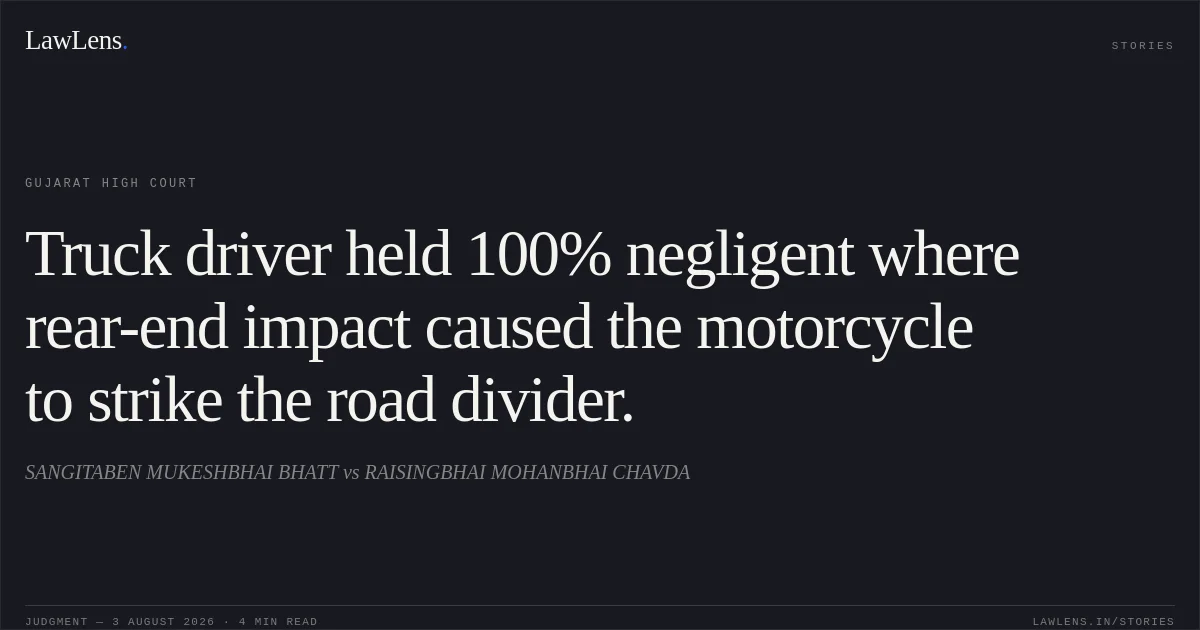
Source reference: para. 8; p.7Since the primary cause was the truck’s failure to maintain a safe distance and its negligent collision with a light vehicle from behind, the Tribunal’s finding attributing 60% negligence to the motorcycle driver was held perverse and unsustainable; the truck driver was held 100% negligent
Source reference: paras. 9–10; pp.8–9For the fatal claim, the Court treated the deceased’s age as 41–42 years, his monthly salary as ₹12,724, and added 30% towards future prospects. After deducting one-third for personal expenses and applying a multiplier of 14, it calculated loss of dependency at ₹18,52,614
Source reference: para. 13; p.10Applying Pranay Sethi, it awarded ₹96,800 for loss of consortium, ₹18,150 for loss of estate and ₹18,150 for funeral expenses, resulting in total compensation of ₹19,85,714
Source reference: para. 14; p.11In the injury claim, the Court retained the Tribunal’s assessed compensation of ₹81,650 but removed the 60% deduction for contributory negligence
Source reference: para. 15; p.11Holding
The Court held that the truck driver was solely and 100% negligent and that the driver, owner and insurer were jointly and severally liable
First Appeal Nos. 35 and 36 of 2011 filed by the claimants were allowed, while the Insurance Company’s First Appeal Nos. 29 and 30 of 2011 were disposed of accordingly
Source reference: para. 17(A)–(C); pp.13–14In MACP No. 535 of 2002, compensation was enhanced to ₹19,85,714, resulting in an enhancement of ₹12,50,714. In MACP No. 534 of 2002, compensation was enhanced to ₹81,650, resulting in an enhancement of ₹48,950
Source reference: para. 16; p.12The Insurance Company was directed to deposit the aggregate enhanced amount of ₹12,99,664 with interest at 9% per annum from the date of the claim petitions until realization, within four weeks
Source reference: para. 17(D); p.13The Tribunal was directed to disburse the awarded amount to the claimants after verification and compliance with applicable procedure, subject to deduction of court fees, if unpaid
Source reference: paras. 17(E)–(F); pp.13–14Original Court PDF
SANGITABEN MUKESHBHAI BHATTvsRAISINGBHAI MOHANBHAI CHAVDA
Click to open original judgment
Original judgment, available to read, download and summarize on LawLens.in