Facts
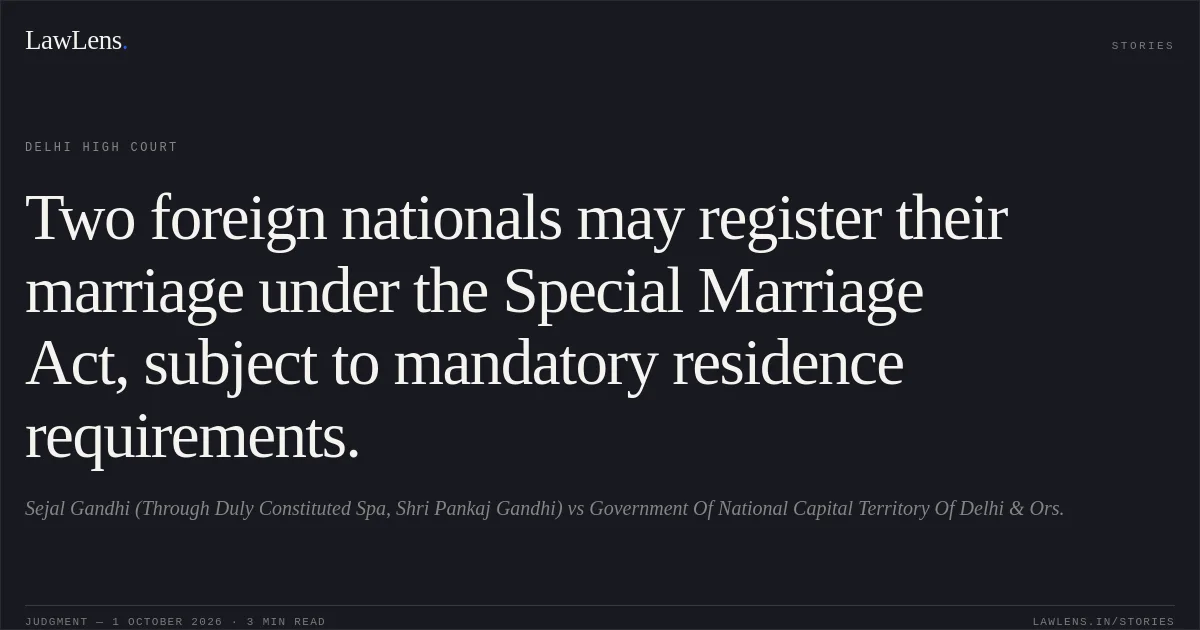
The petitioner, a Swedish citizen and OCI cardholder, married a Swedish citizen in Delhi at an Arya Samaj Mandir on 14 March 2026.
Source reference: para. 2–4She asserted that her husband had converted to Hinduism before the ceremony, but the marriage certificate recorded only that the marriage was solemnised according to Hindu rites and did not establish either party’s religion or the husband’s conversion.
Source reference: para. 2–4, 12–16After encountering difficulty registering the marriage through the Aadhaar-based online portal, she made representations to the authorities and filed a writ petition challenging citizenship and residence conditions for registration under the Hindu Marriage Act, 1955 (HMA), and seeking registration without proceeding under Chapter III of the Special Marriage Act, 1954 (SMA).
Source reference: para. 5–7, 1The respondents opposed the petition, relying on the absence of proof that the HMA applied and on the amended guidelines allowing marriages between two foreign nationals to be registered under the SMA, subject to prescribed requirements.
Source reference: para. 9.1–9.6Issues
1. Whether the petitioner could challenge the citizenship and permanent-residence conditions for HMA registration without establishing that the marriage fell within the HMA.
Source reference: para. 11–182. Whether registration under Chapter III of the SMA was an available alternative remedy for the two foreign-national spouses, and whether its residence requirement could be relaxed.
Source reference: para. 19–293. Whether the respondents should provide alternative identity-verification and appearance procedures for applicants unable to use Aadhaar-based authentication or appear physically.
Source reference: para. 30–32Law Applied
Section 2 of the HMA limits its application to the persons and categories specified there, including persons Hindu by religion; under Perumal Nadar v. Ponnuswami, a person may become Hindu by conversion, but a bare declaration is insufficient, and bona fide intention accompanied by unequivocal conduct may establish conversion without a formal purification ceremony.
Source reference: para. 14–15The Court also relied on Rohit Pandey v. Union of India, applying Priya Balan Ghosh v. Suresh Chandra Ghosh, for the proposition that an Arya Samaj certificate alone does not conclusively establish a valid marriage under the HMA.
Source reference: para. 17Under the amended guidelines governing SMA registration, two foreign nationals may apply without an Indian-citizen spouse, subject to requirements including residence in the relevant district for thirty days, valid visas, identity and residence verification, and personal appearance with three witnesses; the Court treated the residence requirement as jurisdictional and not relaxable merely for inconvenience.
Source reference: para. 19–22, 25–26, 29The Court also referred to earlier decisions concerning portal access and alternative procedures for appearance.
Source reference: para. 30–32Reasoning
The petitioner’s assertion that her husband had converted was unsupported by independent material, and the Arya Samaj certificate established only the form of the ceremony, not the parties’ religious status or the HMA’s applicability. She therefore had not established the foundational basis to challenge the HMA registration conditions.
Source reference: para. 16–18In any event, both spouses were Swedish citizens and fell within the amended-guidelines exception permitting foreign nationals to apply under Chapter III of the SMA; the petitioner’s OCI status did not make her an Indian citizen.
Source reference: para. 20, 24–26The Court declined to dispense with the thirty-day residence requirement, which it considered necessary to establish the Marriage Officer’s territorial jurisdiction.
Source reference: para. 29It nevertheless recognised the access difficulties raised by the petitioner and addressed them through directions concerning alternative identity verification and video appearance.
Source reference: para. 30–32Holding
The petition was disposed of. The HMA-based constitutional challenge was held not maintainable for lack of locus standi because the petitioner had not established that the HMA applied to the marriage.
The petitioner may apply for registration under Chapter III of the SMA, subject to applicable requirements, including the thirty-day residence condition, which the Court would not relax.
Source reference: para. 33, 34(ii)–(iii), 35The respondents were directed to consider suitable portal modifications permitting authentication through passports, OCI cards, or other appropriate means, and to permit the petitioner to appear by video conference if requested, to the extent permissible by law.
Source reference: para. 31–32, 34(iv)–(v)Any SMA application must be considered on its merits and in accordance with law.
Source reference: para. 34(vi)Acts & Sections Cited
5 provisions across 2 statutes referred to in this judgment. Each provision opens on LawLens.
Hindu Marriage Act, 19551
Special Marriage Act, 19544
Original Court PDF
Sejal Gandhi (Through Duly Constituted Spa, Shri Pankaj Gandhi)vsGovernment Of National Capital Territory Of Delhi & Ors.
Click to open original judgment
Original judgment, available to read, download and summarize on LawLens.in