Facts
The petitioner challenged an order dated 25.02.2026 passed by the Additional District Magistrate (ADM), Amethi, declaring him a ‘Goonda’ under Section 3/4 of the U.P. Control of Goondas Act, 1970.
Source reference: p. 1, para 2This declaration was based on the petitioner's involvement in two criminal cases: one from 2021 (IPC Sections 376/306) and one from 2025 (BNS Sections 115(2)/352/351/317(2)), alongside two beat reports and one prohibitory report from April 2025.
Source reference: p. 1, para 2The petitioner’s appeal under Section 6 was dismissed by the Commissioner, Ayodhya Division, on 06.05.2026.
Source reference: p. 1, para 3The petitioner then moved the High Court seeking to quash both orders.
Source reference: p. 1Issues
1. Whether the involvement in two isolated criminal cases with a significant time gap constitutes being a "habitual offender" under Section 2(b) of the U.P. Control of Goondas Act, 1970.
Source reference: p. 8, para 13-142. Whether beat information reports, lacking investigation or an opportunity for rebuttal, serve as valid grounds for declaring a person a 'Goonda'.
Source reference: p. 8, para 15Law Applied
The court applied Section 2(b) of the U.P. Control of Goondas Act, 1970, which defines a 'Goonda' as a person who "habitually commits" specific offenses.
Source reference: p. 2, para 5Relying on Vijay Narain Singh v. State of Bihar (1984) and Imran Alias Abdul Quddus Khan v. State of U.P. (1999), the court defined "habitually" as repeatedly, persistently, and requiring a thread of continuity rather than isolated or dissimilar acts.
Source reference: p. 2-3, para 6; p. 4, para 7It further cited Pavan v. State of U.P. (2021) regarding the Right to Reputation as a facet of Article 21 of the Constitution.
Source reference: p. 5, para 9The court cited Bharat Singh v. State of U.P. (2023) which requires a reasonable nexus and temporal proximity between the acts and the proceedings.
Source reference: p. 7, para 12Reasoning
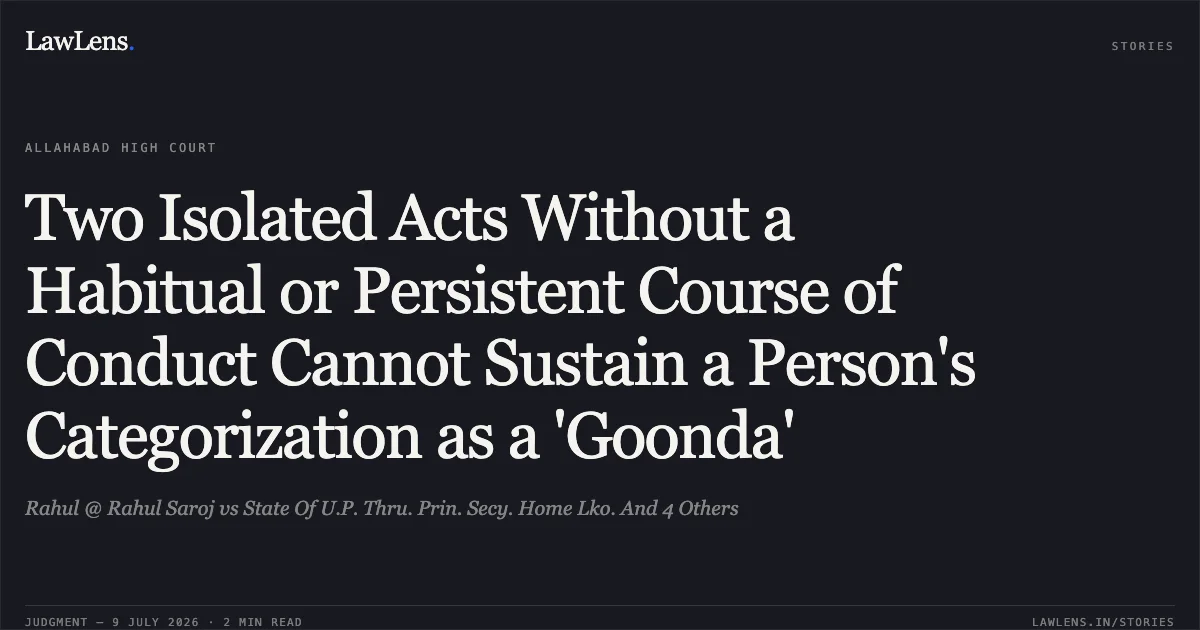
The court reasoned that the term 'Goonda' is reserved for habitual criminals whose conduct shows a degree of frequency and continuity.
Source reference: p. 7, para 13In the present case, the court found that the petitioner’s involvement in two cases—one in 2021 and another in 2025—did not establish a persistent "habit" or "propensity" to commit crime.
Source reference: p. 8, para 14The court noted a lack of nexus between these isolated acts and any immediate threat to public order.
Source reference: p. 8, para 14The court criticized the reliance on beat reports, stating that such reports, which lack investigation or the right of the accused to rebut, cannot form the basis of a stigmatic 'Goonda' declaration.
Source reference: p. 8, para 15The court emphasized that the Act is a preventive tool meant for hardened criminals who cannot be reached by ordinary penal laws, whereas the petitioner was already being prosecuted under ordinary law for the cited offenses.
Source reference: p. 8, para 13-14Holding
The court held that the ADM and the Appellate Authority erred in declaring the petitioner a 'Goonda' based on two isolated cases and unsubstantiated beat reports.
The High Court allowed the writ petition and quashed the orders dated 25.02.2026 and 06.05.2026.
Source reference: p. 9, para 17The court concluded that branding a citizen as a 'Goonda' without meeting the strict "habitual" criteria is an arbitrary exercise of power that irreparably damages an individual's reputation.
Source reference: p. 8, para 16Acts & Sections Cited
12 provisions across 4 statutes referred to in this judgment. Each provision opens on LawLens.
Indian Penal Code, 18604
Bharatiya Nyaya Sanhita, 20234
Arms Act, 19593
Code of Criminal Procedure, 19731
Original Court PDF
Rahul @ Rahul SarojvsState Of U.P. Thru. Prin. Secy. Home Lko. And 4 Others
Click to open original judgment
Original judgment, available to read, download and summarize on LawLens.in


