01Facts
The appellants claim to be recorded tenants of the subject plots and allege dispossession otherwise than by due process of law by private respondents Harekrishna Mondal and Naresh Mistry.
¶ 3The appellants challenged the Single Judge's judgment dated 22 September 2026 in WPA 442, 443 and 444 of 2026, which held that the Tehsildar could not exercise jurisdiction under Regulation 161 because the dispossession complaint was not made within two years.
¶ 4 · ¶ 17The appeals were heard analogously by consent.
¶ 1The record shows that the appellants' father complained in 2020 of illegal occupation and of a house constructed five years earlier, and nothing demonstrated that the Tehsildar was approached within the two-year period.
¶ 1502Issues
i.1. Whether the two-year limitation in Regulation 161(1) of the 1966 Regulation is directory or mandatory, i.e., whether the Tehsildar must be approached within two years of dispossession before jurisdiction can be invoked.
¶ 2 · ¶ 4ii.2. Whether the use of the word "may" in Regulation 161(1), and the absence of an express penal consequence for delay, renders the two-year period optional.
¶ 4 · ¶ 10iii.3. Whether an applicant who is time-barred under Regulation 161 can invoke the Tehsildar's powers under Regulation 98 instead.
¶ 11 (quoting Edmund George · ¶ 21–22) · ¶ 1203Law Applied
Regulation 161 of the Andaman and Nicobar Islands Land Revenue and Land Reforms Regulation, 1966, particularly sub-regulations (1) and (2), confers a summary remedy for a dispossessed tenant on application made "within two years" of dispossession.
¶ 6 · ¶ 9The 1966 Regulation is a self-contained code, promulgated under Article 240 of the Constitution, under which a time limit attached to a summary remedy is a condition precedent going to the root of jurisdiction.
¶ 8The settled principle that "may" is not conclusively directory and that statutory meaning turns on legislative intent, object, scheme and consequences, as stated in Bachahan Devi v. Nagar Nigam, Gorakhpur (2008) 12 SCC 372 and State of U.P. v. Jogendra Singh, AIR 1963 SC 1618.
¶ 10The rebuttable presumption in Vidarbha Industries Power Ltd. v. Axis Bank Ltd. (2022) 8 SCC 352 was accepted.
¶ 16Binding Division Bench authority in Edmund George v. Secretary (Revenue) (2007) 3 CHN 358 held that the three conditions in Regulation 161(1) (tenancy, dispossession, and dispossession within two years) must be satisfied, that a time-barred complaint cannot be adjudicated under Regulation 98, and that a party left out of time retains a civil suit subject to limitation.
¶ 11 · ¶ 12M/s. Patel Brothers v. State of Assam (2017) 2 SCC 350, as cited in the judgment.
¶ 12Provisions in the judgment · 1
the Act (alias, unresolved) (unresolved)
04Reasoning
The Court read Regulation 161 plainly: sub-regulation (2)'s adjudicatory jurisdiction is triggered only by a competent application under sub-regulation (1), which must be filed within two years of dispossession. An out-of-time application therefore does not engage the Tehsildar's power to adjudicate rival claims.
¶ 9The argument that "may" makes the limit directory was rejected because statutory interpretation depends on legislative purpose and consequences, not grammar alone.
¶ 10The absence of an express penalty did not alter this, as the time bar is an integral part of the summary jurisdiction.
¶ 8Applying Edmund George, the Court held that the two-year period is a precondition defining the Tehsildar's jurisdiction, and that the applicant cannot circumvent the bar by invoking Regulation 98.
¶ 12 · ¶ 14On the facts, the Single Judge's finding that nothing on record showed a Tehsildar application within two years was supported by the 2020 complaint about a house built five years earlier, so no perversity or illegality was shown.
¶ 15The controlling authority was not cited by either party and was raised only by the Court, and the appellants' counsel attempted to distinguish it afterward.
¶ 1305Holding
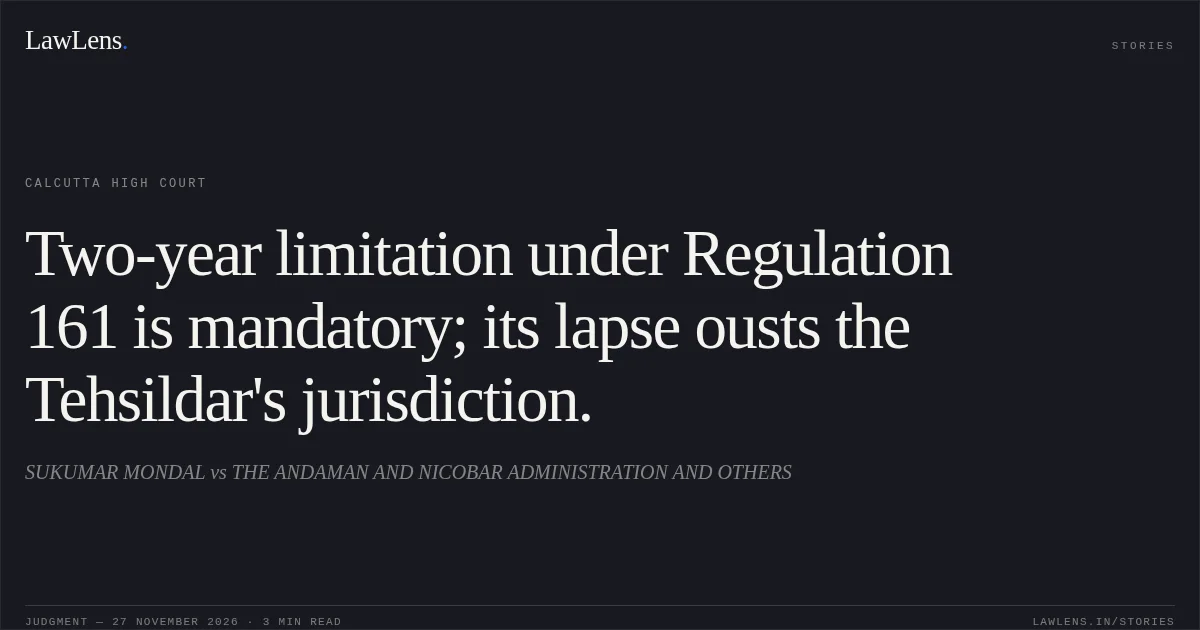
The two-year period in Regulation 161(1) is a mandatory precondition, not a directory provision. It defines the Tehsildar's jurisdiction, so an application made after two years is not a valid application under the Regulation.
¶ 14 · ¶ 9The "may" wording does not alter this result.
¶ 10 · ¶ 16A time-barred applicant cannot invoke Regulation 98 to avoid Regulation 161.
¶ 12The appeals are dismissed with no order as to costs. The Single Judge's judgments in WPA 442, 443 and 444 of 2026 are affirmed.
¶ 17The appellants remain free to pursue any other substantive remedy, including a civil suit subject to limitation, in the appropriate forum.
¶ 12 · ¶ 17Original Court PDF
SUKUMAR MONDALvsTHE ANDAMAN AND NICOBAR ADMINISTRATION AND OTHERS
Click to open original judgment
Original judgment, available to read, download and summarize on LawLens.in