Facts
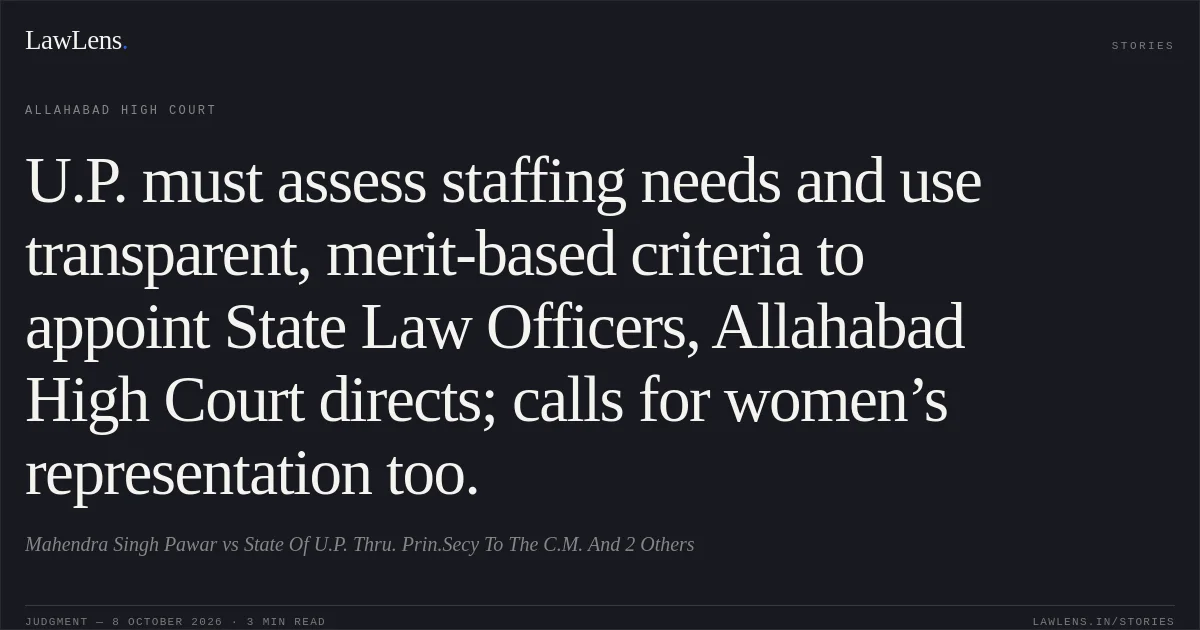
The connected proceedings challenged aspects of the selection and appointment of Uttar Pradesh State Law Officers, including alleged lack of transparency, merit-based criteria and assessment of need.
Source reference: no citationThe petitions also raised concerns about the number of appointments, criminal antecedents, women’s representation, supervision and private practice by State Law Officers.
Source reference: no citationThe Court had earlier called on the State to explain the steps taken to implement State of Punjab v. Brijeshwar Singh Chahal and to provide a scheme for selection and appointment.
Source reference: paras. 6–8The State relied on the Legal Remembrancer’s Manual (LR Manual), maintained that Chahal was distinguishable, and stated that a committee chaired by the Advocate General scrutinised proposed engagements.
Source reference: paras. 29–36, 72–73The Court ultimately identified, among other matters, the absence from the record of a reasoned needs assessment and of an explanation for appointing six Chief Standing Counsel.
Source reference: paras. 65–77Issues
1. Whether the principles and directions in Brijeshwar Singh Chahal applied to the appointment of State Law Officers in Uttar Pradesh.
Source reference: paras. 37–422. Whether the State’s appointment framework and the material on record demonstrated a sufficiently objective, transparent and need-based process, including safeguards concerning merit, criminal antecedents and workload.
Source reference: paras. 58–69, 71–773. Whether further directions were warranted concerning women’s representation, supervision and reporting, private practice and participation in Bar elections.
Source reference: paras. 43–55, 78–79Law Applied
The Court relied on State of Punjab v. Brijeshwar Singh Chahal, which emphasised realistic assessment of need, credible and transparent selection, assessment of merit, and consultation with the High Court in the circumstances considered there; it also noted the Supreme Court’s express observation that other States should reform their systems as appropriate.
Source reference: paras. 24, 40Under State of U.P. v. U.P. State Law Officers’ Association, however, whatever selection method is adopted must demonstrate that the search for meritorious candidates was undertaken and that appointments were made on merit, not extraneous considerations.
Source reference: para. 42The Court also applied the principle that precedent must be considered in its factual setting and may be distinguished where material facts differ, relying on State of M.P. v. Narmada Bachao Andolan and Quinn v. Leathem.
Source reference: paras. 38–39The LR Manual provides for the State to determine the number of certain law officers, permits specified Government Advocates to undertake private practice subject to restrictions, and requires annual returns concerning criminal cases handled.
Source reference: paras. 48, 51, 65, 74The Court treated the State’s discretion over appointments as subject to rational, relevant considerations and the proper use of public funds.
Source reference: paras. 65–69Reasoning
The Court distinguished Chahal because that case concerned Punjab and Haryana, where the Court had identified a lack of norms and relied on a CAG report; Uttar Pradesh had an LR Manual and a different remuneration structure.
Source reference: paras. 38–42It therefore declined to apply Chahal as if its specific directions governed Uttar Pradesh, while affirming that appointments must be demonstrably merit-based.
Source reference: paras. 38–42The existence of the Manual and a selection committee did not, however, answer the concerns on the record: the State had not produced a reasoned assessment of the number of officers required, and it had not explained the appointment of six Chief Standing Counsel.
Source reference: paras. 65–68, 72–77The Court considered the existing supervisory provisions relevant but directed that reporting extend beyond criminal cases to every category of work.
Source reference: paras. 51–54It also found the material insufficient to reach a definite conclusion on alleged private practice, but considered safeguards necessary; and it declined to disturb existing appointments while requiring deficiencies to be addressed in future appointments.
Source reference: paras. 49–50, 70Holding
The Court disposed of all connected petitions and applications by directing the State, for future appointments, to conduct a realistic needs assessment; prescribe transparent eligibility and selection criteria addressing merit, competence, integrity and suitability; exclude persons with criminal antecedents or undesirable behaviour; extend workload reporting to all categories of cases; make the selection process public to the extent permissible; and ensure adequate representation of women, subject to availability.
It further directed that information about an FIR or criminal case against a State Law Officer be forwarded promptly to the Advocate General for appropriate action; required a prior NOC for State Law Officers appearing against the State, subject to the stated exception and LR Manual restrictions; and required the State to examine, after consultation with relevant stakeholders, whether such officers may contest or participate in Bar elections.
Source reference: para. 79(VI)–(VIII)The Court clarified that its observations were not intended to disturb appointments already made.
Source reference: para. 70Original Court PDF
Mahendra Singh PawarvsState Of U.P. Thru. Prin.Secy To The C.M. And 2 Others
Click to open original judgment
Original judgment, available to read, download and summarize on LawLens.in