Facts
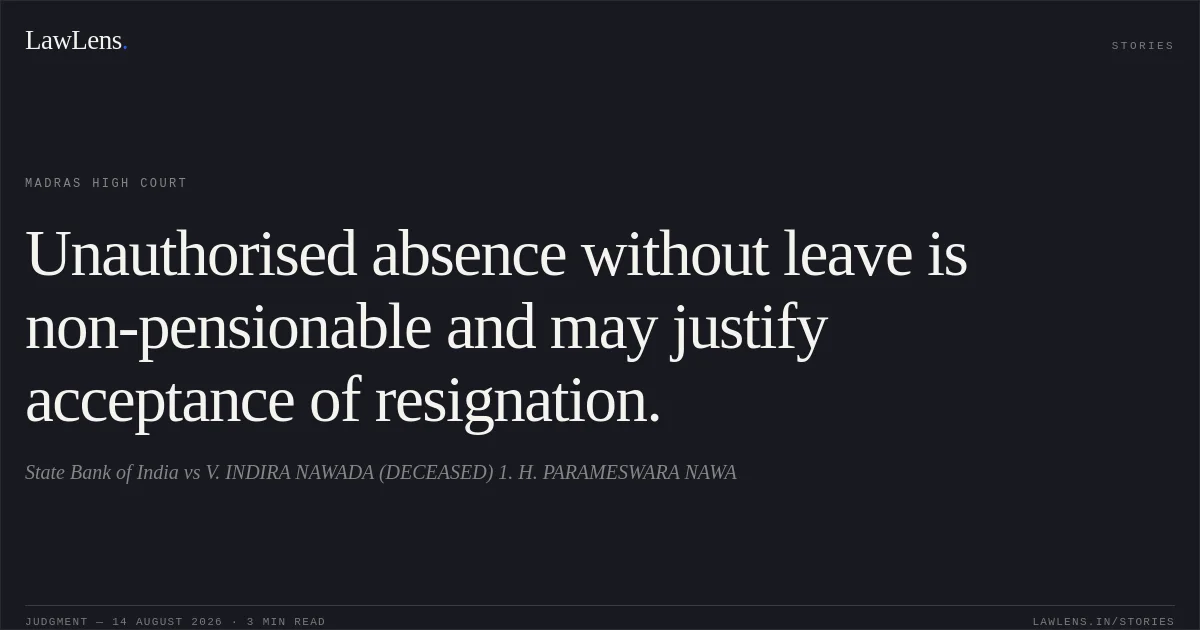
The respondent’s predecessor was appointed as a Clerk-cum-Cashier with the State Bank of India on 11.07.1985 and served in various branches. From September 2003 onwards, she remained absent from duty for extended periods, allegedly due to illness, while residing first in Mumbai and subsequently in Vienna, Austria, where her husband was stationed. The Bank’s records showed a total unauthorised absence of 1,391 days
Source reference: pp.3–5; paras. 3.1–4The Bank issued communications dated 16.06.2006, 11.12.2006 and 14.09.2007 requiring her to resume duty and warning of disciplinary action. In response, she tendered her resignation on 06.01.2007, reiterated it on 28.09.2007, and later submitted an application for voluntary retirement on 02.11.2007
Source reference: pp.5–7; paras. 6–9The Bank accepted her resignation by decision dated 30.11.2011, communicated on 07.12.2011, with effect from 07.11.2007, and settled her terminal benefits
Source reference: p.7; para. 9She challenged the acceptance of resignation and the denial of pensionary benefits in W.P. No. 13678 of 2016. The learned Single Judge allowed the writ petition on 16.08.2023, holding that the Bank had effectively condoned her absence and could not exclude the condoned period from pensionable service
Source reference: pp.8–9; para. 10The Bank preferred the present writ appeal. During the appeal, the original writ petitioner died and was represented by her legal heirs
Source reference: p.2; para. 1Issues
Whether the Bank was justified in accepting the employee’s resignation after her prolonged unauthorised absence and repeated failure to resume duty or provide a satisfactory explanation?
Source reference: pp.5–12; paras. 6–9, 14–17Whether the period of unauthorised absence could be counted as pensionable service under Rule 21(i) of the State Bank of India Employees’ Pension Fund Rules?
Source reference: pp.9–10; paras. 11–12Whether the learned Single Judge was correct in directing that the period allegedly condoned by the Bank be included for determining pensionary benefits?
Source reference: pp.8–12; paras. 10–18Law Applied
The Court applied Rule 21(i) of the State Bank of India Employees’ Pension Fund Rules, which provides that leave without salary or absence without leave does not count as pensionable service; a period of suspension counts only to the extent declared pensionable by the competent authority at the time of reinstatement or retirement
Source reference: p.9; para. 11The Court held that unauthorised absence is consequently excluded from pensionable service unless the competent authority specifically declares it pensionable
Source reference: p.10; para. 12It also relied on Life Insurance Corporation of India & Ors. v. Om Prakash, 2024 INSC 870, where the Supreme Court held that abandonment of service through prolonged absence without informing the employer may justify appropriate action by the employer and may disentitle the employee to equitable relief under Article 226 of the Constitution
Source reference: pp.10–11; para. 15Reasoning
The Division Bench found that the employee had remained absent for 1,391 days and had received several communications requiring her to report for duty. Despite these opportunities, she neither resumed service nor furnished a satisfactory explanation for her prolonged and irregular absence; even her resignation and subsequent communications did not adequately address the absence
Source reference: pp.5–7, 11; paras. 6–9, 14Applying Rule 21(i), the Court held that unauthorised absence could not automatically be treated as pensionable service, particularly when there had been no reinstatement or specific declaration by the competent authority that the period was pensionable
Source reference: p.10; paras. 11–12The Court further held that the Bank’s conduct amounted to extending repeated opportunities and ultimately taking a reasonable administrative decision after the employee failed to return to duty. In light of Om Prakash, the prolonged unexplained absence could be treated as abandonment of service, and the employee was not entitled to equitable interference under Article 226
Source reference: pp.10–12; paras. 14–17Holding
The writ appeal was allowed. The Division Bench set aside the learned Single Judge’s order dated 16.08.2023 in W.P. No. 13678 of 2016 and upheld the Bank’s acceptance of the employee’s resignation and denial of pensionary benefits
The Court held that the period of unauthorised absence was not pensionable under Rule 21(i), and that the Bank’s action was fair, reasonable and not liable to interference. No order was made as to costs, and the connected miscellaneous petition was closed
Source reference: p.12; para. 18Acts & Sections Cited
1 provisions across 1 statute referred to in this judgment. Linked provisions open on LawLens.
Letters Patent1
Original Court PDF
State Bank of IndiavsV. INDIRA NAWADA (DECEASED) 1. H. PARAMESWARA NAWA
Click to open original judgment
Original judgment, available to read, download and summarize on LawLens.in