Facts
The applicant, a Stenographer Grade-II appointed in 1979, was absent from duty during three distinct periods: 20.11.1998 to 08.10.2001, 01.04.2004 to 24.08.2015, and from 19.09.2015 until his superannuation
Source reference: p. 3The applicant claimed these absences were due to serious illness (blood circulation issues and mental instability) and that he had submitted medical certificates
Source reference: p. 2The respondents issued show-cause notices via speed post regarding the unauthorized absence, which the applicant claimed not to have received
Source reference: p. 2-3Consequently, the respondents passed orders dated 08.02.2016 and 18.03.2016 invoking Rule FR 17-A, treating the periods of absence as "interruption and break in service," thereby rendering him ineligible for pension and gratuity
Source reference: p. 3The applicant challenged these orders as arbitrary and penal
Source reference: p. 4Issues
1. Whether the prolonged unauthorized absence of the applicant could be treated as an "interruption or break in service" under FR 17-A without a formal departmental inquiry
Source reference: p. 5, 82. Whether the impugned orders treating the absence as a service break were punitive/stigmatic in nature or merely administrative
Source reference: p. 8-9Law Applied
Fundamental Rule (FR) 17-A, which mandates that unauthorized absence by an individual employee shall be deemed to cause an interruption or break in service for purposes like leave travel concession and eligibility for examinations, unless otherwise decided by a competent authority
Source reference: p. 6The court further relied on the Supreme Court precedent of State of Punjab v. Dr. P.L. Singla (2008), which established that unauthorized absence is an act of indiscipline where the employer may either condone the absence by sanctioning leave or treat it as misconduct
Source reference: p. 7The precedent also clarifies that administrative orders accounting for a period of absence (like dies non) are not necessarily punitive if they do not result in severance of employment
Source reference: p. 8Reasoning
The Tribunal found that the applicant failed to prove that his decade-long absence was duly sanctioned or regularized by the competent authority
Source reference: p. 6While the applicant pleaded medical grounds, the court noted that mere submission of representations years after the fact does not entitle an employee to continuity of service
Source reference: p. 6The court determined that the respondents had followed the principles of natural justice by issuing show-cause notices via speed post, which are presumed served when not returned
Source reference: p. 3, 6Applying the Dr. P.L. Singla doctrine, the Tribunal reasoned that invoking FR 17-A is an administrative and accounting procedure to regulate service status rather than a major penalty under disciplinary rules
Source reference: p. 8-9Since the action did not involve dismissal or removal, a full-scale departmental inquiry or formal charge-sheet was not a prerequisite for treating the unauthorized absence as a break in service
Source reference: p. 9Holding
The Tribunal held that the impugned orders were legally valid as the applicant's prolonged absence was unauthorized and and he failed to discharge his official duties for years
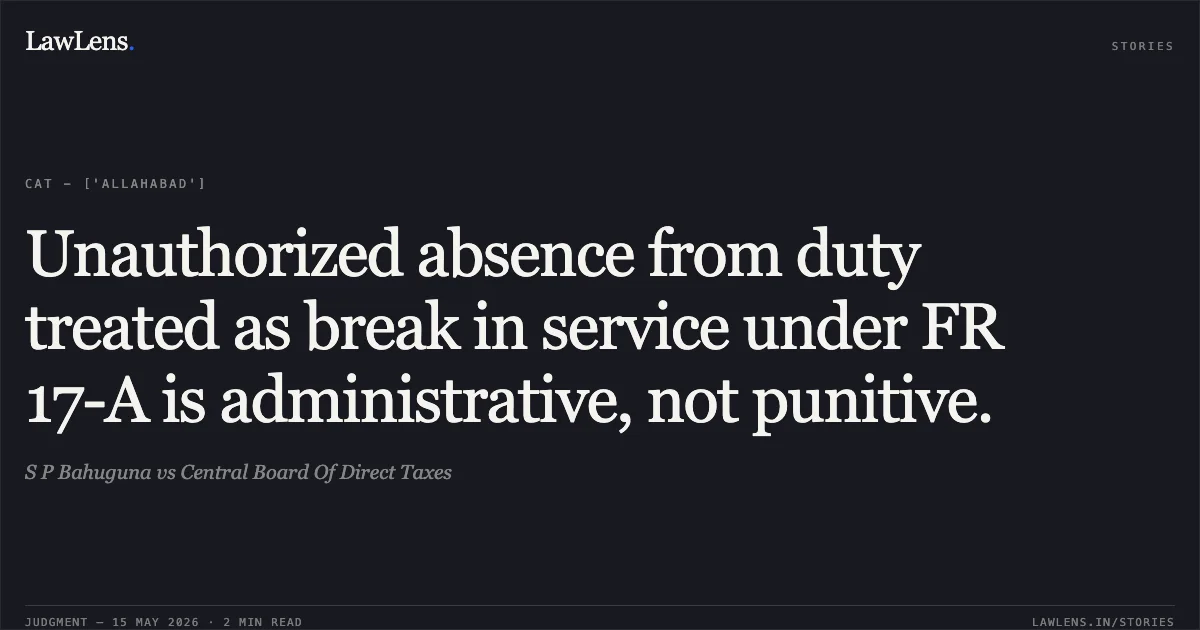
The court answered that orders under FR 17-A are administrative, not punitive, and do not suffer from procedural infirmity for lack of a formal inquiry
Source reference: p. 9Consequently, the Original Application was dismissed, and the orders treating the periods of absence as a break in service were upheld
Source reference: p. 9Acts & Sections Cited
1 provisions across 1 statute referred to in this judgment. Each provision opens on LawLens.
Administrative Tribunals Act, 19851
Original Court PDF
S P BahugunavsCentral Board Of Direct Taxes
Click to open original judgment
Original judgment, available to read, download and summarize on LawLens.in