Facts
Chunnu sustained multiple firearm injuries in an incident on 20 July 1981.
Source reference: no citationThe prosecution alleged that Munnilal and Ballu fired at him, while Hassu—whose name was not in the prompt FIR—was armed with a knife and helped restrain him.
Source reference: no citationThe Sessions Court convicted Hassu and Ballu under Section 307 read with Section 34 IPC and sentenced each to five years’ rigorous imprisonment and a fine.
Source reference: para. 2–4Ballu died during the appeal, which accordingly abated against him; the appeal continued for Hassu.
Source reference: para. 2–4The injured witness, PW-4, attributed the firing to Munnilal and Ballu and alleged a different role for Hassu.
Source reference: para. 11–13, 16–22The informant, PW-2, gave conflicting accounts of whether he witnessed the incident, while PW-3 did not support the prosecution.
Source reference: para. 11–13, 16–22Issues
Whether the prosecution proved beyond reasonable doubt that Hassu participated in the assault on Chunnu
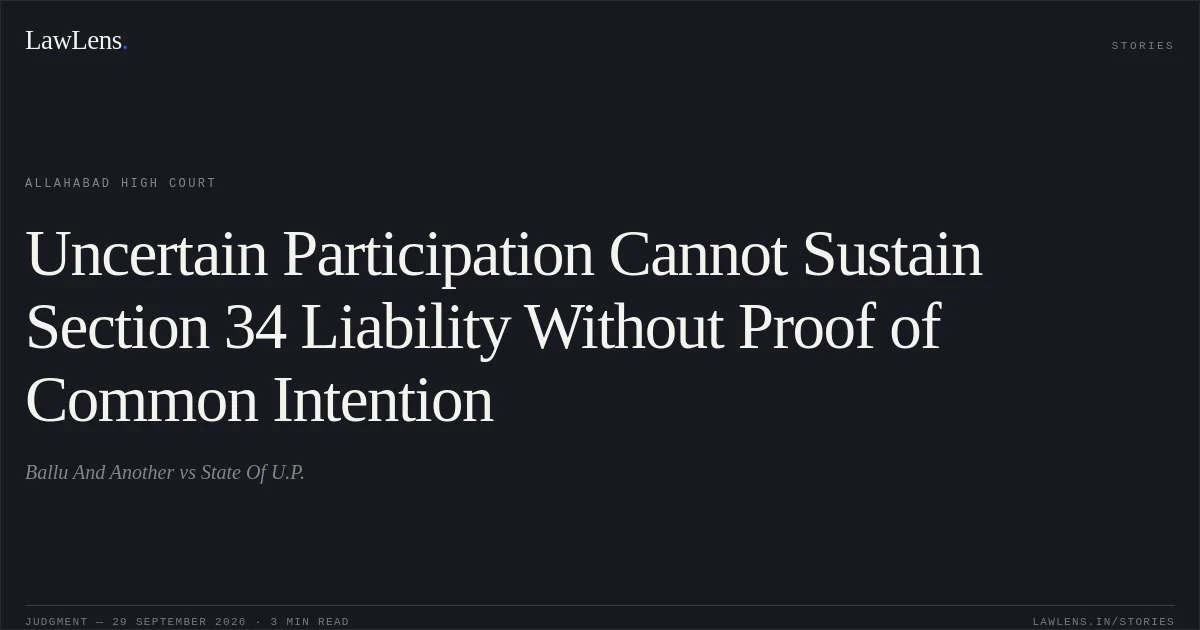
Source reference: para. 14–15Whether Hassu’s participation and common intention with the other accused to commit the offence under Section 307 IPC were established so as to attract Section 34 IPC
Source reference: para. 14, 28–29Law Applied
Section 307 IPC concerns an attempt to murder, while Section 34 IPC imposes joint liability where a criminal act is committed by several persons in furtherance of their common intention; the prosecution must prove both participation and the requisite common intention, which may be inferred from reliable evidence but cannot rest on conjecture or mere presence.
Source reference: para. 28Under Sections 145 of the Evidence Act and 161 of the CrPC, a prior police statement may be used to contradict a witness in court in accordance with the procedure described in Tahsildar Singh v. State of Uttar Pradesh, AIR 1959 SC 1012; an omission may amount to a contradiction where it meets the principles identified in that decision.
Source reference: para. 23The prosecution must prove guilt beyond reasonable doubt, and a reasonable doubt grounded in the evidence must benefit the accused; the Court referred to Shivaji Sahebrao Bobade v. State of Maharashtra, State of Punjab v. Jagir Singh, Yogesh Singh v. Mahabeer Singh and Suresh Thipmppa Shetty v. State of Maharashtra.
Source reference: para. 31–35Test identification evidence is corroborative and cannot substitute for reliable substantive identification.
Source reference: para. 27Reasoning
The Court found that the medical evidence established Chunnu’s firearm injuries but did not establish Hassu’s participation. PW-2’s contradictory evidence made him unreliable as an eyewitness, and PW-3 provided no corroboration.
Source reference: para. 15–17PW-4 specifically attributed the shooting to Munnilal and Ballu; Hassu’s alleged role was inconsistent, and the specific claim that he caught Chunnu by the hair was a material improvement over his police statement. No knife injury was found.
Source reference: para. 18–24Hassu’s omission from the prompt FIR, together with the delayed and questionable identification proceedings, further weakened the case against him.
Source reference: para. 26–27In these circumstances, the Court held that neither Hassu’s participation nor his sharing of a common intention to commit the firearm assault was proved; Section 34 could not supply the missing proof.
Source reference: para. 28–30, 36–37Holding
The Court allowed Hassu’s appeal, set aside his conviction and sentence under Section 307/34 IPC, and acquitted him by giving him the benefit of doubt.
It directed that he be released if not required in another case, cancelled any subsisting bail bonds and discharged the sureties; it also directed transmission of the judgment and payment of the amicus curiae’s remuneration.
Source reference: para. 41–44Acts & Sections Cited
3 provisions across 2 statutes referred to in this judgment. Each provision opens on LawLens.
Indian Penal Code, 18602
Code of Criminal Procedure, 19731
Original Court PDF
Ballu And AnothervsState Of U.P.
Click to open original judgment
Original judgment, available to read, download and summarize on LawLens.in