Facts
The respondent was initially appointed as an LDC/Computer, promoted and regularised as Junior Investigator, and subsequently appointed on deputation as Junior Technical Analyst in the Department of Science and Technology (“DST”). After the creation of the Department/Ministry of Non-Conventional Energy Sources (“DNES/MNES”) and the Solar Energy Sector (“SEC”), he was directly recruited as a Technical Analyst on 16 October 1985.
Source reference: pp. 1–2, paras. 1–3Under the Recruitment Rules applicable to the DST, a Technical Analyst became eligible for consideration for promotion as Junior Analyst (Technical) after three years of regular service.
Source reference: p. 2, para. 4The respondent’s claim for promotion was litigated before the Central Administrative Tribunal (“Tribunal”). In OA 509/1999, decided on 26 July 2001, the Tribunal recorded that the Government had admitted that the respondent had completed the requisite three years’ service as Technical Analyst and directed consideration of his promotion as Junior Analyst (Technical).
Source reference: pp. 3–4, paras. 7–9The respondent was ultimately regularised as Junior Analyst (Technical) with effect from 2 November 2001.
Source reference: p. 4, para. 13Contending that his promotion ought to have been granted from 1988–89, the respondent filed OA 2668/2005 after withdrawing an earlier writ petition pursuant to the liberty granted by the High Court in view of L. Chandra Kumar v. Union of India, (1997) 3 SCC 261.
Source reference: p. 5, para. 14The Tribunal directed the petitioners to reconsider the respondent for promotion to the posts of Senior Scientific Officer Grade-II, Senior Scientific Officer Grade-I, Principal Scientific Officer and other higher posts at par with similarly treated employees, including by convening a review DPC and granting consequential notional and retiral benefits, subject to fitness.
Source reference: pp. 6–7, paras. 20–23The Union of India challenged that decision before the High Court.
Source reference: p. 7, para. 24Issues
Whether the respondent was entitled to be considered for promotion as Junior Analyst (Technical) after completing three years of regular service as Technical Analyst, notwithstanding that the DNES framed its own Recruitment Rules only in 2001?
Source reference: pp. 7–8, paras. 26–29Whether the Tribunal could direct reconsideration of the respondent’s further promotions by treating him as having been promoted as Junior Analyst (Technical) from the relevant earlier period, in light of the final and unchallenged judgment in OA 509/1999?
Source reference: pp. 8–9, paras. 30–33Whether the Tribunal’s directions to convene a review DPC and reconsider the respondent for higher posts suffered from any legal or jurisdictional error?
Source reference: p. 9, paras. 32–34Law Applied
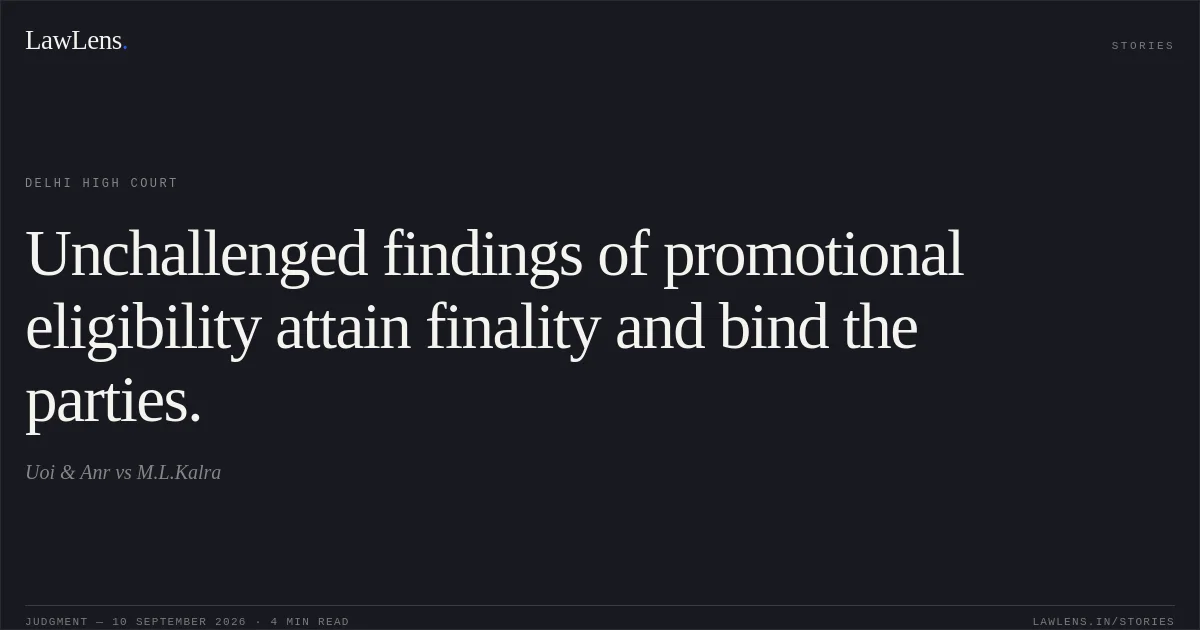
The Court applied the principle that an unchallenged judicial finding attaining finality is binding on the parties and cannot be reopened in subsequent proceedings.
Source reference: p. 8, para. 28It further applied the doctrine that an admission made by a party in earlier litigation, when recorded in a judicial decision, may determine the parties’ rights unless that decision is successfully challenged.
Source reference: pp. 7–8, paras. 26–28The Court also relied on the applicable Recruitment Rules, under which three years of regular service as Technical Analyst constituted eligibility for consideration for promotion as Junior Analyst (Technical).
Source reference: pp. 2, 3–4, paras. 4, 8–9L. Chandra Kumar v. Union of India, (1997) 3 SCC 261, was relevant to the procedural history because it enabled the respondent to withdraw his earlier writ petition and pursue the remedy before the Tribunal.
Source reference: p. 5, para. 14Reasoning
The Court held that the central issue had already been substantially resolved in OA 509/1999.
Source reference: no citationIn that decision, the Tribunal expressly recorded the petitioners’ admission that the respondent, having been directly recruited as Technical Analyst on 16 October 1985, had completed the requisite three years’ service and was eligible for consideration for promotion as Junior Analyst (Technical).
Source reference: pp. 3–4, para. 9Since that judgment was never challenged, its finding attained finality and bound the parties.
Source reference: p. 8, para. 28The reference to eligibility could not relate to the DNES Recruitment Rules framed only in 2001; it necessarily referred to the Recruitment Rules then applicable by which the respondent became eligible in 1988–89.
Source reference: p. 8, para. 26Accordingly, the petitioners could not rely on the later framing of Recruitment Rules or the respondent’s subsequent regularisation in 2001 to defeat his accrued right to consideration.
Source reference: no citationThe Tribunal was therefore justified in directing a review of his entitlement to higher promotions, while leaving the actual grant of promotion subject to suitability and fitness.
Source reference: pp. 8–9, paras. 29–33Holding
The High Court dismissed the Union of India’s challenge and upheld the Tribunal’s judgment dated 7 June 2007 in OA 2668/2005, finding no legal or jurisdictional error.
The petitioners were directed to reconsider the respondent for promotion to the posts of Senior Scientific Officer Grade-II, Senior Scientific Officer Grade-I, Principal Scientific Officer and other appropriate higher posts by convening a review DPC, if required, within twelve weeks.
Source reference: p. 9, para. 33Such consideration was to proceed on the basis that the respondent’s entitlement to further promotions would reckon by treating him as Junior Analyst (Technical) with effect from 13 October 1992, subject to his being found suitable for the respective posts.
Source reference: p. 8, para. 31; p. 9, para. 33Original Court PDF
Uoi & AnrvsM.L.Kalra
Click to open original judgment
Original judgment, available to read, download and summarize on LawLens.in