Facts
The petitioner sought consideration for promotion to Statistical Officer ahead of respondents Nos. 4–6, alleging that juniors had been promoted while his case had not been considered.
Source reference: para. 1–2He had submitted a representation and asked the Court, in the alternative, to direct the authorities to decide it.
Source reference: para. 1–2At the hearing, the petitioner sought a direction to submit a fresh representation for decision within a specified time; the State did not oppose that limited request.
Source reference: para. 2–4Issues
1. Whether the petitioner’s representation concerning his non-consideration for promotion should be directed to be decided by the competent authority.
Source reference: para. 2–4, 10–122. Whether uncommunicated ACR entries may be relied on when considering an employee for promotion.
Source reference: para. 5–9Law Applied
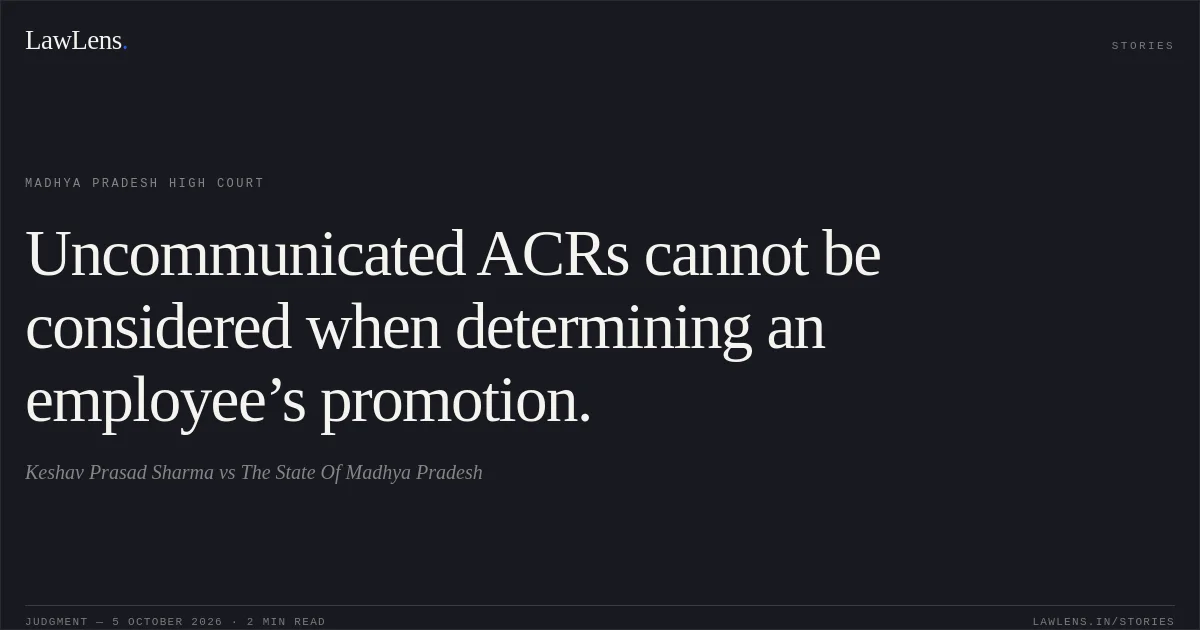
Under Article 14 of the Constitution, non-communication of an adverse ACR entry that may affect promotion is arbitrary; uncommunicated ACRs cannot be considered to the employee’s detriment in promotion proceedings.
Source reference: para. 5–9The Court relied on Dev Dutt v. Union of India, (2008) 8 SCC 725; Abhijit Ghosh Dastidar v. Union of India, (2009) 16 SCC 146; Gurdial Singh Fijji v. State of Punjab, (1979) 2 SCC 368; and the other decisions discussed in paragraphs 5–9.
Source reference: para. 5–9It also referred to Union of India v. K.V. Jankiraman, AIR 1991 SC 2010, and subsequent decisions for the principle that “no work, no pay” may not apply where the employee was not at fault and the department deprived him of the opportunity to perform promotional duties.
Source reference: para. 7Reasoning
The Court considered the authorities concerning uncommunicated ACRs and noted that such entries cannot be used by a DPC to deny promotion.
Source reference: para. 5–9It also observed that the respondents had not shown any fault on the petitioner’s part for the non-consideration of his case alongside his juniors.
Source reference: para. 7However, the petitioner pressed only for a direction to have a fresh representation decided, and the State did not oppose that request.
Source reference: para. 2–4The Court therefore left the promotion claim for consideration by the competent authority rather than deciding the petitioner’s entitlement to promotion itself.
Source reference: para. 10–12Holding
The petition was disposed of with directions that the petitioner submit a fresh, detailed representation within two weeks.
The competent authority must give him a personal hearing, pass a reasoned and speaking order in accordance with law, consider the decisions referred to in paragraphs 5–9, and decide the representation within one month of receiving a certified copy of the order.
Source reference: para. 10–12The Court did not itself grant promotion or consequential monetary benefits.
Source reference: para. 10–12Original Court PDF
Keshav Prasad SharmavsThe State Of Madhya Pradesh
Click to open original judgment
Original judgment, available to read, download and summarize on LawLens.in