Facts
The petitioner, an Investigator in the Directorate of Economics and Statistics since 2010, became eligible for his first time-scale pay upgrade on 19.07.2020.
Source reference: para. 2The respondents denied this benefit, citing that his Annual Confidential Reports (ACRs) for 2017–2020 did not meet the prescribed benchmark.
Source reference: para. 2These ACRs, while not "adverse" (graded as "average" and "good"), were never communicated to the petitioner.
Source reference: para. 5The petitioner discovered the gradings via an RTI application and filed a representation for upgradation, which remained pending.
Source reference: para. 2Although he was eventually granted the pay scale effective 19.07.2022, he approached the High Court seeking the benefit retrospectively from 2020 by challenging the non-communication of the ACRs.
Source reference: para. 3Issues
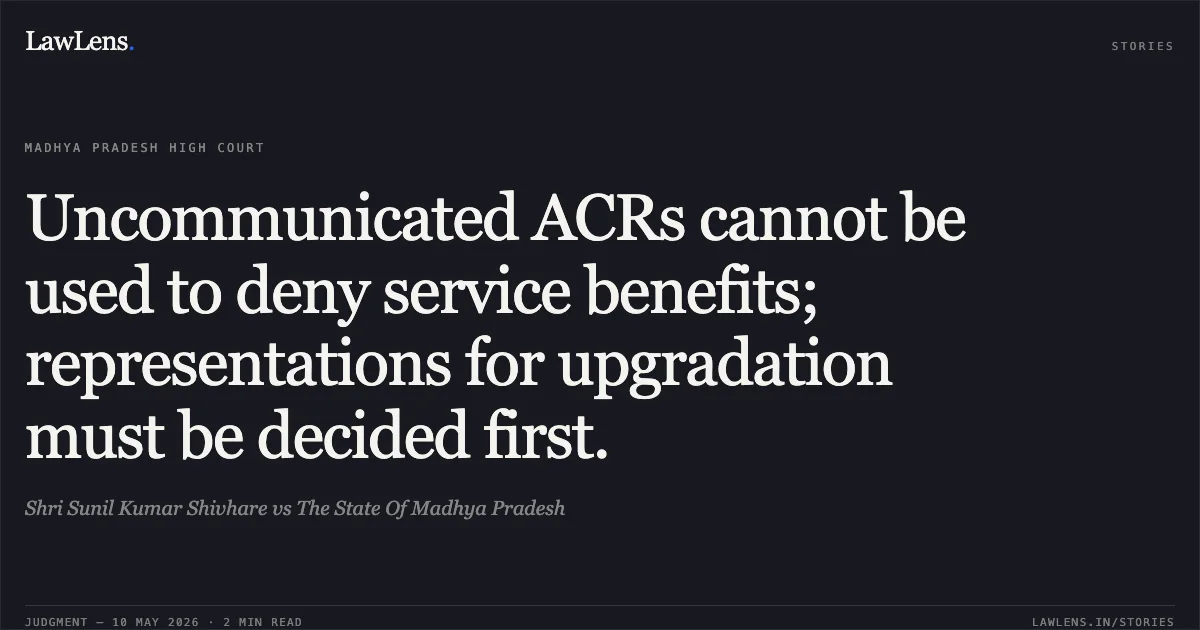
1. Whether the respondents were legally obligated to communicate ACRs graded "average" or "good" to the petitioner before using them to deny a financial benefit.
Source reference: para. 92. Whether uncommunicated ACRs that fall below a benchmark should be expunged or if the petitioner should be granted an opportunity to represent against them for retrospective reconsideration.
Source reference: para. 12-13Law Applied
The court primarily applied the principle of fairness and natural justice under Article 14 of the Constitution as interpreted by the Supreme Court in Dev Dutt v. Union of India (2008).
Source reference: para. 9Every entry in the ACR (be it poor, fair, average, good, or outstanding) must be communicated to a public servant within a reasonable period.
Source reference: para. 9, para. 17 of Dev DuttNon-communication of an entry that adversely affects promotion or benefits is arbitrary and illegal.
Source reference: para. 9, para. 16 of Dev DuttReasoning
The court found that the respondents admittedly failed to communicate the ACRs for 2017–2020 to the petitioner.
Source reference: para. 11It rejected the State’s argument that "average" or "good" entries did not require communication, noting that when such entries fall below a specific benchmark for a benefit (like the time-scale pay), they function as adverse entries.
Source reference: para. 9Applying the Dev Dutt framework, the court reasoned that while the petitioner sought to have the ACRs "expunged" based on Pradeep Kumar Sharma v. State of M.P., the more appropriate remedy under Apex Court guidelines is to allow the competent authority to decide on the pending representation for upgradation first.
Source reference: para. 13The court linked the denial of the 2020 pay scale directly to these uncommunicated reports, characterizing the omission as a violation of the "soul of natural justice".
Source reference: para. 10Holding
The Court partly allowed the petition.
The Court held that the non-communication of the ACRs was improper and directed the respondents to decide on the petitioner’s pending representation for ACR upgradation (Annexure-P/5) within 30 days.
Source reference: para. 13The court ordered that if the ACRs are subsequently upgraded and the petitioner meets the benchmark, the respondents must reconsider his case for the first time-scale pay retrospectively from 19.07.2020 and grant all consequential arrears within an additional 60 days.
Source reference: para. 14Acts & Sections Cited
1 provisions across 1 statute referred to in this judgment. Linked provisions open on LawLens.
Right to Information Act, 20051
Original Court PDF
Shri Sunil Kumar ShivharevsThe State Of Madhya Pradesh
Click to open original judgment
Original judgment, available to read, download and summarize on LawLens.in


![Authorities must decide pensionary and retiral-benefit claims through a reasoned order within eight weeks.. Habibullah khan vs HOME DEPARTMENT. CAT - ['Srinagar']. LawLens](/stories/thumbnails/authorities-must-decide-pensionary-and-retiral-benefit-claims-through-a-reasoned-order-wit-d0cbe8a8119c48fbabe7df9f2d353488.webp)