Facts
The applicant was appointed as General Manager (R&D), Level 13, at the National Council for Cement and Building Material (NCCBM) on October 27, 2014
Source reference: p. 3, para 2Although he initially held additional responsibilities, these were withdrawn in 2018-2019, and he was issued a censure order in July 2019
Source reference: p. 3, para 2In November 2020, the applicant was called for a Standing Selection Committee (DPC) for promotion to Joint Director (Level 13A).
Source reference: p. 4, para 2He submitted a representation stating that his Annual Performance Appraisal Reports (APARs) from 2014 onwards had never been communicated to him
Source reference: p. 4, para 2Despite this, the DPC was held, and junior officers were promoted in December 2020
Source reference: p. 4, para 2The applicant was subsequently supplied copies of his APARs for 2014–2019, showing a "Poor" rating for 2019, which the respondents used to declare him ineligible for promotion
Source reference: p. 4, para 2The applicant challenged the legality of relying on uncommunicated APARs to deny promotion
Source reference: p. 2, para 1Issues
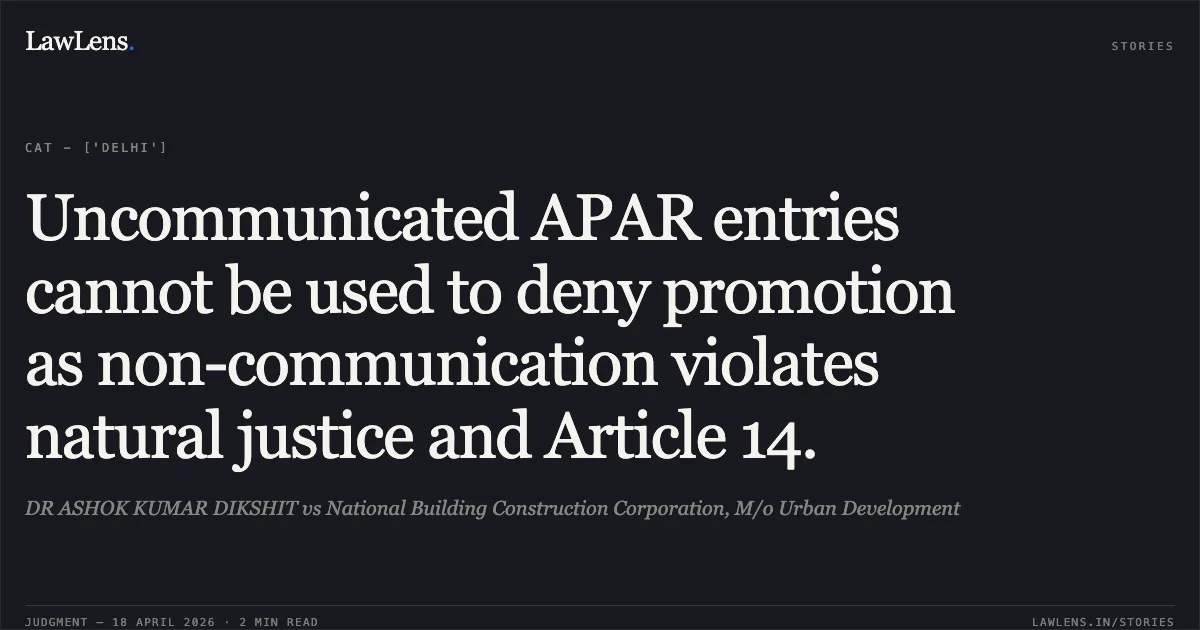
1. Whether the non-communication of APAR entries from 2014 to 2019 constitutes a violation of the Principles of Natural Justice and Article 14 of the Constitution
Source reference: p. 11, para 62. Whether the Departmental Promotion Committee (DPC) can legally rely upon uncommunicated "below benchmark" or "adverse" APAR entries to deny an employee promotion
Source reference: p. 11, para 6Law Applied
The court primarily relied on the landmark Supreme Court precedents in Dev Dutt v. Union of India (2008) and Abhijit Ghosh Dastidar v. Union of India (2008), which established that every entry in the APAR (whether adverse or merely below benchmark) must be communicated to the public servant to ensure transparency and provide an opportunity for improvement or representation
Source reference: p. 11, para 6It further cited Sukhdev Singh v. Union of India (2013) and Article 14 of the Constitution, affirming that non-communication of such entries has civil consequences and is inherently arbitrary
Source reference: p. 7, para 3(viii); p. 11, para 6Reasoning
The Tribunal observed that it was an admitted fact that the APARs for the period 2014–2019 were not communicated to the applicant until after the DPC had concluded its proceedings
Source reference: p. 11, para 6The court reasoned that the fundamental purpose of communicating APARs is to allow an officer to rectify defects and improve performance; hence, withholding these entries until the moment of promotion evaluation prevents the employee from exercising their right to representation
Source reference: p. 5, para 3(iii)Applying the ratio from Dev Dutt, the Tribunal held that any entry not communicated within a reasonable period cannot be taken into cognizance by a DPC to the disadvantage of the official
Source reference: p. 11, para 6The Tribunal rejected the respondents' arguments regarding the applicant's "Poor" performance, noting that the procedural failure to communicate those assessments rendered them legally unusable for the purpose of the 2020 DPC
Source reference: p. 11, para 6Holding
The Tribunal allowed the O.A., holding that the balance of convenience lay with the applicant due to the respondents' violation of settled legal principles
The court quashed the reliance on uncommunicated APARs and directed the respondents to conduct a review Departmental Promotion Committee (DPC) within six months to consider the applicant’s promotion to the post of Joint Director (Level 13A) effective from the date his juniors were promoted
Source reference: p. 12, para 7No order was made as to costs
Source reference: p. 12, para 7Acts & Sections Cited
1 provisions across 1 statute referred to in this judgment. Each provision opens on LawLens.
Administrative Tribunals Act, 19851
Original Court PDF
DR ASHOK KUMAR DIKSHITvsNational Building Construction Corporation, M/o Urban Development
Click to open original judgment
Original judgment, available to read, download and summarize on LawLens.in


