Facts
The petitioner was original Defendant No. 7 in Regular Civil Suit No. 559 of 2008 before the Principal Senior Civil Court, Surat.
Source reference: paras. 1.2–1.3; pp. 1–6Respondent Nos. 1–14 were the original plaintiffs, and Respondent Nos. 15–16 represented original Defendant Nos. 1–6. The suit sought declaration of ownership and permanent injunction concerning land bearing Survey No. 21 at Village Vadod, Taluka Choryasi, District Surat.
Source reference: paras. 1.2–1.3; pp. 1–6Defendant Nos. 1–6 had filed a counterclaim. During the pendency of the proceedings, the plaintiffs and Defendant Nos. 1–6 filed separate purses seeking unconditional withdrawal of the suit and counterclaim.
Source reference: paras. 1.2–1.3; pp. 1–6The withdrawal purses referred to a compromise, which Defendant No. 7 denied having entered into. The Trial Court nevertheless allowed the unconditional withdrawal on 19 June 2026 without adjudicating Defendant No. 7’s objection.
Source reference: paras. 1.2–1.3, 5–6; pp. 1–6Defendant No. 7 challenged that order under Article 227 of the Constitution, seeking restoration of the suit and interim protection against dealings with the suit land.
Source reference: para. 2; pp. 2–3Issues
Whether the unconditional withdrawal of the suit and counterclaim was governed by Order XXIII Rule 1 of the Code of Civil Procedure, 1908, or whether the matter was required to be dealt with under Order XXIII Rule 3 on account of the reference to a compromise.
Source reference: paras. 3.1–3.2, 6; pp. 3–4, 6Whether Defendant No. 7 had a right to object to the plaintiffs’ unconditional withdrawal of the suit and to the withdrawal of Defendant Nos. 1–6’s counterclaim.
Source reference: paras. 8, 11–13; pp. 6, 14–17Whether the Trial Court committed any jurisdictional error by allowing the unconditional withdrawal without separately adjudicating Defendant No. 7’s objection.
Source reference: paras. 5, 7–8, 14; pp. 5–7, 17–18Law Applied
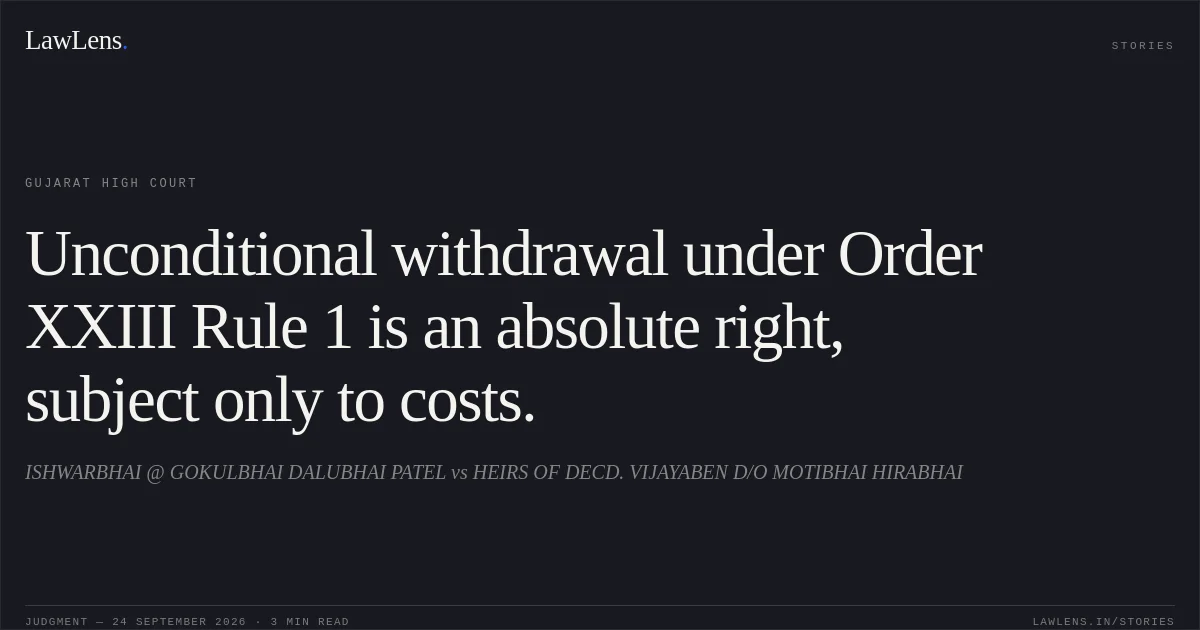
The Court applied Order XXIII Rule 1 CPC, under which a plaintiff has an absolute right to abandon or unconditionally withdraw a suit or part of a claim, without requiring the Court’s permission, subject to the statutory consequences and costs; a defendant cannot compel the plaintiff to continue the suit, except by seeking costs.
Source reference: paras. 10.1–10.3; pp. 7–13This principle was drawn from Shiv Prasad v. Durga Prasad, (1975) 1 SCC 405, Anurag Mittal v. Shaily Mishra Mittal, (2018) 9 SCC 691, and Anil Kumar Singh v. Vijay Pal Singh, (2018) 12 SCC 584.
Source reference: paras. 10.1–10.3; pp. 7–13Order XXIII Rule 3 CPC applies where the Court is called upon to record and adjudicate a compromise or satisfaction, particularly where an objection is raised by a party whose vested rights may be affected.
Source reference: paras. 12–12.2.1; pp. 15–17The Court distinguished Sneh Gupta v. Devi Sarup, (2009) 6 SCC 194, and Mahalaxmi Co-operative Housing Society Ltd. v. Ashabhai Atmaram Patel, (2013) 4 SCC 404, on the basis that those cases concerned compromise arrangements or accrued rights, rather than an unconditional withdrawal.
Source reference: paras. 12–12.2.1; pp. 15–17The same principle was also adopted from the Gujarat High Court decision in Rameshbhai Chhelshankar Oza v. Deven Jagnath Joshi.
Source reference: para. 10.4; p. 13Reasoning
The Court found that the withdrawal purses sought an unconditional withdrawal of the suit and counterclaim and did not seek the Court’s approval of a compromise or the drawing of a consent decree.
Source reference: paras. 7–9; pp. 6–7The reference to a compromise in the purses did not convert the applications into compromise applications under Order XXIII Rule 3, particularly because no compromise decree had been passed.
Source reference: paras. 7–9; pp. 6–7Defendant No. 7 had filed neither a counterclaim nor obtained any decree or crystallized right during the pendency of the suit. Consequently, his objection could not restrict the plaintiffs’ absolute right to withdraw the suit or the counterclaimants’ right to withdraw their counterclaim.
Source reference: para. 8; p. 6Since unconditional withdrawal is effective upon its communication to the Court and a defendant may at most seek costs, the Trial Court was not required to adjudicate Defendant No. 7’s objection before permitting withdrawal.
Source reference: paras. 10.1–10.4, 11–13; pp. 7–17The cases relied upon by the petitioner were distinguishable because they involved compromise proceedings or rights already vested by an earlier decree.
Source reference: paras. 10.1–10.4, 11–13; pp. 7–17Holding
The High Court held that the withdrawal purses were governed by Order XXIII Rule 1 CPC and not Rule 3.
Defendant No. 7 had no legally enforceable or vested right to object to the unconditional withdrawal, and the Trial Court committed no jurisdictional error in allowing the suit and counterclaim to be withdrawn.
Source reference: paras. 13–14; pp. 17–18The petition was dismissed in limine with costs of ₹15,000.
Source reference: paras. 14–16; p. 18The petitioner was directed to deposit the costs with the District Legal Services Authority, Surat, within one month, failing which the amount could be recovered in accordance with law.
Source reference: paras. 14–16; p. 18Acts & Sections Cited
2 provisions across 2 statutes referred to in this judgment. Each provision opens on LawLens.
Code of Civil Procedure, 19081
Hindu Marriage Act, 19551
Original Court PDF
ISHWARBHAI @ GOKULBHAI DALUBHAI PATELvsHEIRS OF DECD. VIJAYABEN D/O MOTIBHAI HIRABHAI
Click to open original judgment
Original judgment, available to read, download and summarize on LawLens.in