Facts
The Appellant/Plaintiff, M/s Hi-Tech Geosynthetics Pvt. Ltd., was engaged by the Respondent/Defendant, M/s Shubh Construction Co., under a Work Order dated 5 May 2009 to execute reinforced earth wall work for a bridge project on Bilhar–Sareni Road, Uttar Pradesh. The total contract value was Rs.14,28,800, and the work was to be completed within 40 days. The Work Order assigned the Appellant responsibility for geosynthetic materials, certain labour, designs, supervision and a corporate performance guarantee, while the Respondent was responsible for machinery, drainage and backfill material, labour, corner columns, permits and related site obligations.
Source reference: paras. 3–4, 21, 51–53The Appellant alleged that delay was caused by the Respondent’s failure to provide site clearance, machinery, labour, drainage material and Form-38 road permits. It claimed Rs.4,28,800 as the contractual balance, along with amounts for anchor pins, idle labour and transportation-related expenses, totalling Rs.7,58,118, together with interest at 24% per annum. The Respondent denied liability, alleged that the Appellant had failed to complete the work and furnish the performance guarantee, and asserted that Rs.10,00,000 had already been paid to the Appellant.
Source reference: paras. 5–8, 18–30The suit was initially instituted under Order XXXVII CPC, but was later treated as an ordinary suit. After the Respondent’s ex parte judgment was set aside under Order IX Rule 13 CPC, the matter proceeded to trial. The Trial Court held that Delhi had territorial jurisdiction but dismissed the suit on the ground that the Appellant had failed to prove due performance, the extent of work executed and its entitlement to the amount claimed. The Appellant challenged that dismissal in the present appeal under Section 96 read with Order XLI CPC.
Source reference: paras. 1, 10–13, 35–40Issues
Whether the suit was maintainable before the Delhi courts and whether any part of the cause of action arose within Delhi?
Source reference: para. 32(i); para. 35Whether the Appellant proved performance of its contractual obligations and was entitled to recover Rs.7,58,118 from the Respondent?
Source reference: para. 32(ii); paras. 51–53, 79–95Whether the Appellant was entitled to pendente lite and future interest, and, if so, at what rate and for what period?
Source reference: para. 32(iii)Whether the Trial Court’s dismissal of the suit warranted interference in appeal under Section 96 CPC?
Source reference: paras. 1, 40–50, 95–97Law Applied
The Court applied Section 96 read with Order XLI CPC, governing a regular first appeal against a decree, and examined the correctness of the Trial Court’s appreciation of the pleadings and evidence.
Source reference: para. 1It applied the contractual allocation of obligations contained in the Work Order, holding that the parties were bound by their respective expressly defined scopes of work, including the Appellant’s obligation to furnish a corporate performance guarantee after satisfactory completion and the Respondent’s obligations concerning machinery, labour, drainage, backfill material and permits.
Source reference: paras. 21, 52, 80, 83–84The Court also applied the general evidentiary principle that the party asserting a monetary entitlement bears the burden of proving the work performed, the amount due and the factual basis of its claim through cogent and reliable evidence; unilateral correspondence and unauthenticated internal records are insufficient where the alleged facts are capable of documentary verification.
Source reference: paras. 66, 70–71, 86–91, 93–95Reasoning
The Court upheld the finding on territorial jurisdiction because the Work Order and correspondence were addressed to the Appellant in Delhi and invoices were raised from its Delhi office, giving rise to part of the cause of action there.
Source reference: para. 35On the merits, the Court found that expiry of the 40-day period did not by itself terminate the contractual relationship, since the Respondent continued dealing with the Appellant and did not terminate the Work Order on that ground.
Source reference: paras. 58–60, 85However, the Appellant failed to substantiate its allegations that the Respondent’s defaults caused the delay. Its letters were unilateral, and there was no independent site record, PWD evidence or other corroboration regarding the alleged non-availability of machinery, labour, drainage material or permits.
Source reference: paras. 64–74Although the Work Order placed drainage-filter obligations on the Respondent, the Appellant did not prove that the filter had actually been omitted or that the alleged saving of Rs.2,50,000 had occurred.
Source reference: paras. 77–84The Appellant also admittedly did not furnish the contractual performance guarantee, and its explanation that the guarantee could be furnished only after completion of the larger bridge project was unsupported by reliable evidence.
Source reference: paras. 79–82, 92Finally, the Measurement Book was not produced; the DPRs were belatedly produced, were not countersigned on the originals by the Respondent or authenticated by PWD officials, and their author was not examined. They therefore could not reliably establish the quantity or value of work executed.
Source reference: paras. 86–91In the absence of proof of the work completed and the precise balance payable, the claim for Rs.7,58,118 failed.
Source reference: no citationHolding
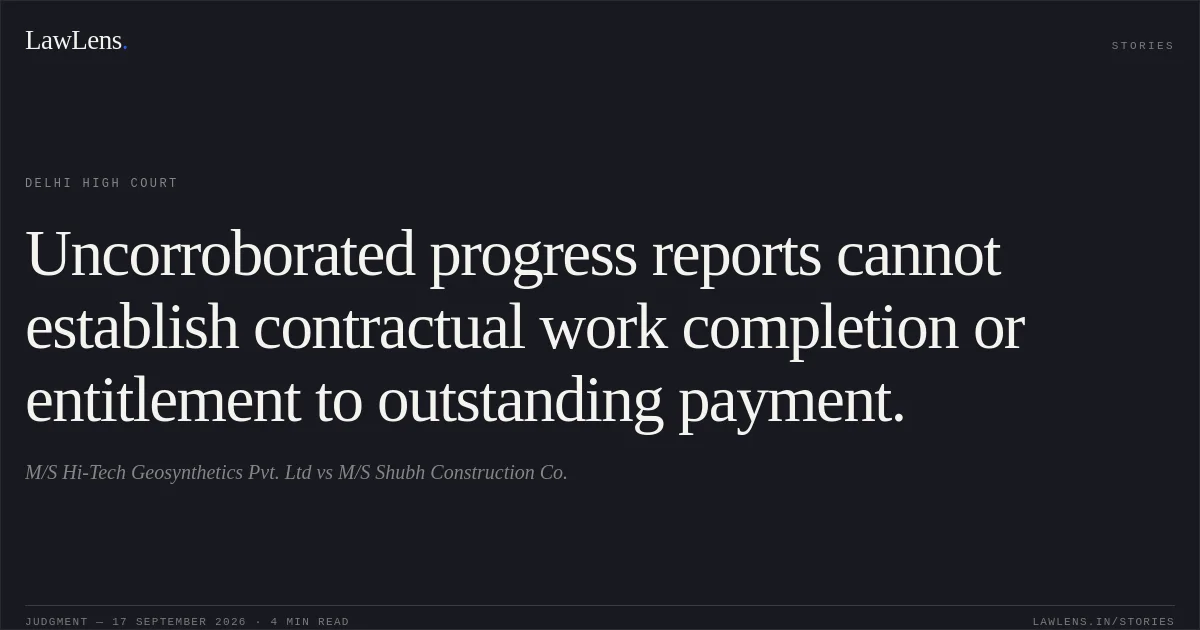
The Delhi High Court held that the Delhi courts had territorial jurisdiction, but that the Appellant failed to prove its contractual entitlement to Rs.7,58,118.
The alleged breaches by the Respondent, the extent of work executed, the balance amount claimed and the supporting expenses were not established through cogent and reliable evidence. The non-furnishing of the performance guarantee and the absence of authenticated measurement records further weakened the claim.
Source reference: paras. 80–95The appeal was dismissed, the Trial Court’s judgment and decree dated 20 February 2026 were affirmed, and all pending applications were disposed of.
Source reference: paras. 95–97Acts & Sections Cited
1 provisions across 1 statute referred to in this judgment. Each provision opens on LawLens.
Code of Civil Procedure, 19081
Original Court PDF
M/S Hi-Tech Geosynthetics Pvt. LtdvsM/S Shubh Construction Co.
Click to open original judgment
Original judgment, available to read, download and summarize on LawLens.in