Facts
The Appellant (Shambhu) was convicted by the Trial Court under Section 376(2) of the IPC and Section 6 of the POCSO Act for the alleged repeated sexual assault and criminal intimidation of his minor sister-in-law (PW1) between 2015 and 2016.
Source reference: p. 1-2The prosecution's case rested on the FIS/FIR (Ext. PW1/B) and a Section 164 statement (Ext. PX5) where PW1 initially alleged non-consensual relations and threats.
Source reference: p. 7-8However, during the trial, PW1 resiled from these statements, testifying that the relationship was consensual and that she was a major (above 18 years) at the time of the incident.
Source reference: p. 10-11PW4 (the mother) also testified that she had deliberately understated PW1's age in school records to secure admission.
Source reference: p. 16The Appellant challenged the conviction primarily on the grounds of failed proof of the victim's minority and the consensual nature of the relationship.
Source reference: p. 6Issues
1. Whether there is any infirmity in the impugned judgment of conviction that warrants interference by the High Court.
Source reference: p. 72. Whether the prosecution proved beyond reasonable doubt that the victim (PW1) was a minor at the time of the alleged offense to sustain a conviction under the POCSO Act.
Source reference: p. 18Law Applied
The Court applied Section 374(2) of the Cr.P.C. regarding appeals from convictions.
Source reference: p. 1It relied on Section 375 of the IPC (definition of rape) and Section 6 of the POCSO Act (aggravated penetrative sexual assault).
Source reference: p. 2Regarding evidence, the Court applied Section 162 of the Cr.P.C., which prohibits the use of statements made to police during investigations as substantive evidence, rendering the school’s age certificate (Ext. PW6/C) inadmissible.
Source reference: p. 18-19The Court adhered to the principle that a conviction cannot stand if the prosecution fails to prove the age of the victim in POCSO cases or the lack of consent in IPC rape cases involving adults.
Source reference: p. 21Reasoning
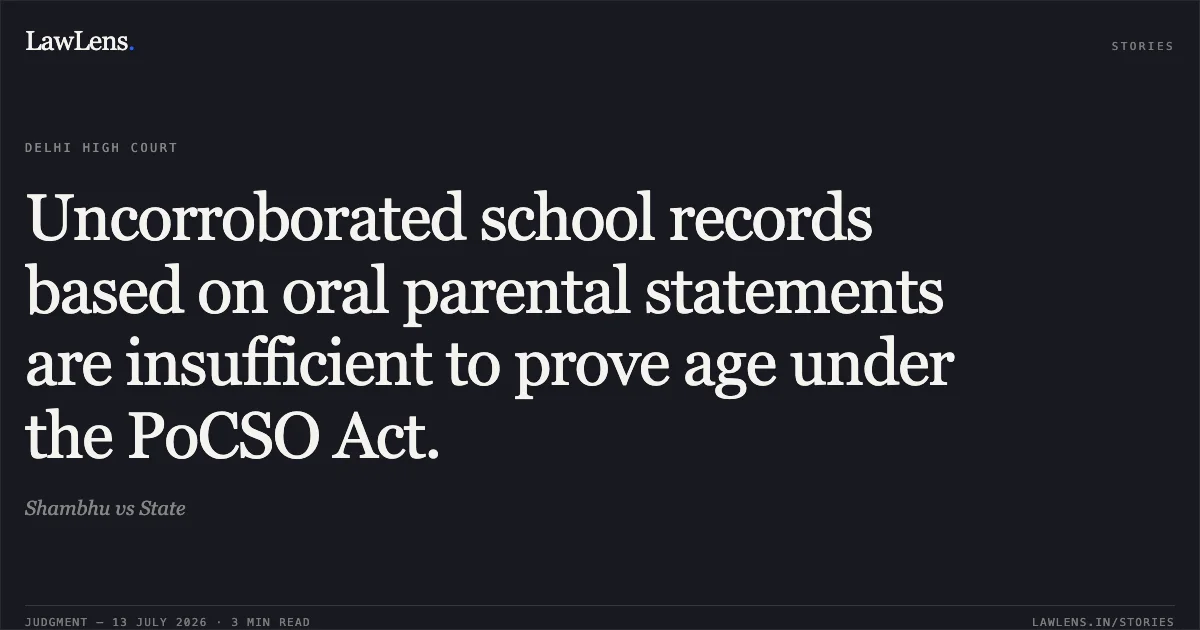
The Court found the prosecution's evidence regarding the victim's age to be unreliable. The school Principal (PW6) admitted that the date of birth in the register (08.03.2004) was based solely on oral statements by parents without documentary proof.
Source reference: p. 17This was further undermined by the mother (PW4), who admitted to providing a false, younger age to the school.
Source reference: p. 16, 19The age certificate (Ext. PW6/C) was discarded as it was prepared for the IO during investigation, violating Section 162 Cr.P.C.
Source reference: p. 18-19Consequently, without credible birth or medical records, the victim's minority was not established.
Source reference: p. 20-21On the merits of the assault, the Court noted that PW1 consistently testified during the trial that the relations were consensual and denied any threats or force.
Source reference: p. 11-13Since the victim claimed to be an adult and a consenting party, and the prosecution failed to rebut this with independent evidence, the essential ingredients of Sections 375 IPC and 6 POCSO Act remained unproven.
Source reference: p. 21Holding
The Court answered the issues in the affirmative, finding significant infirmity in the Trial Court's judgment holding that the prosecution failed to prove the victim was a minor or that the sexual acts were non-consensual.
The appeal was allowed, the judgment dated 12.12.2019 was set aside, the Appellant was acquitted of all charges under Section 235(1) Cr.P.C., and was ordered to be set at liberty immediately.
Source reference: p. 21-22Acts & Sections Cited
4 provisions across 2 statutes referred to in this judgment. Each provision opens on LawLens.
Indian Penal Code, 18603
Protection of Children from Sexual Offences Act, 20121
Original Court PDF
ShambhuvsState
Click to open original judgment
Original judgment, available to read, download and summarize on LawLens.in


