Facts
On April 29, 2003, prohibition officers acting on secret information seized approximately 2.108 kg of charas from a hut in Surat
Source reference: p. 1-2The tenant of the hut named the owner, Aayeshabanu, as the person who stored the contraband.
Source reference: p. 2Upon her arrest, Aayeshabanu disclosed that the contraband was supplied by the respondent-accused
Source reference: p. 2As the respondent was absconding, a supplementary charge-sheet was filed later, resulting in NDPS Case No. 2 of 2004
Source reference: p. 2Before framing charges, the learned Special Judge (NDPS), Surat, discharged the respondent via an order dated June 14, 2005
Source reference: p. 2The State challenged this discharge, arguing that the court failed to properly interpret Section 29 of the NDPS Act regarding conspiracy
Source reference: p. 3Notably, the co-accused (the respondent’s wife) had already been tried and acquitted in a separate proceeding (NDPS Case No. 29 of 2003)
Source reference: p. 3-4Issues
1. Whether the trial court committed a jurisdictional error or illegality in discharging the respondent-accused prior to the framing of charges
Source reference: p. 1, 52. Whether the statement of a co-accused, in the absence of independent corroborative evidence, is sufficient to proceed with a trial under the NDPS Act
Source reference: p. 4-5Law Applied
The court primarily applied Section 397 and Section 401 of the CrPC, which define the limits of revisional jurisdiction, emphasizing that such power is to be exercised only to correct patent defects or errors of jurisdiction
Source reference: p. 1, 5It relied on Section 67 of the NDPS Act and the Supreme Court precedent in Ram Singh v. Central Bureau of Narcotics (2011), which established that an uncorroborated statement of a co-accused cannot be relied upon as substantial evidence
Source reference: p. 4-5Furthermore, the court applied the principles from Amit Kapoor v. Ramesh Chander & Anr. (2012) and Malkeet Singh Gill v. State of Chhatisgarh (2022), holding that a revisional court should not reappreciate evidence or upset findings of fact unless they are found to be perverse or arbitrary
Source reference: p. 5-6Reasoning
The High Court observed that the respondent was implicated solely on the basis of a statement made by the co-accused, Aayeshabanu, during her interrogation
Source reference: p. 4The prosecution failed to produce any independent evidence or corroborative material to link the respondent to the crime
Source reference: p. 4The court noted that the co-accused had already undergone a full-fledged trial on the same set of facts and was acquitted, which weakened the prosecution's case for seeking a trial against the respondent
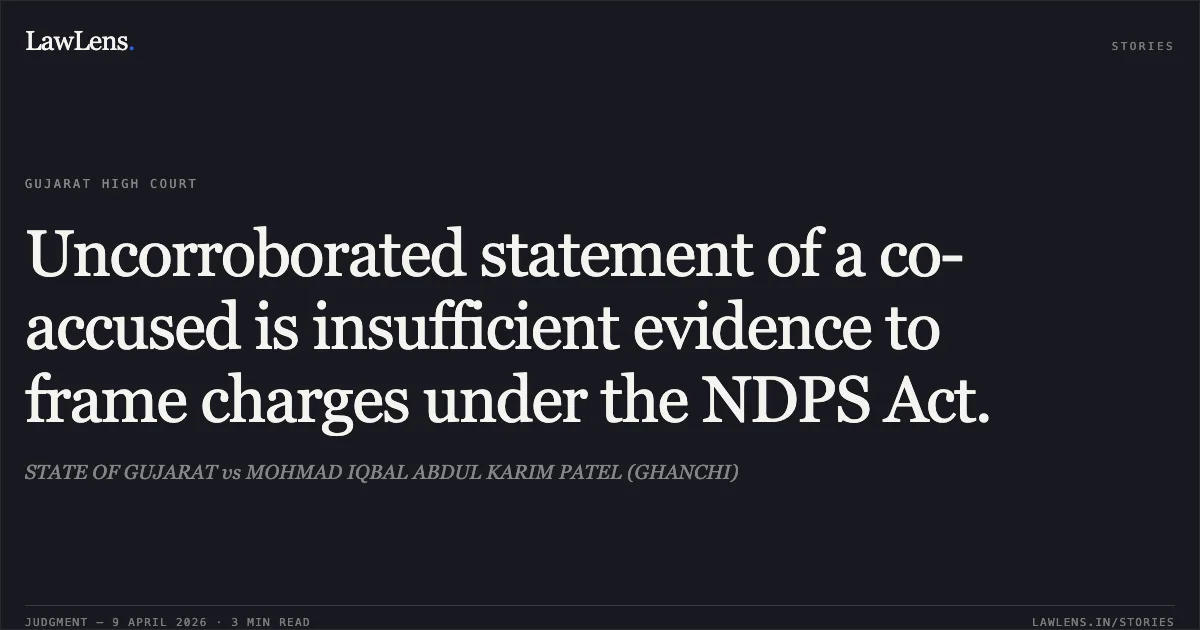
Source reference: p. 4Applying the Ram Singh doctrine, the court held that the statement of a co-accused is not substantial evidence
Source reference: p. 5Regarding the scope of revision, the court reasoned that the trial court had appropriately appreciated the facts and exercised its discretion within the law.
Source reference: p. 5Since the State failed to demonstrate any "palpable error" or "perversity" in the trial court's reasoning, there was no ground for the High Court to substitute its own view for that of the lower court
Source reference: p. 5Holding
The High Court dismissed the Revision Application and upheld the discharge order passed by the Special Judge (NDPS), Surat
The court held that the trial court did not commit any jurisdictional error, as the respondent could not be put to trial based exclusively on an uncorroborated statement of a co-accused who had already been acquitted
Source reference: p. 4-5All interim reliefs were vacated, and the rule was discharged
Source reference: p. 6Acts & Sections Cited
6 provisions across 2 statutes referred to in this judgment. Each provision opens on LawLens.
Code of Criminal Procedure, 19732
Narcotic Drugs and Psychotropic Substances Act, 19854
Original Court PDF
STATE OF GUJARATvsMOHMAD IQBAL ABDUL KARIM PATEL (GHANCHI)
Click to open original judgment
Original judgment, available to read, download and summarize on LawLens.in


