Facts
The appellant was convicted under Section 302 of the Indian Penal Code (IPC) and sentenced to life imprisonment for the alleged murder of Raghunath Yadav on the night of May 27, 1992
Source reference: para. 2The informant (P.W. 8), the victim’s son, claimed he woke up at 03:00 AM to a sound and, using a torch, saw the appellant strike his father's head with a sharp weapon
Source reference: para. 3The prosecution examined 13 witnesses; however, several key independent and attesting witnesses, including P.W. 1, 3, 5, and 9, turned hostile
Source reference: para. 9The appellant contended he was falsely implicated due to long-standing land disputes and enmity
Source reference: para. 6, 20Issues
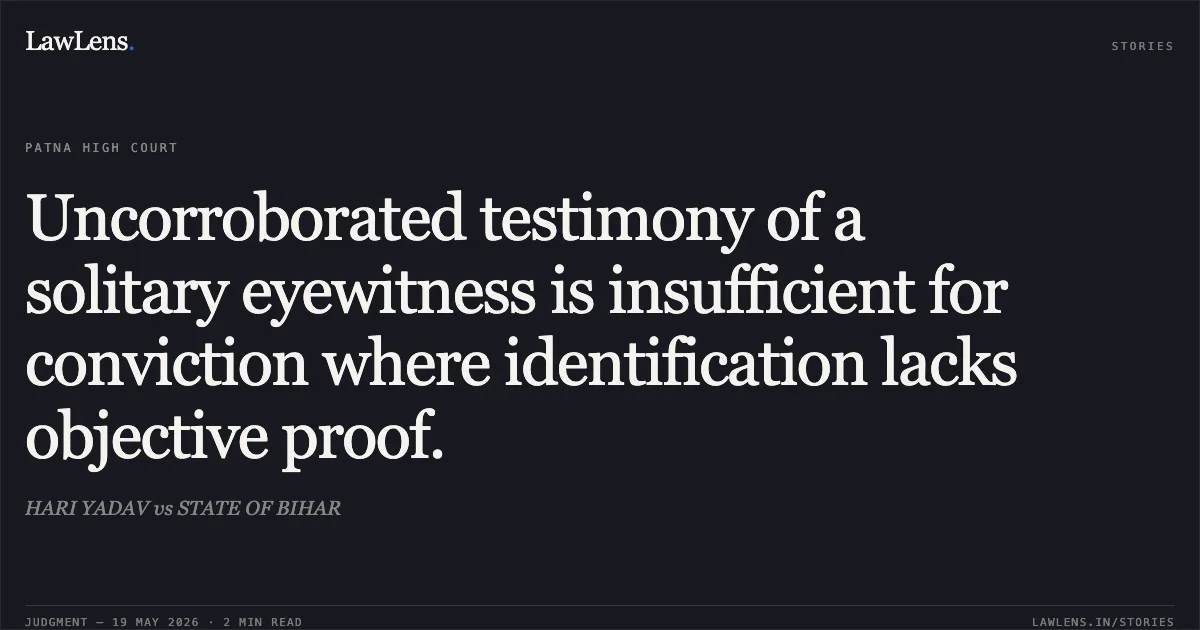
1. Whether the uncorroborated testimony of a solitary eye-witness, who is a relative of the deceased, is sufficient to sustain a conviction when independent witnesses have turned hostile
Source reference: para. 15, 162. Whether the failure to produce the alleged means of identification (the torch) and inconsistencies regarding the place of occurrence and post-assault conduct create reasonable doubt
Source reference: para. 17, 18, 19Law Applied
The court applied Section 134 of the Indian Evidence Act, 1872, which stipulates that no particular number of witnesses is required to prove a fact, emphasizing that evidence is weighed, not counted
Source reference: para. 16It relied on the precedent Vadivelu Thevar v. State of Madras (1957), which categorizes witnesses as "wholly reliable," "wholly unreliable," or "neither," noting that the third category requires corroboration in material particulars
Source reference: para. 16the court cited Durbal v. State of Uttar Pradesh (2011) regarding the necessity of producing and proving means of identification (like torches or lanterns) in cases of nighttime offenses to establish the reliability of an eyewitness
Source reference: para. 17Reasoning
The court found that the prosecution's case rested solely on P.W. 8, whose testimony was deemed "neither wholly reliable nor wholly unreliable" due to his status as an interested witness and the presence of significant evidentiary gaps
Source reference: para. 15, 16Specifically, the court noted that despite the informant claiming to identify the appellant via a torch, the torch was never produced, handed over to the Investigating Officer, or listed in a seizure memo, making the identification highly doubtful in the pitch-dark of 03:00 AM
Source reference: para. 17There were further contradictions regarding the sequence of events: P.W. 8 claimed a neighbor treated the victim, while P.W. 11 (the mother) claimed he was taken to a doctor in another town
Source reference: para. 18Additionally, the Investigating Officer found blood near the Chauki (where the son slept) rather than the Khat (where the father was allegedly killed), an anomaly the prosecution failed to explain
Source reference: para. 19Given the admitted history of land litigation and prior enmity, the court held that the risk of false implication necessitated corroboration, which was entirely absent
Source reference: para. 20, 21Holding
The court answered the issues in the negative, holding that the prosecution failed to prove the charges beyond a reasonable doubt
The High Court set aside the judgment of conviction and order of sentence dated January 5, 1996, passed by the Sessions Judge, West Champaran. The appeal was allowed, and the appellant was acquitted of all charges and discharged from his bail bonds
Source reference: para. 23, 24Acts & Sections Cited
1 provisions across 1 statute referred to in this judgment. Each provision opens on LawLens.
Indian Penal Code, 18601
Original Court PDF
HARI YADAVvsSTATE OF BIHAR
Click to open original judgment
Original judgment, available to read, download and summarize on LawLens.in