Facts
The appellant (A1), a Desk Officer in the Ministry of Industry, and A.S.M. Swami (A2), a retired officer, were convicted by the Special Judge, Delhi, for criminal conspiracy (Section 120B IPC) and bribery (Sections 7, 13(1)(d) r/w 13(2) of the PC Act)
Source reference: p. 1-2The prosecution alleged that A1 demanded ₹50,000 (later reduced to ₹30,000) from PW2 to facilitate an export license, and A2 accepted ₹10,000 as part-payment on A1's behalf
Source reference: p. 2A trap was laid on 06.06.1989 where A2 was apprehended with the money, following which A1 was arrested at A2’s residence
Source reference: p. 18-19A1 appealed the conviction; A2’s appeal abated upon his death
Source reference: p. 6Issues
1. Whether there was sufficient reliable evidence to establish the demand and acceptance of illegal gratification by the appellant
Source reference: p. 112. Whether the "disclosure statement" made by A2 while in custody was admissible against the appellant under Section 27 of the Indian Evidence Act
Source reference: p. 33Law Applied
The court primarily applied Sections 7 and 13 of the Prevention of Corruption Act, 1988, which require proof of demand and acceptance of a bribe beyond reasonable doubt
Source reference: p. 11Under Sections 161 and 162 of the Cr.P.C., police statements cannot be used as substantive evidence except to contradict a witness
Source reference: p. 31Regarding Section 27 of the Indian Evidence Act, the court relied on Pulikuri Kottaya v. King-Emperor and K. Chinnaswamy Reddy v. State of Andhra Pradesh, which establish that only the portion of a confession that leads "distinctly" to the discovery of a material fact is admissible
Source reference: p. 35-36Bodh Raj v. State of Jammu and Kashmir was cited to emphasize the "doctrine of confirmation by subsequent events"
Source reference: p. 37Reasoning
The court found the prosecution's evidence regarding the "demand" inconsistent: PW2’s complaint alleged a ₹50,000 demand, whereas his court testimony claimed ₹80,000 reduced to ₹30,000
Source reference: p. 7, 15The court noted procedural lapses, including the FIR being registered before the complaint was lodged and the failure to verify audio recordings through voice samples or forensic analysis
Source reference: p. 24, 26Crucially, PW2 admitted in cross-examination that the money paid to A2 could have been "consultancy charges" for legitimate project revival work
Source reference: p. 20, 28The court held that A2’s statement—that A1 was waiting at his house—did not constitute a "discovery of a fact" under Section 27 of the Evidence Act, as a witness or co-accused’s location is not a "material object" in the sense contemplated by law
Source reference: p. 40-42The trial court’s wholesale marking of Section 161 statements was also cited as a patent illegality
Source reference: p. 31Holding
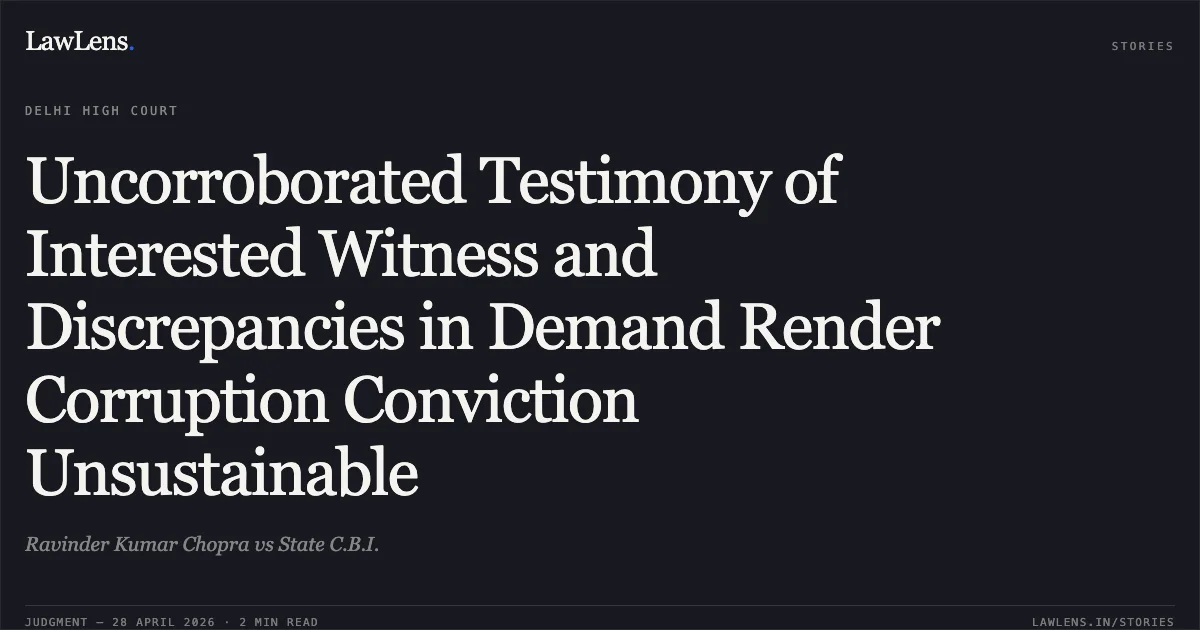
The High Court held that while strong suspicion existed, the prosecution failed to prove the charges beyond reasonable doubt due to material contradictions and the inadmissibility of the disclosure statement. The court answered the issues in the negative.
The court allowed the appeal, and acquitted the appellant of all charges under Section 120B IPC and Sections 7 and 13 of the PC Act
Source reference: p. 42-43Acts & Sections Cited
11 provisions across 3 statutes referred to in this judgment. Each provision opens on LawLens.
Code of Criminal Procedure, 19736
Indian Penal Code, 18603
Prevention of Corruption Act, 19882
Original Court PDF
Ravinder Kumar ChopravsState C.B.I.
Click to open original judgment
Original judgment, available to read, download and summarize on LawLens.in