Facts
On the intervening night of 1 November 2012, the prosecution alleged that the appellant, accompanied by two unknown persons, entered the informant’s house by scaling the boundary wall.
Source reference: para. 3The appellant allegedly pressed the informant’s mouth, threatened and assaulted her, and attempted to remove her saree with the intention of outraging her modesty.
Source reference: para. 3The intruders allegedly fled after the informant raised an alarm and villagers and her mother-in-law arrived.
Source reference: para. 3The informant claimed to have identified the appellant from his voice.
Source reference: para. 3After an unsuccessful village settlement, the FIR was lodged approximately eleven days after the alleged occurrence.
Source reference: para. 3Following investigation, a charge-sheet was submitted under Sections 376, 511, 354 and 452/34 of the Indian Penal Code.
Source reference: para. 3The prosecution examined eleven witnesses, several of whom were declared hostile.
Source reference: para. 4The victim was examined as P.W. 8; however, she stated that there was complete darkness during the occurrence and that she could only suspect the appellant on the basis of his voice.
Source reference: para. 4The Investigating Officer admitted that the victim was neither medically examined nor examined under Section 164 Cr.P.C.
Source reference: para. 4The trial court convicted the appellant under Sections 452 and 354 IPC and sentenced him to seven years’ rigorous imprisonment under Section 452 IPC and two years’ rigorous imprisonment under Section 354 IPC, together with a fine of ₹25,000, with the sentences to run concurrently.
Source reference: para. 2The appellant challenged the conviction in the present appeal.
Source reference: para. 6Issues
Whether the prosecution proved beyond reasonable doubt that the appellant committed house-trespass after preparation for assault or wrongful restraint, punishable under Section 452 IPC?
Source reference: paras. 7, 9–10Whether the prosecution established that the appellant assaulted or used criminal force against the informant with the intention of outraging her modesty, punishable under Section 354 IPC?
Source reference: paras. 3, 7, 9–10Whether identification of the appellant by voice, in circumstances of complete darkness and without independent corroboration, was sufficient to sustain the conviction?
Source reference: paras. 7, 9Whether the unexplained delay of eleven days in lodging the FIR and the investigative omissions materially weakened the prosecution case?
Source reference: paras. 4, 7, 9Law Applied
The Court applied Section 452 IPC, which criminalises house-trespass or house-breaking after preparation for causing hurt, assault, wrongful restraint, or putting a person in fear thereof, and Section 354 IPC, which penalises assault or use of criminal force against a woman with the intent or knowledge that her modesty is likely to be outraged.
Source reference: paras. 2, 10The prosecution was required to establish every essential ingredient of the alleged offences beyond reasonable doubt.
Source reference: no citationThe Court further applied the evidentiary principle that identification by voice has limited probative value where it is unsupported by reliable independent corroboration.
Source reference: para. 9It also reiterated that the FIR is an important instrument for promptly recording the circumstances of the occurrence, the identity and role of the offenders, and the names of witnesses; unexplained delay may create a risk of embellishment, exaggeration or afterthought.
Source reference: para. 9Investigative lapses, including failure to conduct medical examination or record the victim’s statement under Section 164 Cr.P.C., were considered in assessing the overall reliability of the prosecution evidence.
Source reference: paras. 4, 7Reasoning
The Court found that the victim did not provide reliable identification of the appellant.
Source reference: paras. 7, 9Because the incident allegedly occurred in complete darkness, her assertion that she merely suspected the appellant from his voice was considered insufficient, particularly in the absence of independent corroboration.
Source reference: paras. 7, 9The evidence of the mother-in-law and other witnesses did not cure this deficiency, as the prosecution evidence was materially weakened by hostile witnesses, hearsay testimony, and the clarification that the appellant’s identity had also been inferred only from his voice.
Source reference: paras. 4, 7The Court further noted the unexplained eleven-day delay in lodging the FIR, which undermined the spontaneity and reliability of the prosecution version.
Source reference: para. 9The failure to medically examine the victim, record her statement under Section 164 Cr.P.C., or produce other corroborative material constituted additional deficiencies in the prosecution case.
Source reference: paras. 4, 7On the cumulative assessment of these circumstances, the Court held that the prosecution had not proved the alleged house-trespass and assault with the requisite certainty.
Source reference: para. 10Holding
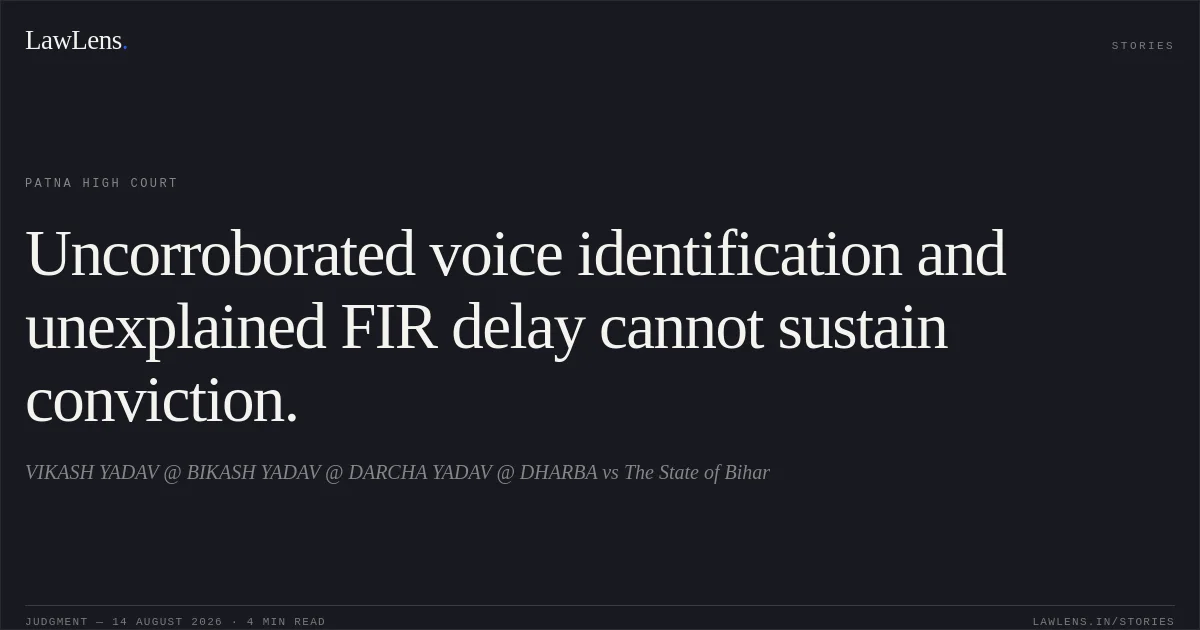
The Court held that the prosecution failed to establish the appellant’s guilt under Sections 452 and 354 IPC beyond reasonable doubt and that the appellant was entitled to the benefit of doubt.
The judgment of conviction and order of sentence dated 16 March 2019 passed by the Fast Track Court-I, Banka, in Sessions Trial No. 95 of 2015 were set aside.
Source reference: para. 11The appellant was acquitted of all charges and discharged from the liability of his bail bond.
Source reference: paras. 12–14The appeal was accordingly allowed, and any pending interlocutory applications were disposed of.
Source reference: paras. 12–14Acts & Sections Cited
6 provisions across 2 statutes referred to in this judgment. Each provision opens on LawLens.
Indian Penal Code, 18605
Code of Criminal Procedure, 19731
Original Court PDF
VIKASH YADAV @ BIKASH YADAV @ DARCHA YADAV @ DHARBAvsThe State of Bihar
Click to open original judgment
Original judgment, available to read, download and summarize on LawLens.in