Facts
The plaintiffs, three real-estate companies, claimed established goodwill and reputation in the real-estate industry.
Source reference: no citationPlaintiff No. 1 entered into a business arrangement with Defendant No. 1 on 9 December 2020 for sharing investments, profits and losses in the ratio of 75:25.
Source reference: no citationDefendant No. 1 subsequently initiated insolvency proceedings under Section 7 of the Insolvency and Bankruptcy Code, 2016 against Plaintiff No. 1 before the NCLT.
Source reference: no citationThe NCLT dismissed the petition on 14 February 2023, and Defendant No. 1’s appeal was dismissed by the NCLAT on 13 December 2023.
Source reference: p.3, para.15The plaintiffs alleged that the insolvency proceedings and articles published by Defendants Nos. 2 and 3 on 8 and 9 August 2022 damaged their reputation and goodwill.
Source reference: p.3, paras.13–16They sought ₹10 crore in damages against Defendant No. 1, mandatory injunctions directing Defendants Nos. 2 and 3 to remove or update the articles, and costs.
Source reference: p.3, paras.13–16Before formal summons were issued, the defendants appeared and objected that the plaint disclosed no cause of action and that the suit was barred by limitation under Articles 74 and 75 of the Limitation Act, 1963.
Source reference: p.4, paras.17–23The plaintiffs stated that the suit had been e-filed on 12 December 2024, whereas the defendants claimed that it was instituted on 17 January 2025.
Source reference: p.22, para.45Issues
Whether the defendants could appear and be heard before formal issuance of summons in order to raise objections falling within Order VII Rule 11 of the CPC?
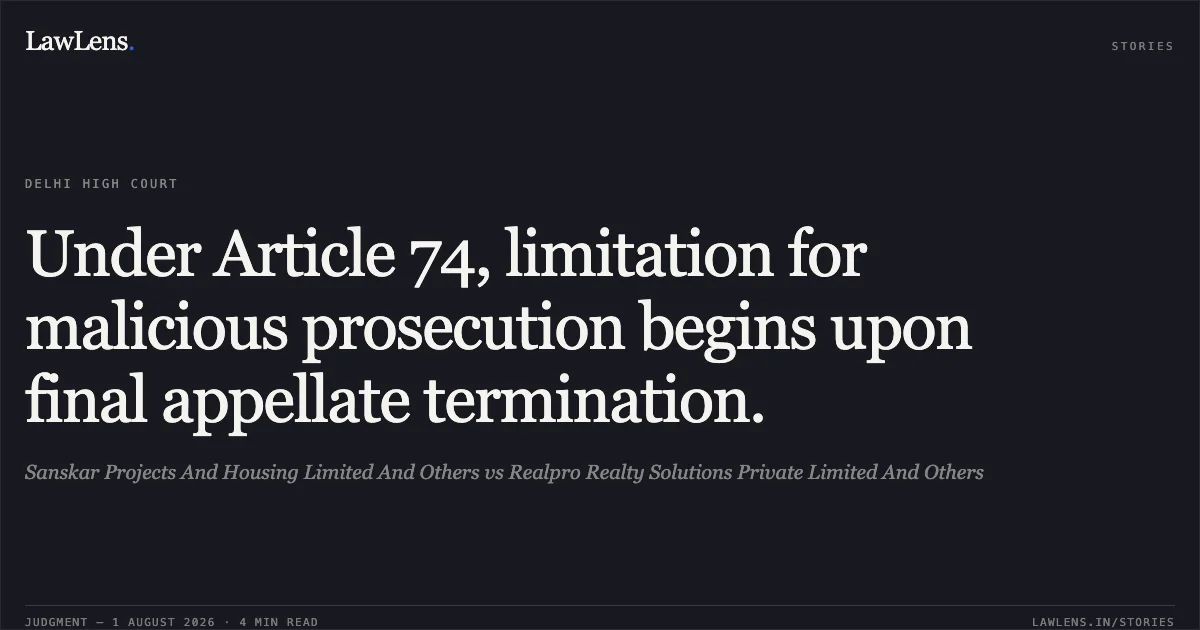
Source reference: pp.8–16, paras.30–32Whether the suit, insofar as it was based on malicious prosecution, was barred by Article 74 of the Limitation Act, 1963, and whether limitation commenced from the NCLT’s dismissal of the insolvency petition or from the NCLAT’s dismissal of the appeal?
Source reference: pp.16–21, paras.33–42Whether the claims based on defamatory publications were barred by the one-year limitation prescribed under Article 75 of the Limitation Act, 1963?
Source reference: pp.21–22, paras.43–44Whether the plaint disclosed a cause of action against the defendants?
Source reference: pp.4–6, paras.17–19; p.22, para.46Law Applied
Order VII Rule 11(a) and (d) of the CPC empower the court to reject a plaint that discloses no cause of action or appears from its statements to be barred by law; the plaint and documents relied upon must be examined, while disputed defence pleas and factual merits are not considered at that stage.
Source reference: pp.9–13, para.30Under Dahiben v. Arvindbhai Kalyanji Bhanusali, the power may be exercised at any stage, including before issuance of summons.
Source reference: pp.14–16, paras.30–32Bright Enterprises Pvt. Ltd. v. MJ Bizcraft LLP and Tajunissa v. Vishal Sharma establish that a defendant present before issuance of summons may be heard on Order VII Rule 11 objections, although a duly instituted suit ordinarily requires issuance of summons unless such a statutory ground for rejection exists.
Source reference: pp.14–16, paras.30–32Article 74 of the Limitation Act prescribes one year for compensation for malicious prosecution, commencing when the plaintiff is acquitted or the prosecution is otherwise terminated; Article 75 prescribes one year for compensation for libel from the date of publication.
Source reference: p.17, paras.33–35Relying on Laxmi Narayan Soni v. Roop Chand Soni and Tirlok Chand Bansal v. Bharat Bhushan Bansal, the Court held that where the initial termination is followed by appellate proceedings, “otherwise terminated” refers to final termination upon the appellate order.
Source reference: pp.18–21, paras.38–40The Court also noted its duty under Section 3 of the Limitation Act to examine limitation independently.
Source reference: p.22, para.47Reasoning
The Court held that the defendants were entitled to assist it before summons were issued, but only in relation to objections within Order VII Rule 11.
Source reference: pp.14–16, paras.30–32On limitation under Article 74, it rejected the argument that time began from the NCLT’s order dated 14 February 2023.
Source reference: pp.17–18, paras.36–37Reading “acquitted” and “otherwise terminated” disjunctively, the Court reasoned that the latter expression must cover cases where the initial termination is subject to appeal; otherwise, the provision would create anomalous results if the appellate court later reversed the initial order.
Source reference: pp.17–18, paras.36–37Since the NCLAT dismissed Defendant No. 1’s appeal on 13 December 2023, the malicious-prosecution claim accrued on that date.
Source reference: pp.19–22, paras.39–45On the plaintiffs’ version that the suit was filed on 12 December 2024, the claim was within one year.
Source reference: pp.19–22, paras.39–45The Court declined to reject the libel-related claims at the pre-summons stage, notwithstanding the publications having appeared in August 2022.
Source reference: pp.21–22, paras.43–44It observed that the plaintiffs alleged that the publications were made at the instance and behest of Defendant No. 1 and that the claims against the defendants were interlinked.
Source reference: pp.21–22, paras.43–44Determining whether the claims were legally distinct and time-barred could require evidence and was therefore left for an appropriate stage.
Source reference: pp.21–22, paras.43–44The objection regarding absence of cause of action was also reserved for a later stage.
Source reference: p.22, para.46Holding
The Court rejected the defendants’ preliminary objections based on limitation and did not reject the plaint under Order VII Rule 11.
It held that the malicious-prosecution claim was not prima facie barred because limitation commenced from the NCLAT’s appellate order dated 13 December 2023, and the suit was filed on 12 December 2024.
Source reference: p.22, para.45The Article 75 objection concerning libel and the objection that the plaint disclosed no cause of action were left open for determination at the appropriate stage.
Source reference: p.22, para.46The plaint was ordered to be registered as a suit, summons were issued, Defendant No. 1 accepted summons through counsel, and summons were directed to be issued to Defendant No. 2 by all permissible modes.
Source reference: p.23, paras.49–52The defendants were granted 30 days from receipt of summons to file written statements with affidavits of admission/denial, and the matter was listed before the Joint Registrar on 9 October 2026 and before the Court on 30 November 2026.
Source reference: p.23, paras.53–58Original Court PDF
Sanskar Projects And Housing Limited And OthersvsRealpro Realty Solutions Private Limited And Others
Click to open original judgment
Original judgment, available to read, download and summarize on LawLens.in