Facts
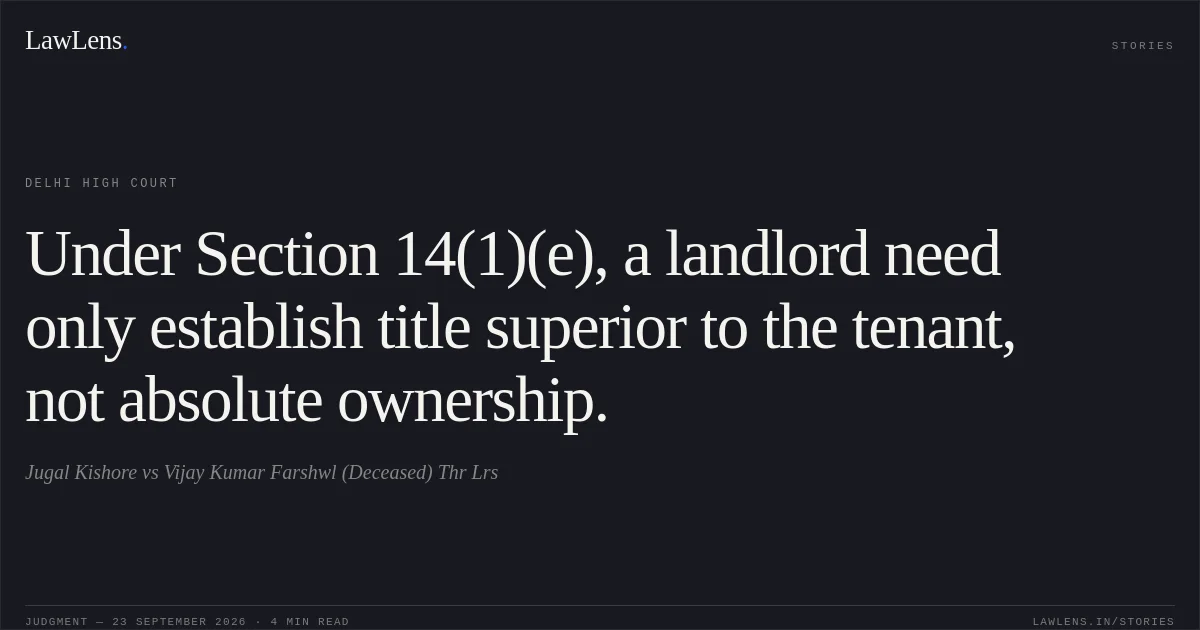
The petitioner-tenant challenged the order dated 27 April 2026 passed by the learned SCJ-cum-Rent Controller, Central District, Tis Hazari Courts, Delhi, in RC/ARC No. 177/2022. The Rent Controller had dismissed the petitioner’s application for leave to defend and passed an eviction order under Section 14(1)(e) of the Delhi Rent Control Act, 1958, concerning Property No. 9340, Katra Ganga Bishan, Bagh Raoji, Delhi.
Source reference: p.2, paras. 3–4The petitioner contended that there was no landlord-tenant relationship because the respondent had not established ownership of the premises. He further asserted that the property formed part of Nazul land belonging to the Government, thereby defeating the respondent’s claim of ownership and locus.
Source reference: pp.2–3, paras. 5–8The respondent relied upon a registered partition deed dated 22 March 1959 and registered Wills dated 11 June 1963 and 24 April 1982 to establish his title. He also relied upon rent receipts recording the petitioner’s father as tenant in the premises.
Source reference: pp.6–9, para. 18The Rent Controller held that the respondent had demonstrated a title superior to that of the tenant and that the petitioner’s objections did not raise any triable issue.
Source reference: pp.6–9, para. 18The petitioner’s delay of 33 days in re-filing the revision petition was separately condoned.
Source reference: p.1, paras. 1–2Issues
1. Whether the Rent Controller erred in holding that the respondent had established a title or interest superior to that of the petitioner and that a landlord-tenant relationship existed between the parties?
Source reference: pp.9–10, paras. 19–222. Whether the petitioner’s contention that the premises formed part of Nazul land raised a triable issue or otherwise defeated the respondent’s locus to maintain the eviction petition?
Source reference: pp.10–12, paras. 23–273. Whether the impugned order disclosed any jurisdictional error, material irregularity, perversity, manifest illegality, or error apparent on the face of the record warranting interference under the proviso to Section 25-B(8) of the Delhi Rent Control Act, 1958?
Source reference: pp.3–5, 11–13, paras. 11–17 and 28–30Law Applied
The Court applied the proviso to Section 25-B(8) of the Delhi Rent Control Act, 1958, under which the High Court exercises limited supervisory and revisional jurisdiction rather than appellate jurisdiction; it may interfere only for jurisdictional error, material irregularity, perversity, manifest illegality, absence of adjudication, or an error apparent on the face of the record.
Source reference: pp.3–5, paras. 11–16Relying on Sarla Ahuja v. United India Insurance Co. Ltd., Hindustan Petroleum Corporation Ltd. v. Dilbahar Singh, and Abid-Ul-Islam v. Inder Sain Dua, the Court held that it cannot reappreciate evidence or substitute its own view merely because another view is possible.
Source reference: p.4, para. 14For an eviction petition under Section 14(1)(e), the landlord need not establish absolute title as in a title suit; it is sufficient to demonstrate a title or interest superior to that of the tenant, as recognised in Shanti Sharma v. Ved Prabha and Rajender Kumar Sharma v. Leela Wati.
Source reference: pp.6–7, paras. 18–20The Court also applied the doctrine of tenant’s estoppel, under which a tenant cannot ordinarily deny the landlord’s title during the continuance of the tenancy.
Source reference: p.9, para. 18Reasoning
The Court found that the Rent Controller had properly considered the registered partition deed and the two registered Wills forming the respondent’s chain of title. These documents, taken cumulatively, established an interest superior to that of the petitioner for the purposes of Section 14(1)(e), without requiring adjudication of absolute title.
Source reference: pp.9–10, paras. 19–20The rent receipts identifying the petitioner’s father as tenant further supported the existence of the landlord-tenant relationship. The petitioner’s allegation that the receipts were forged was held to be a bare assertion unsupported by any material, and therefore did not constitute a triable issue.
Source reference: p.10, para. 21The Nazul-land objection was not raised in the application for leave to defend and was introduced only during arguments and through documents filed with written submissions. The Rent Controller was therefore justified in declining to consider it at that stage.
Source reference: p.11, para. 24In any event, even assuming that the premises stood on Nazul land, that fact would not automatically displace the respondent’s status as landlord vis-à-vis the petitioner, particularly when no material showed that the Government had asserted a competing title or that the respondent’s enforceable status as landlord had been extinguished.
Source reference: pp.11–12, paras. 25–26Reconsidering that factual controversy in revision would exceed the limited scope of Section 25-B(8).
Source reference: p.12, para. 27Holding
The Court held that the respondent had sufficiently established a title superior to that of the petitioner and the existence of a landlord-tenant relationship.
The objections concerning ownership, alleged forgery of rent receipts, adverse possession, and Nazul land did not disclose any triable issue or justify interference with the eviction order.
Source reference: pp.9–13, paras. 22, 26, 28–29Finding no jurisdictional error, material irregularity, perversity, manifest illegality, or error apparent on the face of the record, the Court dismissed RC.REV. 310/2026 under the proviso to Section 25-B(8) of the Delhi Rent Control Act, 1958.
Source reference: p.13, paras. 29–31The pending applications were also disposed of, while the 33-day delay in re-filing had already been condoned.
Source reference: p.1, paras. 1–2; p.13, paras. 29–31Acts & Sections Cited
2 provisions across 2 statutes referred to in this judgment. Each provision opens on LawLens.
Code of Civil Procedure, 19081
delhi rent control act, 19581
Original Court PDF
Jugal KishorevsVijay Kumar Farshwl (Deceased) Thr Lrs
Click to open original judgment
Original judgment, available to read, download and summarize on LawLens.in