Facts
Dhampur Sugar Mills Ltd. (“DSM”) entered into several agreements with Indian Oil Corporation Ltd. (“IOCL”) for the supply of indigenous anhydrous ethanol to locations in Delhi, Haryana, Rajasthan and Punjab, and subsequently entered into an agreement for supply to Uttarakhand.
Source reference: paras. 2–3The agreements contained a reciprocal “Take or Pay/Supply or Pay” clause requiring supply or upliftment of at least 90% of the contracted quantity, subject to a 10% variation.
Source reference: para. 4DSM alleged that IOCL delayed furnishing statutory Form-C declarations, exposing it to higher interstate sales-tax liability and related proceedings.
Source reference: paras. 5–8, 11–12DSM demanded the pending declarations or an indemnity and thereafter suspended further ethanol supplies.
Source reference: paras. 5–8, 11–12IOCL disputed DSM’s right to suspend performance and invoked Clause 3 for short supply, demanding and deducting amounts towards damages.
Source reference: paras. 7–9, 13The arbitral tribunal accepted that Form-C had been delayed but held that DSM had no contractual right to suspend supplies, and upheld IOCL’s deductions under Clause 3 as liquidated damages.
Source reference: paras. 28–38DSM consequently filed the present petition under Section 34 of the Arbitration and Conciliation Act, 1996, seeking setting aside of the award dated 21.08.2015.
Source reference: para. 1Issues
Whether DSM was contractually entitled to suspend ethanol supplies because of IOCL’s delay in furnishing Form-C declarations and DSM’s consequent tax exposure?
Source reference: paras. 20–23, 73–79Whether IOCL was entitled to recover or deduct amounts under Clause 3 without separately proving actual monetary loss, having regard to Section 74 of the Indian Contract Act, 1872?
Source reference: paras. 24, 48–50, 81–88Whether IOCL could adjust the disputed damages allegedly arising under earlier agreements against payments due under the subsequent Uttarakhand agreement, particularly in the absence of a separate counterclaim?
Source reference: paras. 16, 50, 91–94Whether the arbitral award was liable to be set aside because of the approximately seventeen-month delay in its publication?
Source reference: paras. 51, 63–68Whether the award was invalid for having been published beyond the two-year period stipulated in Clause 16(g) of the arbitration agreement?
Source reference: paras. 52, 69–72Whether the award disclosed patent illegality, perversity, violation of the fundamental policy of Indian law, or other grounds warranting interference under Section 34?
Source reference: paras. 61–62, 98–110Law Applied
The Court applied the limited scope of judicial review under Section 34 of the Arbitration and Conciliation Act, 1996: an arbitral award cannot be reappreciated as if in appeal, and a plausible interpretation of contractual terms or evidence must ordinarily be respected.
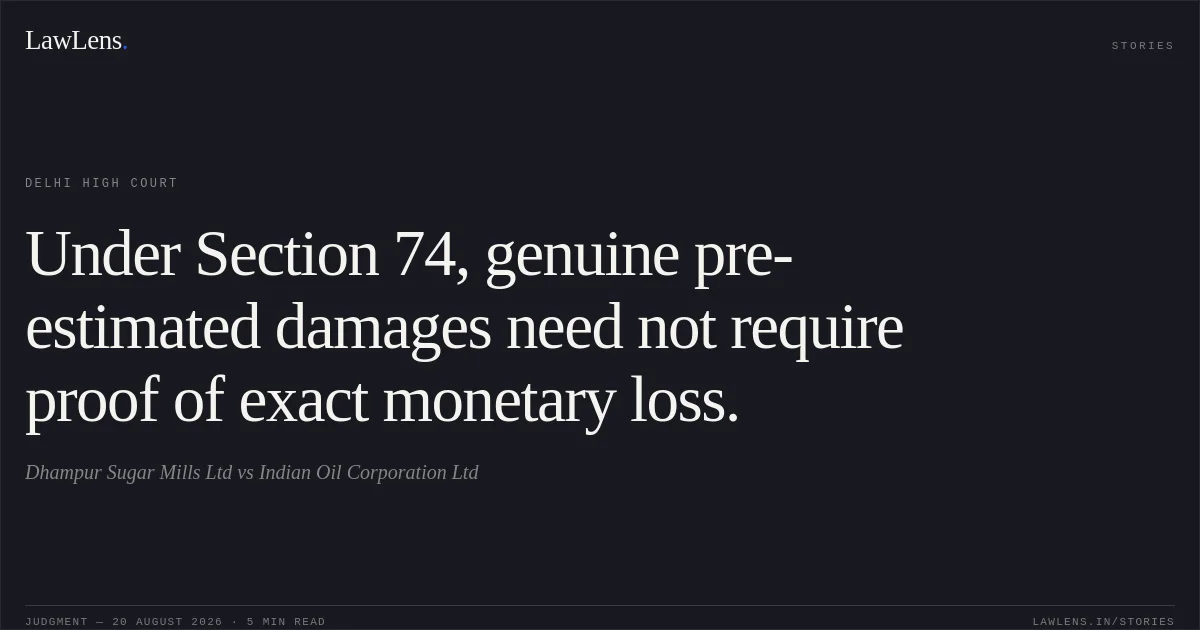
Source reference: paras. 61–62; Associate Builders v. DDA, (2015) 3 SCC 49Under Sections 73 and 74 of the Indian Contract Act, 1872, stipulated damages remain subject to the requirement of reasonable compensation and cannot operate as a penalty; however, where parties have made a genuine pre-estimate of loss and precise proof of loss is difficult, separate proof of the exact monetary loss may not be necessary.
Source reference: paras. 81–88; Fateh Chand v. Balkishan Dass, AIR 1963 SC 1405; ONGC Ltd. v. Saw Pipes Ltd., (2003) 5 SCC 705; Kailash Nath Associates v. DDA, (2015) 4 SCC 136; Construction & Design Services v. DDA, (2015) 14 SCC 263A disputed claim for unliquidated damages does not become an existing debt merely through unilateral assertion, but the disputed liability may be adjudicated in arbitration and, once upheld, recovered through an agreed contractual adjustment mechanism.
Source reference: paras. 91–94; Iron & Hardware (India) Co. v. Shamlal & Bros. and Tower Vision India Pvt. Ltd. v. Procall Pvt. Ltd.Delay in publishing an award is not by itself an automatic ground for setting it aside; the challenger must establish that the delay adversely affected the decision-making process.
Source reference: paras. 63–68; Lancor Holdings Ltd. v. Prem Kumar MenonA distinct challenge based on a contractual time limit for making the award cannot ordinarily be introduced for the first time after expiry of the Section 34(3) limitation period.
Source reference: paras. 69–72; State of Maharashtra v. Hindustan Construction Co. Ltd., (2010) 4 SCC 518Reasoning
The Court held that DSM’s grievance regarding delayed Form-C declarations was genuine, and the tribunal had correctly acknowledged the delay; nevertheless, the agreements contained no express term permitting suspension of supply or making an indemnity a condition precedent to further performance.
Source reference: paras. 73–75The tribunal also reasonably considered that the provisional tax proceedings involved issues beyond delayed Form-C, that DSM had not sought the available statutory extension, and that the final assessment did not sustain the apprehended differential liability in the manner initially claimed.
Source reference: paras. 75–77As to Clause 3, the Court read the award as a whole and found that the tribunal had treated the clause as a reciprocal, commercially negotiated and reasonable pre-estimate applicable only when performance fell below 90%, rather than as an automatic penalty.
Source reference: paras. 81–88The tribunal’s reference to recovery without proof of actual loss was understood as dispensing with proof of the exact quantum of loss, not as authorising a windfall where no legal injury existed.
Source reference: paras. 81–88The challenge based on unequal treatment was rejected because DSM’s reciprocal claims independently failed for want of proof of IOCL’s default, supporting documents and the claimed amounts.
Source reference: para. 89The objection to cross-contractual adjustment also failed: although IOCL had not filed a separately titled counterclaim, DSM had directly challenged the deductions, and Issue No. 4 expressly required adjudication of IOCL’s entitlement.
Source reference: paras. 91–94After the liability was upheld, the Letter of Intent and undertaking could reasonably operate as mechanisms for adjustment against later payments.
Source reference: paras. 91–94The seventeen-month delay was criticised but was not shown to have affected the award’s reasoning or findings.
Source reference: paras. 63–68The Clause 16(g) objection was treated as a new and independent ground introduced beyond the statutory period and was therefore not entertained.
Source reference: paras. 69–72Holding
The Court answered the principal issues against DSM. It held that DSM was not contractually entitled to suspend ethanol supplies because of delayed Form-C declarations; IOCL’s recovery under Clause 3 was sustainable as reasonable liquidated damages on the facts and within the principles of Section 74; and the disputed liability, having been adjudicated in arbitration, could be adjusted against payments under the subsequent agreement.
The delay in publishing the award did not justify setting it aside, and the Clause 16(g) challenge was rejected as belated.
Source reference: para. 108Finding no patent illegality, perversity, violation of the fundamental policy of Indian law, or other ground under Section 34, the Court dismissed the petition and upheld the arbitral award dated 21.08.2015 in its entirety.
Source reference: paras. 109–112Acts & Sections Cited
3 provisions across 2 statutes referred to in this judgment. Each provision opens on LawLens.
Arbitration and Conciliation Act, 19961
Indian Contract Act, 18722
Original Court PDF
Dhampur Sugar Mills LtdvsIndian Oil Corporation Ltd
Click to open original judgment
Original judgment, available to read, download and summarize on LawLens.in