Facts
The petitioner challenged the opinion dated 22.04.2022 of the Foreigners Tribunal, 5th, Goalpara, which declared her a foreigner who entered India after 25.03.1971.
Source reference: p. 3, para. 1Before the Tribunal, she filed a written statement and relied on an NRC extract, voter lists from 1966 to 2005, a sale deed, a Gaon Panchayat certificate, and oral evidence from herself and three witnesses.
Source reference: pp. 3–5, paras. 2, 4–5The Tribunal found that she had not discharged the burden of proving that she was not a foreigner.
Source reference: no citationIn the writ petition, she argued that her evidence established her Indian citizenship; the respondents maintained that the evidence did not establish the required family linkage and that the Tribunal’s decision disclosed no reviewable error.
Source reference: pp. 5–9, paras. 6–14Issues
1. Whether the petitioner discharged the burden under Section 9 of the Foreigners Act, 1946, of proving that she was not a foreigner by establishing her linkage to persons in pre-cut-off-date records.
Source reference: pp. 9–10, 12–15, paras. 16, 20–232. Whether the Foreigners Tribunal’s opinion disclosed an error warranting interference under Article 226 of the Constitution.
Source reference: pp. 11–12, 15–16, paras. 18–19, 24–26Law Applied
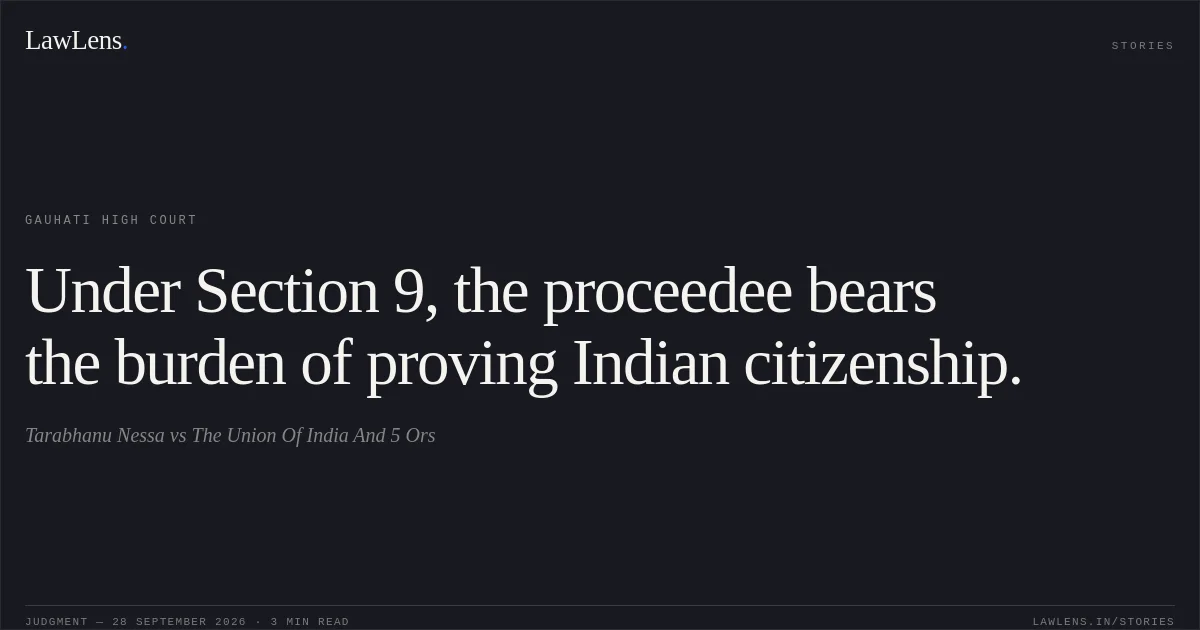
Section 9 of the Foreigners Act, 1946 places on the person concerned the burden of proving that they are not a foreigner.
Source reference: p. 9, para. 16Sarbananda Sonowal v. Union of India, (2005) 5 SCC 665, explains that citizenship-related facts—such as birth, parentage, and family connections—are ordinarily within the person’s knowledge and should be established by them.
Source reference: pp. 6–7, para. 9The Court also relied on Fateh Mohd. v. Delhi Administration, AIR 1963 SC 1035, and Union of India v. Ghaus Mohammad, AIR 1961 SC 1526, concerning the burden imposed by the Foreigners Act.
Source reference: pp. 10–11, para. 17Under Article 226, a writ court exercising certiorari jurisdiction does not reweigh evidence or substitute its view for that of the tribunal; interference is warranted for a jurisdictional or apparent error of law.
Source reference: pp. 11–12, para. 19A Gaon Panchayat certificate is not proof of citizenship by itself: its authenticity and contents must be verified, and it can serve only to establish linkage to a legacy person.
Source reference: pp. 13–15, para. 21, discussing Rupajan Begum v. Union of India, (2018) 1 SCC 579Oral evidence without adequate documentary support is insufficient to establish citizenship or linkage.
Source reference: p. 8, para. 12, discussing Nur Begum v. Union of India, 2020 (3) GLT 347Reasoning
The Court found the petitioner’s written statement deficient because it did not provide essential particulars, including her date and place of birth and details concerning her parents.
Source reference: p. 12, para. 20The 1951 NRC extract naming her projected sister and the voter lists naming her projected family members did not establish the petitioner’s link to them; the later voter lists with her husband did not supply the missing pre-cut-off-date linkage.
Source reference: pp. 13–14, para. 21The Panchayat certificate, issued decades after the asserted marriage, was subject to a disclaimer and was not accompanied by the documents required for its validity; it could not independently prove citizenship.
Source reference: pp. 14–15, para. 22The oral testimony likewise lacked sufficient documentary corroboration, including a common voter-list record linking the petitioner to her projected father.
Source reference: p. 15, para. 23Finding no error in the Tribunal’s assessment that the burden remained undischarged, the Court held that the opinion did not warrant interference under Article 226.
Source reference: pp. 15–16, paras. 24–25Holding
The Court answered both issues against the petitioner, holding that she had not proved that she was not a foreigner and that the Tribunal’s opinion called for no interference.
The writ petition was dismissed, the interim order was vacated, and consequential action was to proceed in accordance with law.
Source reference: p. 16, para. 26The Tribunal’s records were directed to be returned with a copy of the order.
Source reference: p. 16, para. 27Acts & Sections Cited
3 provisions across 1 statute referred to in this judgment. Each provision opens on LawLens.
Assam Panchayat Act, 19943
Original Court PDF
Tarabhanu NessavsThe Union Of India And 5 Ors
Click to open original judgment
Original judgment, available to read, download and summarize on LawLens.in