Facts
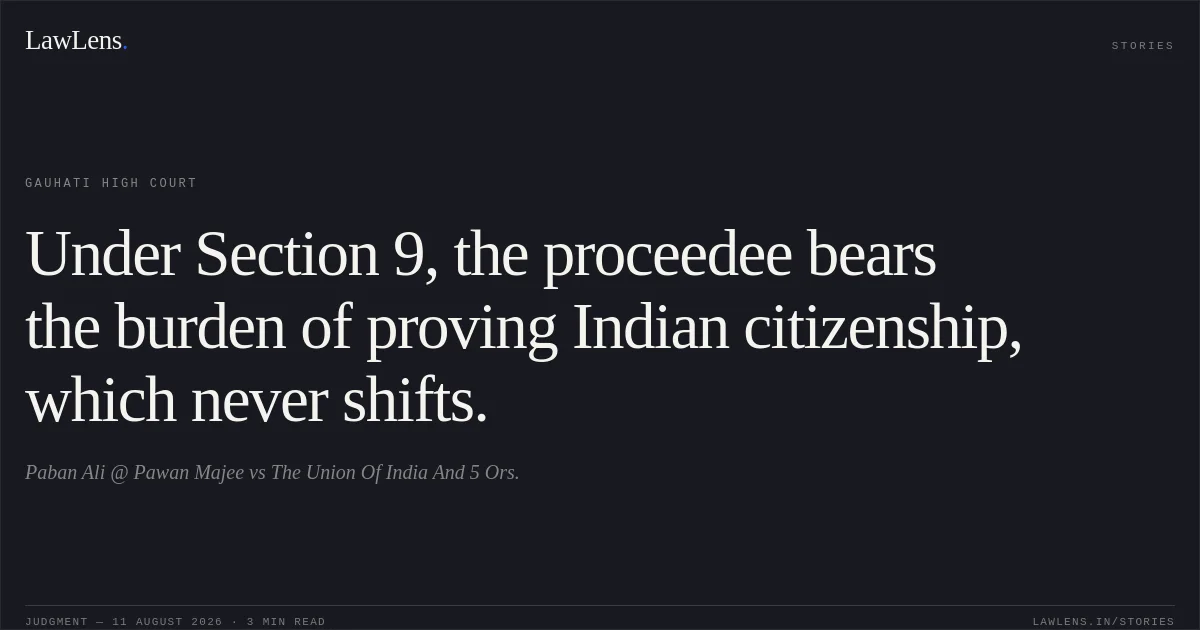
A reference was made by the Superintendent of Police (B), Nagaon, against the petitioner under the Foreigners Act, 1946, leading to F.T. (Nal) Case No. 502/2010 before Foreigners Tribunal No. 1, Nalbari.
Source reference: para. 2(i)The petitioner filed a written statement, adduced evidence through three witnesses, and relied on documents including voter lists, school certificates, a Gaonburah certificate, a Permanent Resident Certificate, NRC-related documents, and tax-payment records.
Source reference: paras. 2(ii), 4–6By opinion dated 29 May 2018, the Tribunal declared him a foreigner who had entered India after 25 March 1971, holding that he had failed to discharge the burden under Section 9 of the Foreigners Act.
Source reference: paras. 2(iii), 27The petitioner challenged that opinion under Article 226 of the Constitution.
Source reference: no citationIssues
1. Whether the petitioner discharged the burden under Section 9 of the Foreigners Act, 1946, of proving that he was not a foreigner and was an Indian citizen.
Source reference: paras. 7–9, 15–162. Whether the materials relied upon by the petitioner—particularly the school certificates, voter lists, Gaonburah certificate, and municipal certificate—were legally admissible, reliable, and sufficient to establish his citizenship and pre-25 March 1971 Indian ancestry or residence.
Source reference: paras. 21–253. Whether the Foreigners Tribunal’s opinion suffered from an error of law, procedural illegality, or perversity warranting interference by the High Court in certiorari jurisdiction under Article 226.
Source reference: paras. 17–18, 27Law Applied
Section 9 of the Foreigners Act, 1946 places the burden upon the person concerned to prove that he is not a foreigner, notwithstanding the Indian Evidence Act.
Source reference: para. 15The Court relied on Sarbananda Sonowal v. Union of India, (2005) 5 SCC 665, which requires a person claiming citizenship to disclose and establish material particulars such as date and place of birth, the identity and citizenship of parents, and, where relevant, grandparental details.
Source reference: paras. 8, 19–20The Court also applied the principles in Fateh Mohd. v. Delhi Administration, AIR 1963 SC 1035, concerning the statutory burden under Section 9.
Source reference: para. 16In certiorari proceedings, the High Court does not reappraise or reweigh evidence as an appellate court; interference is justified only for jurisdictional error, patent error of law, procedural illegality, reliance on legally impermissible evidence, or findings unsupported by evidence, as reflected in Nur Begum v. Union of India, 2020 (3) GLT 347, and Central Council for Research in Ayurvedic Sciences v. Bikartan Das, Civil Appeal No. 3339 of 2023.
Source reference: paras. 10, 17–18A certificate must also be proved both as to its authenticity and the authenticity of its contents, following Rupajan Begum v. Union of India, (2018) 1 SCC 579.
Source reference: para. 11Reasoning
The Court held that the petitioner’s written statement was materially deficient because it did not disclose his date of birth, place of birth, mother’s name, siblings’ names, or other particulars necessary to establish his citizenship claim.
Source reference: paras. 19, 24The school certificate dated 25 August 1986 was not proved by the issuing authority.
Source reference: para. 21The other certificate, dated 8 September 1986, was found unreliable because it was issued on plain paper, contained inconsistent school names and stamps, was issued approximately sixteen years after the alleged admission, lacked the Deputy Inspector of Schools’ countersignature, conflicted with the school register and the petitioner’s own testimony, and contained discrepancies in his and his father’s names.
Source reference: para. 21The 1955 voter-list document was only a photocopy and also showed a discrepancy in the projected father’s name.
Source reference: para. 23The later voter lists did not adequately establish the petitioner’s birth or citizenship and contained inconsistencies regarding his name, his father’s name, and age.
Source reference: para. 23The Gaonburah certificate established, at most, local residence and was not conclusive proof of citizenship.
Source reference: para. 22The alleged 2017 municipal certificate was not the document actually exhibited before the Tribunal; the exhibited document related to 1975.
Source reference: para. 25Since the evidence was unreliable and the pleadings and testimony were inconsistent, the petitioner failed to discharge the statutory burden.
Source reference: paras. 26–27The Tribunal’s conclusion was therefore supported by the record and disclosed no error warranting certiorari interference.
Source reference: paras. 26–27Holding
The High Court answered the issues against the petitioner and upheld the Foreigners Tribunal’s opinion dated 29 May 2018 declaring him a foreigner who had entered India after 25 March 1971.
The writ petition was dismissed, the earlier interim order was vacated, and all consequential actions were directed to proceed in accordance with law.
Source reference: para. 28The Tribunal records were ordered to be returned with a copy of the judgment.
Source reference: para. 29Acts & Sections Cited
5 provisions across 3 statutes referred to in this judgment. Linked provisions open on LawLens.
Foreigners Act, 19462
Foreigners (Tribunals) Order, 19641
Indian Evidence Act, 18722
Original Court PDF
Paban Ali @ Pawan MajeevsThe Union Of India And 5 Ors.
Click to open original judgment
Original judgment, available to read, download and summarize on LawLens.in