Facts
The petitioner’s assessment for AY 2013–14 was completed under Section 143(3) read with Section 144C of the Income Tax Act, 1961, following a transfer-pricing adjustment.
Source reference: p.2After a survey under Section 133A, the Assessing Officer issued a notice under Section 148 dated 31 March 2021, relying on information that sales to the Canteen Stores Department reported in VAT returns differed from sales recorded in the petitioner’s income-tax books; the recorded reasons identified an unexplained difference and potential escaped income.
Source reference: p.2, p.4–6The Assessing Officer rejected the petitioner’s objections on 22 March 2022.
Source reference: p.2–4The petitioner challenged the notice and that rejection by writ petition, contending, among other things, that the relevant matters had already been examined, that there was no failure to disclose material facts, and that the Assessing Officer had relied on borrowed satisfaction.
Source reference: p.2–4Issues
1. Whether the notice under Section 148 was liable to be quashed because the reassessment grounds concerned matters already examined, or because the Assessing Officer had not independently applied his mind.
Source reference: p.3–4, p.6–72. Whether, as the notice was issued more than four years after the end of the relevant assessment year, reassessment was barred absent a failure by the petitioner to disclose fully and truly all material facts.
Source reference: p.3, p.7–83. Whether the petitioner’s explanations for the difference between VAT-reported turnover and turnover in its income-tax books could be determined in the writ proceedings or at the preliminary-objection stage.
Source reference: p.7–8Law Applied
Under the reassessment regime applicable before 1 April 2021, the procedure under Section 148A did not apply to the notice issued on 31 March 2021; an assessee’s preliminary objections were to be considered in accordance with GKN Driveshafts (India) Ltd. v. ITO, (2003) 259 ITR 19 (SC), which requires the Assessing Officer to dispose of objections to reassessment.
Source reference: p.8For a notice issued beyond four years, the applicable limitation rule required a failure by the assessee to disclose fully and truly all material facts necessary for assessment; the Court considered whether the VAT returns and the turnover discrepancy had been disclosed to the Assessing Officer in the original proceedings.
Source reference: p.3, p.7–8Disputed explanations concerning the turnover discrepancy were factual matters for assessment, not matters to be determined in writ jurisdiction or while deciding preliminary objections.
Source reference: p.7Reasoning
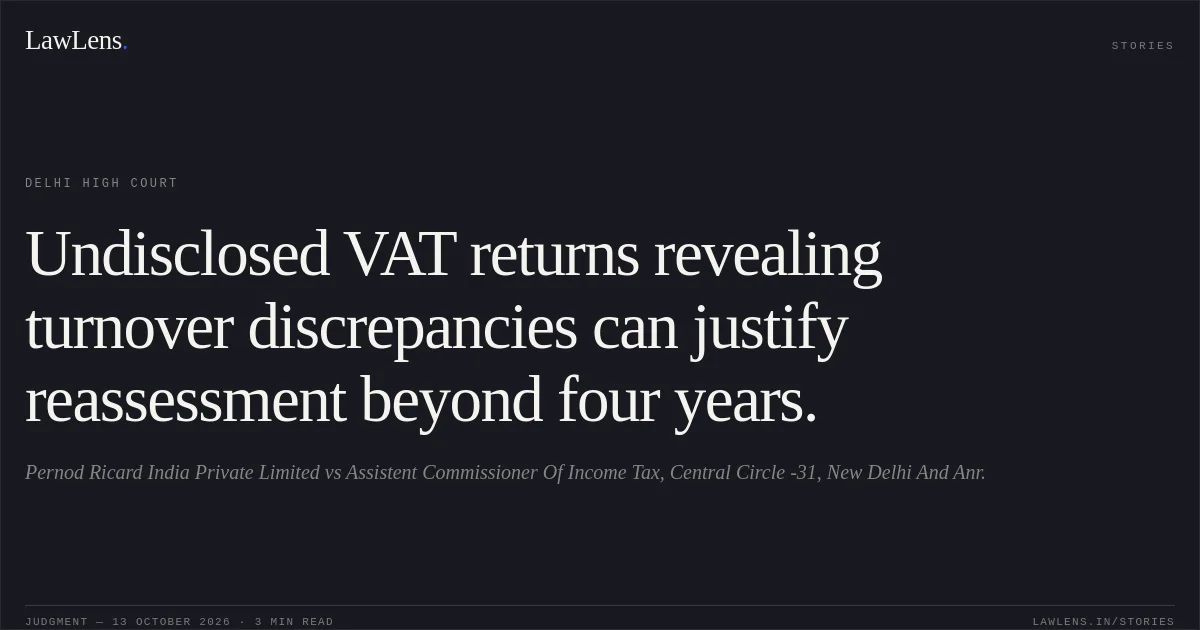
The Court considered the difference between sales to CSD shown in the VAT returns and the lower turnover recorded in the income-tax books sufficient to justify the Assessing Officer’s decision to proceed with reassessment; the petitioner’s explanations, including the effect of state VAT rules and related components, required examination on the facts and applicable law during assessment.
Source reference: p.6–7On the four-year objection, the Court noted that the petitioner had not established that the VAT returns had been filed or shown to the Assessing Officer, or that the relevant provisions required their filing in the income-tax assessment; it therefore upheld the invocation of the extended period.
Source reference: p.8The Court further held that the objections primarily concerned the merits of the proposed reassessment, and that the Assessing Officer’s order, though not well-worded, did not warrant interference under the applicable pre-1 April 2021 procedure.
Source reference: p.8–9The Court did not decide the merits of the petitioner’s explanations or make a separate substantive finding on each of its other grounds.
Source reference: no citationHolding
The High Court rejected the writ petition and declined to quash either the Section 148 notice or the order rejecting the petitioner’s preliminary objections.
It expressly left the merits open, permitting the petitioner to advance its factual and legal pleas before the Assessing Officer, who was directed to consider them in accordance with law.
Source reference: p.10Acts & Sections Cited
7 provisions across 1 statute referred to in this judgment. Linked provisions open on LawLens.
Income Tax Act, 19617
Original Court PDF
Pernod Ricard India Private LimitedvsAssistent Commissioner Of Income Tax, Central Circle -31, New Delhi And Anr.
Click to open original judgment
Original judgment, available to read, download and summarize on LawLens.in